“There is a war coming, Ned. I don’t know when, I don’t know who we’ll be fighting, but it’s coming.” Robert Baratheon was, in many ways, speaking to today’s geopolitical circumstances.
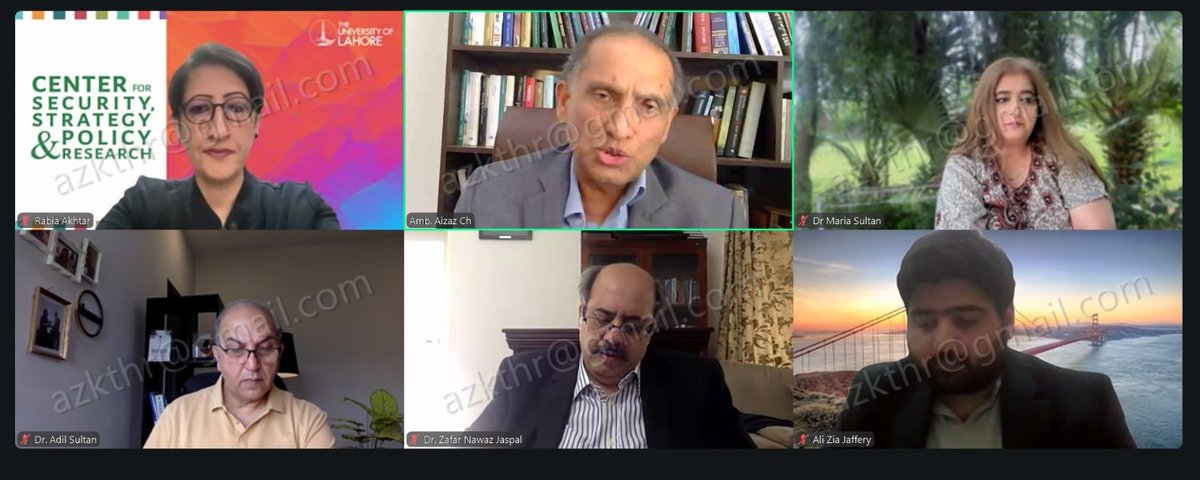
I had the privilege of moderating a timely and thought-provoking @CSSPR_UOL webinar featuring some of Pakistan’s leading diplomats, strategic thinkers, and security experts to unpack one of the most consequential questions for Pakistan’s future as we celebrate #MarkaeHaq #May2025:
What did May 2025 make possible for Pakistan?Together, we explored:
▪️ How Pakistan’s performance in May 2025 challenged assumptions about unilateral escalation dominance
▪️ The changing regional security order and Pakistan’s place within it
▪️ Strategic stability, escalation dynamics, and the risks of future Indo-Pak crises
▪️ The role of AI, emerging technologies, and the future of warfare
▪️ Pakistan’s diplomatic relevance, alliance formations, and mediator potential
▪️ The future of Pak-U.S. and Pak-India relations in an evolving geopolitical landscape
Featuring insights from:
Amb. Aizaz Chaudhry @aizaz1101 Dr. Salma Malik @smalik480 Khalid Banuri @khalidbanuri Dr. Maria Sultan @MariaSultanpk Dr. Adil Sultan @adilsultan Prof. Dr. Zafar Nawaz Jaspal @zafar_jaspal and Syed Ali Zia Jaffery @syedalizia1992
This was more than a conversation about a past crisis. It was a discussion about Pakistan’s future strategic direction and the choices that will shape regional stability in the years ahead.
Tune in: Deterrence to Diplomacy: Pakistan’s Strategic Repositioning After May 2025 https://t.co/HP3oajfefg via @YouTube
While the environment is not propitious, we must create space for nuclear risk reduction, responsibility, and restraint in South Asia, stresses @Rabs_AA.