As model companies absorb more product surface area, the strongest startups may be the ones that can prove an AI output is correct.
That’s the verification moat. I wrote about why it could be AI’s most durable advantage. https://t.co/64T4tn2ju1
We now have state-of-the-art pre-trained base models in the 3T-parameter weight class, built entirely in-house at MAI.
Post-training results coming soon -- stay tuned!
Lots of details in our technical blog post.
https://t.co/xcZ5uV4TAp
We're excited to announce our collaboration with @microsoft to bring Heaviside and AI-powered electromagnetic design to the RF, photonics, and semiconductor ecosystem on Microsoft Discovery.
Every electromagnetic design problem reduces to the same question: how will this design actually behave once built? Heaviside was built to solve the verification problem, predicting the full 3D electromagnetic field response in milliseconds and within a decibel of commercial accuracy.
We are thrilled to be collaborating with the incredible team at Microsoft Discovery. Learn more here: https://t.co/hhgKoAm5Az.
They’re not wrong. We often overlook just how sensitive some of humanity’s most consequential data really is. We wouldn’t want to hand that over to frontier labs or any third party for that matter. There genuinely is a strong case to be made about harnessing AI without compromising access.
Introducing Microsoft-Decision-1, our new model for fast decision-making.
It delivers top performance on structured decision tasks, outperforming both LLMs and other decision models in latency and quality.
We’re already testing it across Microsoft for everything from incident response and quality control to scientific discovery.
We're launching the most accurate real time transcription model in the world... #1 !!!
55% faster and 60% cheaper than ElevenLabs.
Come build agents on our platform!
Serious answer: yes. Before joining Microsoft, I knew maybe five people who used Copilot. I lived in a San Francisco tech bubble, and all of us worked at companies with fewer than 5,000 employees.
Microsoft 365 Copilot now has over 30 million paid seats and is growing fast. It's also a significant market penetration if you look at the number of seats / knowledge workers in Enterprises
Working at MSFT has made me understand why. Large companies need AI that works with their existing data and meets their privacy and compliance requirements, often across multiple countries. Add governments and regulated industries, and it gets even more complex. Copilot can handle that.
So people use Copilot for real work, and yes, most people love it. I use it every day now: Copilot CLI for coding (with access to models from Gemini, OpenAI, xAI and Anthropic!) + Copilot Cowork for regular chat Etc. I’ve been happy with it.
I think the perception gap on this website comes from the San Francisco tech bubble. If you’re a tech bro like me, you mostly know people at smaller companies. You don’t see much of the enterprise world where Copilot is used.
As model companies absorb more product surface area, the strongest startups may be the ones that can prove an AI output is correct.
That’s the verification moat. I wrote about why it could be AI’s most durable advantage. https://t.co/64T4tn2ju1
As model companies absorb more product surface area, the strongest startups may be the ones that can prove an AI output is correct.
That’s the verification moat. I wrote about why it could be AI’s most durable advantage. https://t.co/64T4tn2ju1
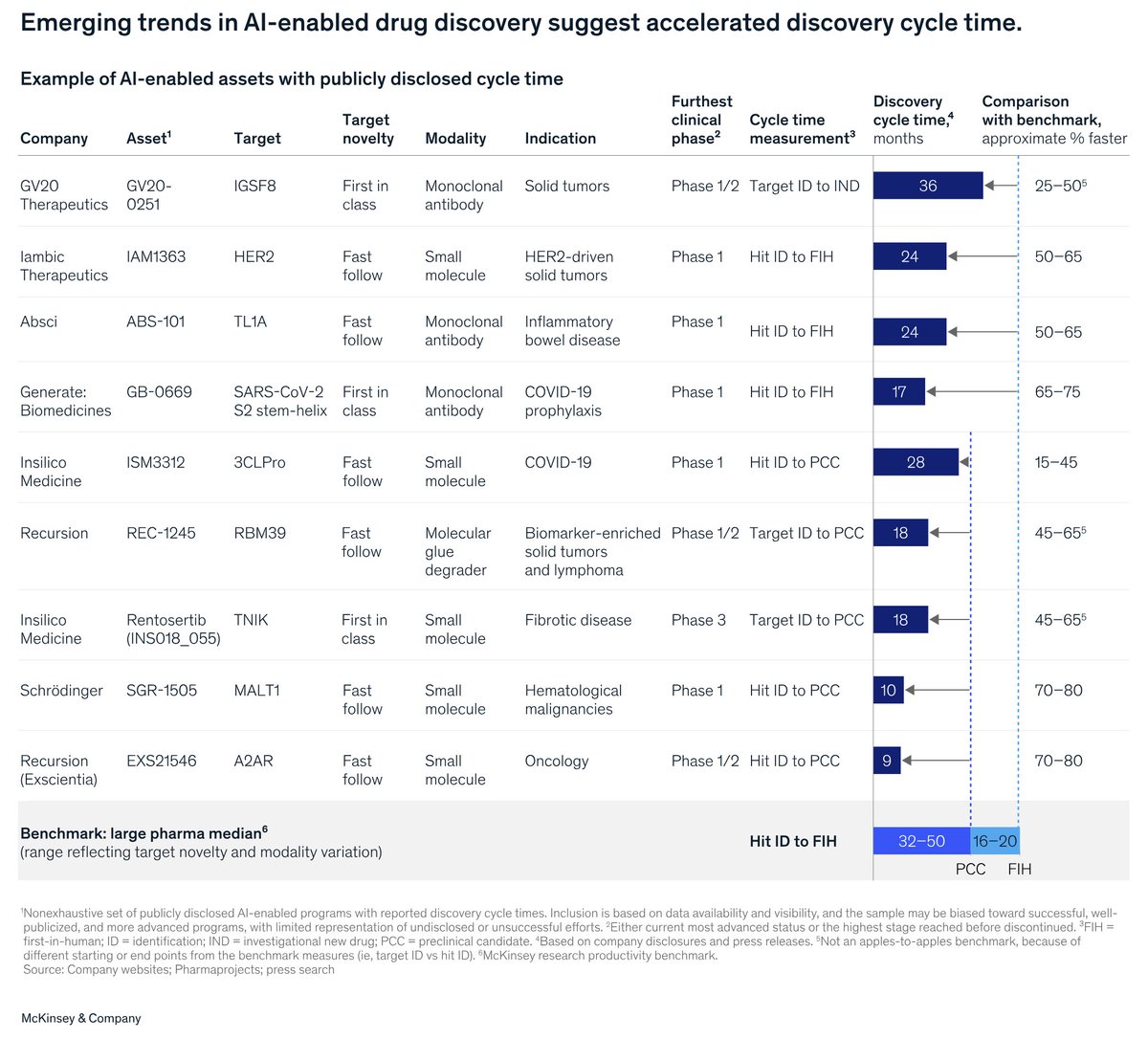
Is AI actually speeding up drug discovery?
According to new McKinsey research, there are early signs that it is: all of these candidates were AI-enabled, with discovery time cut by ~15-80%.
(Incredibly bullish)
Any pursuit of superintelligence has to be grounded in the core principle that if the AI we build is not helping humanity and under human control, it's not worth pursuing.
We also need to accelerate and spread the benefits of AI, such that they are diffused broadly across countries, communities, and companies. This requires a frontier ecosystem in which both closed and open-source models can thrive.
And for firms, it’s imperative that they retain full control over their unique and tacit knowledge. Every organization should be able to build its own continuous learning loop/hill climbing machine, without becoming dependent on any one model provider, and have the ability to embed its own knowledge into models and weights they control.
So, in this context, we welcome the research, focus, and deliberate pacing needed to get alignment right as the design goal. We also welcome ideas like "embedded evaluators" and the broader efforts to develop the mechanisms to make this more than just talk.
The key is that this cannot be controlled by a handful of entities, but must have broad representation across the ecosystem, countries, and fields, including academia.
This is the approach we are taking: broad access and choice at every layer of the AI stack; enterprise control of learning loops and models; and the “Code of Conduct” that underlies our own first party MAI models that we’ll publish tomorrow for public consultation.