As a pilot for 20 years I have questions:
- where are the cabin crew here?
- where are the oxygen masks that automatically drop during a rapid emergency descent?
- how did the Capt manage to open the door while being stabbed?
- Omani pilots were not allowed to fly to Israel, why was he allowed?
- how did the offending pilot get a weapon onboard?
- why has this happened so close to elections?
- how are passengers walking around while apparently in a nosedive?
- who else was injured? Nose dives cause significant g force incidents
- why is there two perfectly positioned people recording the incident and not helping?
- why did a plumber take control and not the 2 pilots onboard who would certainly know when an aircraft was in a nosedive?
- why was the plumber speaking in English to Bibi after the flight
- why was he still in his blood soaked clothes 8 hours after the incident
False Flags have been a very effective mechanism to influence public opinion
Hitler burnt down the Reichstag just before his parliament elections and he won the election…changing the course of history.
A full and independent investigation should be carried out here.
Hopefully independent journalist will be allowed to view this too.
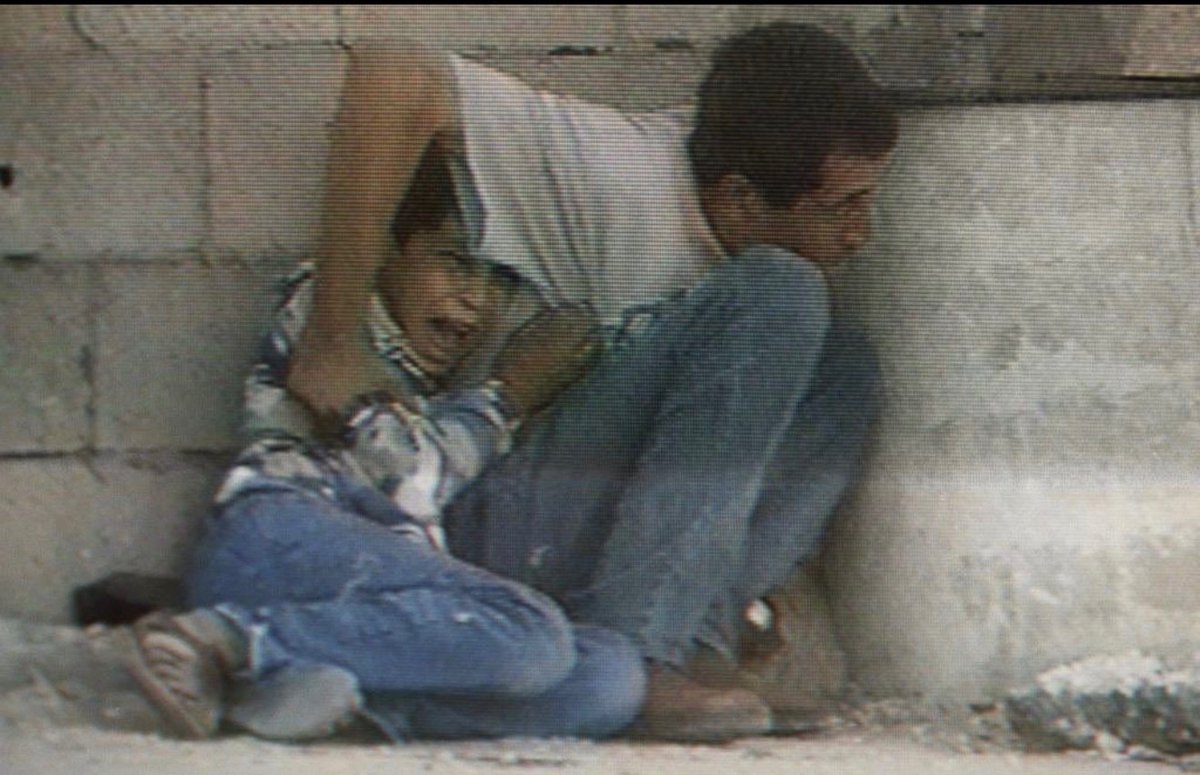
On this day 26 years ago, the world watched, as Jamal al-Durrah tried to protect his 12-year-old son Muhammad from Israeli bullets that rained down on them in Gaza for 40 minutes. Despite pleads, Israeli soldiers intentionally shot Muhammad in the stomach- whose final moments of fear and horror were caught on camera and streamed by France TV, and injured his father.
Muhammad became the defining and haunting image of the Second Intifada.
According to an informed federal official, in the coming months the Trump administration plans to send a total of 40,000 Mark 84 and Blu-117 bombs to the government of Israel. Each bomb weighs 2,000 pounds. This appears to be the largest transfer of conventional explosive ordnance from the United States in modern history.
How big is this shipment? It amounts to 40,000 tons of bombs. For perspective, the largest American air raid of World War Two was the Eighth Air Force’s attack on Berlin in March of 1945. Combined, the 2,023 Allied aircraft involved dropped about 3,000 tons of bombs. That’s 7.5 percent of what Trump is sending to Israel. That same month, March of 1945, the US Army Air Forces began the single most destructive bombing raid in human history, Operation Meetinghouse over Tokyo. More than 100,000 Japanese civilians were killed. By the end of that operation, the US had dropped 1,600 tons of bombs. That’s four percent of what Trump is sending to Israel. World War Two ended five months later, when the US dropped an atomic bomb on the city of Hiroshima. The shipment Trump is sending to Israel amounts to more than three times the destructive power of that nuclear explosion. There is no precedent for what the Trump administration is doing.
Nor is there a justification. The government of Israel is not fighting World War Two, or even a war. It is engaged in periodic skirmishes with a guerrilla force in Lebanon, and it is working to exterminate an unarmed civilian population in Gaza. Neither front requires modern 2,000-pound bombs.
An American-made Mark 84 has a destruction radius of half a mile. It releases a thermal wave the temperature of the surface of the sun. Within 100 feet of the explosion, rock melts and human flesh turns to vapor. The bomb collapses apartment buildings and leaves craters thirty-five feet deep. Until the war with Iran, the US military generally avoided using the Mark 84 in urban areas. It kills too many civilians.
For the Netanyahu government, that’s been the upside. In the weeks after October 7, the IDF dropped nearly six hundred 2,000-pound bombs on densely populated areas in Gaza, including on more than 100 officially designated civilian evacuation zones. The slaughter was so grotesque and embarrassing that for a moment the Biden administration paused a shipment of Mark 84s. Those shipments quickly resumed under Trump. Now they’ve accelerated.
It’s hard to overstate the scale of the crime the Israeli government is committing in Gaza. Over the last three years, more than a quarter-million Palestinians have been killed or wounded by Israeli forces there. The majority of them have been noncombatants: women, the elderly and tens of thousands of children. Many thousands more remain missing, presumably entombed under the rubble of 200,000 collapsed buildings. So far the Israelis have destroyed 92 percent of all homes in Gaza, and 34 of the 36 hospitals. By comparison, the 1945 Allied bombings of Dresden, now acknowledged as a war crime, destroyed about half of the city’s inhabited buildings.
By any definition, what the Netanyahu government has done in Gaza is genocide. The 40,000 new bombs the Trump administration is sending will be used to do the same in Lebanon, and likely in other countries in the region. If you wanted to extend the Iran war into the indefinite future, this is exactly what you’d do.
So far none of this has received public scrutiny. At some point, inevitably, it will be described in media accounts as an “arms sale.” It is not an arms sale. It is a gift, funded by American taxpayers through the Foreign Military Financing program, an arrangement designed to disguise welfare as capitalism: Congress appropriates money to the executive branch, which transfers the cash to Israel to “buy” American-made weapons, in this case from General Dynamics. Politicians claim this is a win for America. Most voters have no idea they paid for it. The bill in this case is about $3 billion. Add that to the $352 billion the US Treasury has transferred to Israel since 1951.
How did this happen? The request for 40,000 new high-explosive civilian-killing bombs originated at the US Embassy in Jerusalem, which is run by Christian Zionist Ambassador Mike Huckabee and his aide David Milstein, who is the stepson of Fox News host Mark Levin. From there it moved to the State Department, where Marco Rubio enthusiastically approved it.
At this point, only four more people need to sign off before the bombs ship to Israel: Senators Jim Risch and Jeanne Shaheen, the chairman and ranking member of the Senate Foreign Relations Committee; and Congressmen Brian Mast and Gregory Meeks, the top two members of the equivalent House committee. All four are committed neocons. Collectively they’ve taken millions from the Israel lobby. In 2015, Brian Mast traveled to Israel to volunteer for the Israeli military. In 2023, Mast showed up in the House of Representatives wearing an IDF uniform.
It’s hard to imagine any of them hesitating before sending more free bombs to Israel. Only public outrage can stop this.
We’ve been covering settler violence against Palestinians in the West Bank for years.
But yesterday, we found ourselves on the menu.
A group of masked settlers beat our team and pummelled the 51 year old woman we were interviewing unconscious.
We’re all ok now - and Aida is out of the hospital - but this is just one incident among an unprecedented surge in settler violence across the West Bank.
Here’s out story on yesterday’s attack on Sunday Today on @NBCNews.
#Israel #WestBank @TODAYshow
Imran Khan's medical reports are alarming. I have gone through them with several specialists, and I am writing this in plain language so every Pakistani can understand exactly what is happening.
In order of priority, this is what worries me most: his anxiety and stress levels, his palpitations, and his high blood pressure. Sleeplessness is not mentioned in the report, but looking at the medications, it is almost certainly there too.
I have known Imran Khan for more than 35 years. Stress was never his weakness. That it is now at peak levels tells you everything about what three years of imprisonment and total isolation have done to him.
The causes are not hard to understand: the state of the country, his colleagues in jail, those sentenced, the killed, and their grieving families. His own isolation, no newspapers, no books, no knowledge of what is happening outside. And yes, his anxiety over Bushra Bibi, his sisters, his workers and his party.
Look at the medications, as there is no diagnosis. He is on Citanil and Lexotanil, three times a day. That is not sleeplessness being treated. That is daytime anxiety being treated. Read that twice.
His heart rate is 54 bpm. Doctors will call that "normal." It is not normal for him. His resting heart rate has been in the low 40s his whole adult life, the mark of a lifelong elite athlete. A jump to 54 is a real shift.
He has reported heart palpitations. That is not something to note and move on from. It needs a 24-hour Holter monitor immediately, to catch the frequency and get him on the right medication. Even an Apple Watch linked to an Apple ID outside Pakistan (as that function is disabled in Pakistan) can flag Atrial Fibrillation and palpitations in real time.
He is on three separate BP medications now. That requires proper daily AM/PM monitoring to titrate correctly, not once-a-week guesswork. He is also on a cholesterol-lowering drug. Raised cholesterol at his age is both genetic and stress-driven, and needs diet, exercise, and medication working together, as does his blood pressure. Less salt. More movement. Real monitoring.
And the following tests that must happen now, without further delay:
1) A Stress Test
2) An Echocardiogram
3) Cardiac MRI
4) Cardiac Artery Calcium (CAC) scan, because of raised cholesterol to check for calcified deposits that block arteries and lead directly to heart attacks or the need for stents.
5) Cardiac CT Angiogram and other tests if indicated.
I am deeply worried. Isolation is taking a physical toll on his body. If this is not addressed immediately, the damage may become irreversible with more complications to follow.
@ImranKhanPTI definitely needs to be moved to a hospital environment now, under an independent panel of doctors. Neither his family nor the people of Pakistan trust government-appointed doctors alone. We have already seen reports manipulated before, numbers exaggerated or suppressed, platelets among them.
The next three months will decide whether his condition is reversed or becomes permanent.
We all are alarmed.
The country needs him more than ever before. May Allah keep him healthy. Ameen. 🤲
Argentina are officially the first nation in World Cup HISTORY to reach the semi-finals without facing a single Top 10 ranked team.
Must be a coincidence… of course.
Israeli settlers, brandishing American made M4s, detained me & other Americans on my trip to Palestine.
When the IDF arrived, they sided with the settlers & continued our detention.
They made a huge mistake.
You will be hearing more soon. https://t.co/rZw8bRAn64
🚨Argentina have reached the last 8 at the World Cup without beating a team ranked better than 23rd in the World:
🇩🇿Algeria (29th)
🇦🇹Austria (23rd)
🇯🇴Jordan (73rd)
🇨🇻Cabo Verde (64th)
🇪🇬Egypt (24th)
Incredible Egyptian goal is disallowed because of a foul far away, then same situation a few minutes later and goal for Argentina not disallowed! No VAR, nothing? FIFA again looks like a corrupt joke, playing favorites for stars.
I appreciate the intense interest in my column. For skeptics, why not agree on Red Cross and lawyer visits for the 9,000 Palestinian "security" prisoners? If you think these abuse allegations are false, such monitoring visits would be protective. So why not?
🚨New Testimonies Reveal Dr. Hossam Abu Safiya Stripped, Beaten, and Set Upon by Dogs in Israeli Detention
Three recently released Palestinian prisoners have provided harrowing testimony about the condition of Dr. Hossam Abu Safiya, director of Kamal Adwan Hospital in northern Gaza, who has been held in Israeli detention since his arrest on December 27, 2024.
Released prisoner Ahmad Qaddas said he initially did not recognize Abu Safiya due to his physical deterioration. He described the doctor spending most of his time “sitting in a daze,” barely able to speak, while fellow prisoners could hear him screaming during beatings but were powerless to intervene — with those who tried to help facing tear gas raids.
A second witness, Hamza Abu Omeira, said Abu Safiya suffered constant vomiting, could not keep food down, and was denied medical care. He described seven consecutive days during which prisoners were shackled by both hands and feet. He said Abu Safiya was also reportedly forced to repeat degrading phrases about himself under torture.
A third released prisoner said he witnessed Abu Safiya being stripped, beaten after interrogation, and attacked by police dogs that “scratched him and knocked him to the ground.”
All three witnesses warned he faces imminent death if not released immediately. Abu Safiya is one of 737 medical workers arrested by Israel since the start of the war, according to Al Jazeera.
Source: Palestinian Information Center
Why the Iran ceasefire may have shifted the dynamics back in Trump's favor
Diplomacy between Washington and Tehran has not yet unraveled, despite JD Vance’s theatrical departure from last week’s talks in Islamabad. Trump now signals that the two sides could reconvene within days in the Pakistani capital. Whether negotiators return to the table or continue their exchanges through quieter, remote channels before the ceasefire lapses, one reality appears to have shifted: Trump has clawed back a measure of momentum—and with it, leverage—over Iran, largely by virtue of the ceasefire. Here’s why.
Trump entered this moment politically cornered and strategically constrained. Surging gasoline prices were inflicting acute domestic pain, eroding his standing at home. More critically, he faced a barren escalation ladder. Each conceivable move—strikes on Iran’s oil infrastructure, attacks on civilian targets, the seizure of Persian Gulf islands, or covert operations to capture enriched uranium—carried the near-certainty of forceful Iranian retaliation. Such responses would not merely match his escalation but compound it, deepening his economic exposure, amplifying political risk, and entangling him further in a perilous and unwinnable strategic bind.
Nor could he simply extricate the United States from the conflict on his own terms. Absent an understanding with Tehran, Iran retained both the capacity and the incentive to continue targeting Israel and vulnerable U.S. assets across the Gulf. Trump needed Iran’s permission to get out of the war.
The ceasefire, however, has subtly altered that equation. Trump may no longer need a formal nod from Tehran to step back. If he disengages now—without a comprehensive agreement—Iran will almost certainly maintain its grip over the Strait of Hormuz, a strategic setback for Washington. Yet Tehran is unlikely to resume direct military operations against U.S. targets in the Persian Gulf. To do so, in the absence of renewed American strikes, would cast Iran as the aggressor, inviting severe and potentially coordinated repercussions—not only from Washington but from wary global powers such as Russia and China.
Moreover, the balance of needs has tilted. Iran now appears to need an agreement more than the United States does. Trump has already secured his central objective—the escape from a war he was ill-advised to begin—while Iran, despite accruing leverage through its command of the Strait, remains far from realizing its broader ambitions: meaningful sanctions relief, a definitive and enduring end to hostilities, and perhaps even the contours of a more stable, constructive relationship with Washington.
Tehran’s decision to dispatch its largest, most senior, and most expansive delegation to Islamabad for direct talks with the American vice president reflected a striking confidence—that it occupied its strongest negotiating position vis-à-vis the United States since 1979. Yet to convert that moment of perceived ascendancy into little more than a cessation of U.S. bombardment would fall short of its aspirations. Even if Washington were to acquiesce to Iran’s control of the Strait, such an outcome would pale against the far more consequential gains Tehran believes are within reach.
Instead, Iran needs to translate this leverage not only into a durable end to the war, but ideally, into a new peace: One that delivers sweeping sanctions relief and inaugurates a more stable, mutually defined economic and political relationship with Washington. Such an arrangement would serve as a bulwark against renewed conflict. The economic imperative is especially stark: sanctions relief is indispensable to reconstruct a country now burdened with damage running into the hundreds of billions of dollars.
As I have argued before, sanctions relief is not merely an economic demand—it is a strategic necessity. Without it, Iran risks a condition of chronic erosion, a slow but steady weakening that would leave it exposed. That vulnerability, in turn, could invite further attacks. It was, after all, the misperception of Iranian weakness that helped open the window for initial strikes.
But Trump does not, in any fundamental sense, require any of this. The United States can endure without a formal agreement with Iran and without the benefits of an economic relationship with Tehran. To be sure, a negotiated settlement would better serve long-term American interests: the nuclear constraints Trump seeks can only be credibly secured at the negotiating table. Abruptly abandoning diplomacy while leaving Iran in undisputed control of the Strait would also unsettle key regional allies. Yet these are strategic preferences, not immediate necessities.
Trump’s calculus is far more transactional and far less patient. He can point to the damage already inflicted on Iran’s nuclear infrastructure and conventional forces, proclaim a hollow victory, and disengage. He has already emphasized that the United States no longer depends on Persian Gulf oil, insulating it from the direct economic consequences of Iran’s toll regime. As a result, the burden shifts outward: the Strait becomes a problem for European and Asian powers—countries that Trump has noted declined to rally to his side when he sought their help in prying the waterway from Tehran’s grip.
The window now open offers Tehran a chance to convert battlefield leverage into lasting strategic gain. To let it close would mean forfeiting not just incremental progress, but the possibility of reshaping its economic and geopolitical position. By contrast, the United States, having already secured a tenuous exit ramp through the ceasefire, has less at stake in the short term. Walking away, therefore, is politically and strategically easier for Trump than for his Iranian counterparts. Both can live with diplomatic failure, but Tehran has more gains to lose.
How Tehran chooses to navigate this narrowing corridor—whether it presses its advantage or overplays its hand—will be interesting to see.
💢 Israeli Forces Shot and Killed a 9-Year-Old Girl in a Classroom Tent
Ritaj Rihan, a third-grade student, was shot and killed by Israeli forces inside an educational tent in Beit Lahia, northern Gaza pitched atop the ruins of a school destroyed during the genocide.
Palestinian poet Mosab Abu Toha, who attended the same school, reported that the tent where Ritaj was studying and where she was killed stood on the rubble of his former high school. “Even when kids try to learn, after over two years of nonstop running from the bombs, Israel shoots them,” he wrote.
Yesterday the VP said Iran would be stupid to blow up the ceasefire over Lebanon
Well what does it say about the US that we're willing to blow up the global economy over Israel's desire to ethnically cleanse and annex half of Lebanon?
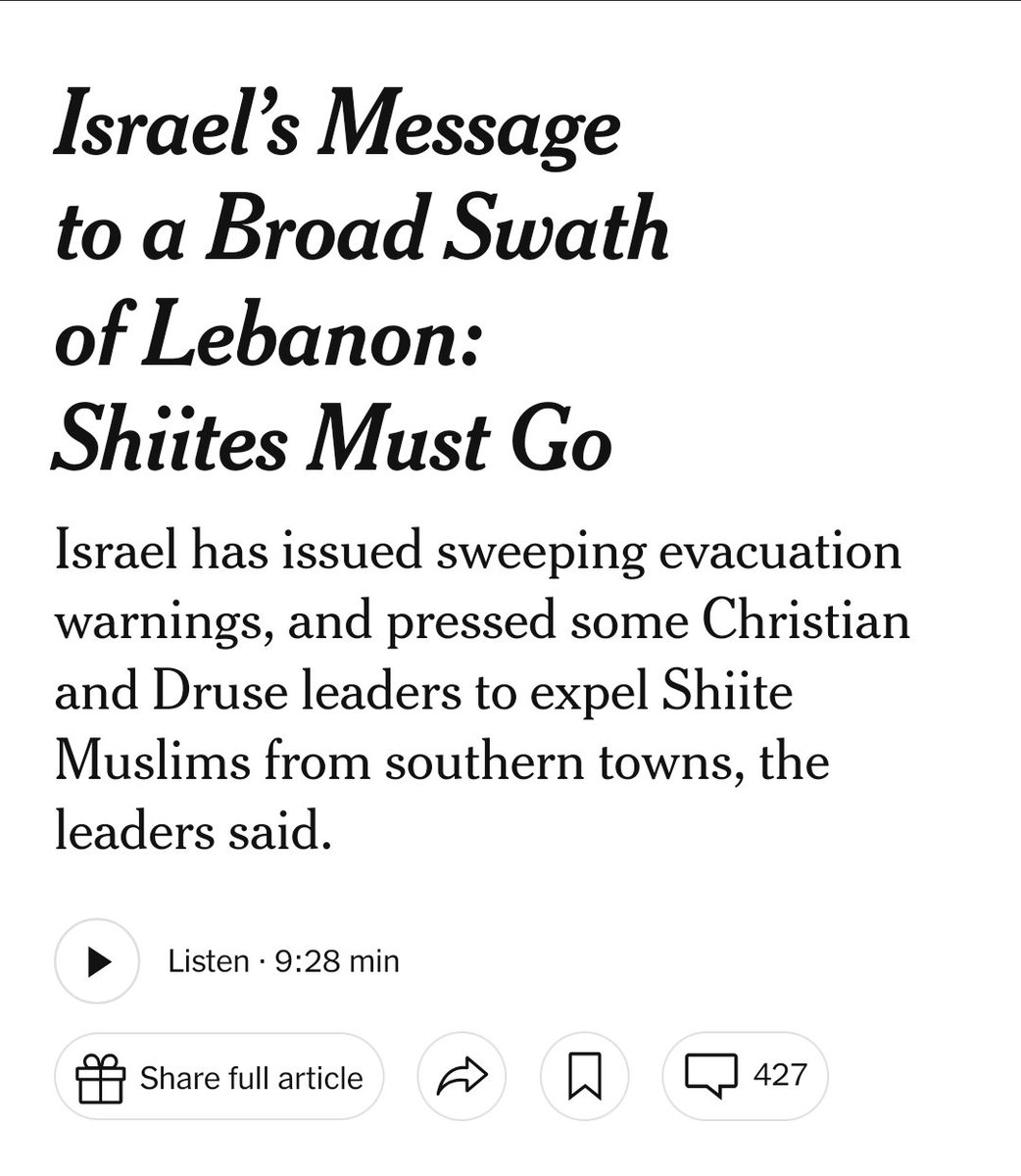
Israel is explicitly warning Christian and Druze residents in southern Lebanon not to hide Muslim residents among them as their forces advance.
Not a peep from Sheryl Sandberg.
A brotherly reminder:
- No Muslim is obliged in any way to defend Bajwa and the "Hafiz" Asim Munir's decision to throw Imran Khan in jail.
- No Muslim is obliged to defend any injustice. Allah said in the Quran [5: 8] "O you who believe! Stand out firmly for Allah, as witnesses to fair dealing, and let not the hatred of others to you make you swerve to wrong and depart from justice. Be just: that is next to piety: and fear Allah. For Allah is well-acquainted with all that ye do."
- No Muslim is obliged to perform verbal gymnastics to suggest that an unjust act by Bajwa and Munir is justified because "it's politics" and "Imran Khan made a deal with them in the first place to get to power".
- No Muslim is obliged to choose corruption and oppression over chaos, or cede their God-given dignity to the boots of the military. The "Farooq" Umar ibn Al-Khattab (RA) did not demand the former and the "Sword of Allah" Khalid Ibn Al-Walid (RA) did not demand the latter.
- Security of a state is not protected first and foremost by a military, but by a commitment to justice. Caliph Umar Bin AbdulAziz was sent a letter by one of his governors in Khorasan who complained that he was surrounded by unruly tribes that threatened national security. He asked the Caliph for more military spending and security forces to resist them to "fortify the state with more troops". The Caliph declined to send more troops and responded instead with "fortify it with justice". How many mighty armies of oppression fell to smaller forces of justice?
Pakistan's security is not threatened first and foremost by India or its neighbours. It is threatened by corruption, injustice, and normalisation of oppression in the name of "national security". Ibn Khaldun said: [such] oppression heralds the destruction of civilisation.
Those who truly care about Pakistan are not those who tell you an innocent man in jail is necessary or a natural consequence of protecting stability and "national security". Those who care will call out injustice wherever it is desperately seeking to prevent the destruction of civilisation predicted by Ibn Khaldun and every civilisational historian worth their weight.
May Allah protect Pakistan from the greatest threat it faces today.