Contemporary media platforms are wild... they hold the power to strip you off your beliefs and thoughts and morph you into mainstream sentiments.. we need to watch out and not compromise with our viewpoints! #writerslift#WritingCommnunity
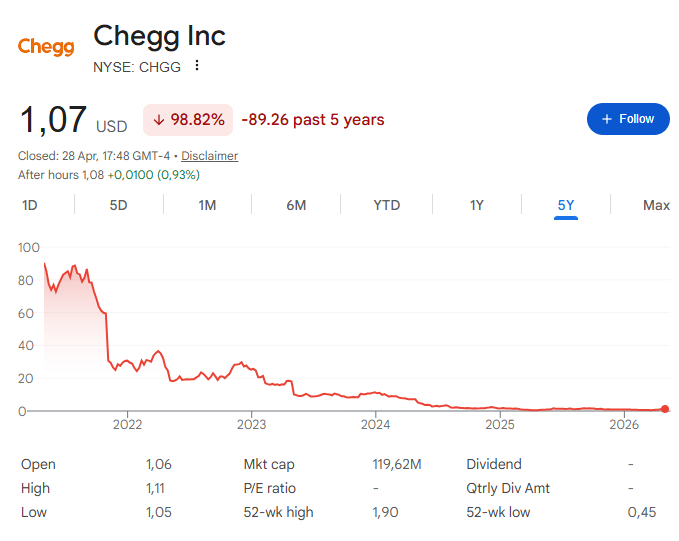
While everyone talks about how AI killed Chegg, no one is talking about the possibility of a recovery in this business as management is pivoting to a B2B Workforce Skilling Platform, away from its legacy solved homework business. Any positive news can boost the stock a lot #chegg
@riteshmjn Hey Ritesh, which countries do you think would be providers and which will be users of MaaS? Would appreciate a reply and your thought process here FIRST before I ask Grok
@JavierBlas Good points Javier - do you think this was written on the wall? The ceasefire was not meant to hold anyway. It lasted exactly *drum rolls* 4 days
I Spoke With my Fixed Income Professor Mr. Tarek Amyuni Who Predicted the US-Iran Ceasefire Will Not Hold and Brent Will be Back Above $100. That’s exactly what is happening today! #usiran#oil#brent#crudeoil#hormuz
https://t.co/WR9I4r8303
@AlaliQasem Travel back from where?
Load and return to where?
Why are we assuming 25-30 days? quite obvious that the duration will not be the same considering their starting point
Hi all, my name is Shaheer and I'm a 23 year old M&A Analyst. I'm not an AI researcher or an AI expert. I'm just someone living through the biggest technological shift of my lifetime and I have thoughts that I shared unfiltered in this video.
https://t.co/Uj3uHCqW1k
Gold and silver are not acting well in a period of rapidly rising geopolitical risks. We have an Iran War, Strait of Hormuz blockade, rising volatility. In the old framework, that setup should be close to ideal for gold. But once you understand what is now driving gold, this move makes perfect sense.
Something fundamental changed after the US and Europe froze Russian reserves in 2022. For decades, surplus countries parked their excess savings in US dollar assets, mostly Treasuries. The freezing of Russian reserves combined with the current administration's explicit push to discourage foreign countries from parking excess savings in US financial assets, forced surplus countries to rethink where they store reserves.
And those countries haven't changed their domestic policies that generate the excess savings, so those savings have to be placed somewhere. The result is that gold and silver have increasingly become the obvious “neutral” reserve assets.
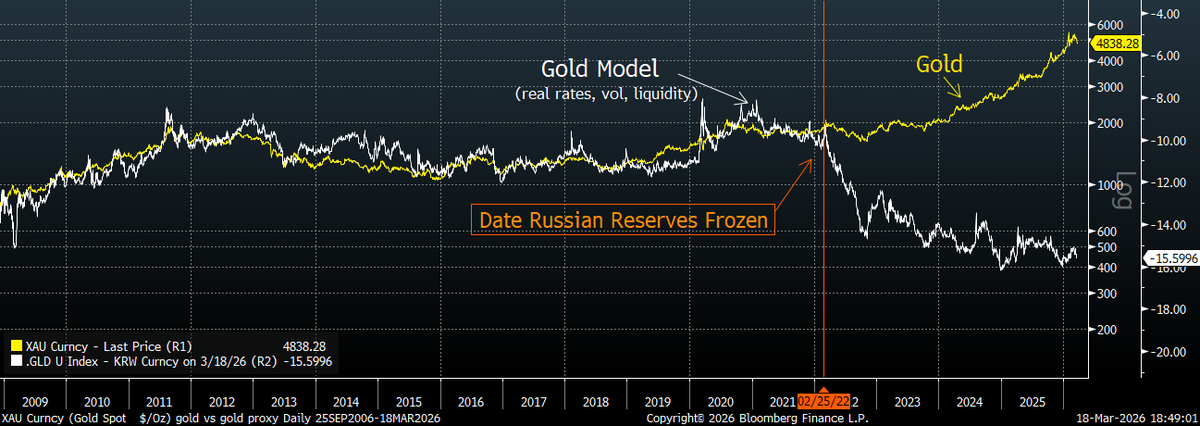
That’s why gold decoupled from the three factors that used to explain it…real interest rates, volatility, and liquidity. Now reserve accumulation flows have become the primary driver.
That shift has a consequence I don’t think most investors have thought through. If gold is now primarily driven by reserve flows from surplus countries, then gold has become pro-cyclical.
Reserve growth is driven by export revenues, trade surpluses, economic growth in surplus economies. When the global economy is strong and surplus countries are generating large export revenues, their excess savings grow, their reserve accumulation accelerates, and gold catches a bid. When that surplus generation is disrupted, the bid weakens or reverses.
This is exactly what is happening with the blockade of the Strait of Hormuz.
The GCC countries are major reserve/gold buyers and now their export revenues are collapsing. They likely need to liquidate some reserves to cover fiscal obligations, and gold is one of their most liquid assets. Even if the reserve sales aren’t excessive yet, the market can see their reserve accumulation has stalled and probably reversed. That flow, which was a meaningful source of gold demand, has gone to zero at best.
There are also secondary effects on other surplus economies. China is the world's largest oil importer. An energy shock of this magnitude slows Chinese growth, and compresses Chinese surpluses, which slows Chinese reserve accumulation. That same growth shock ripples through Korea, Taiwan, Japan, and the rest of Asia.
The whole chain that has been driving gold higher, surplus countries generating excess savings that need a home outside the dollar system, is being disrupted by an event that in the old model would have been unambiguously bullish for gold.
This doesn't mean the structural case for gold is broken. The dollar standard is still ending. Surplus countries still need an alternative to Treasuries and gold is still the most obvious destination. But it does mean gold is going to be more volatile along that structural trend than most people expect, and the volatility will correlate with global growth and surplus generation rather than with the old drivers. Gold rallies when surpluses expand. Gold sells off when surpluses contract. Even if the reason for the contraction is rising geopolitical risk that, under the old model, should have sent gold to the moon.
You can see the regime break for yourself.
Before the Russian reserve freeze, gold tracks the old model (real rates, volatility, liquidity). Right after the reserves were frozen, that correlation breaks down.
That was the moment gold became a neutral reserve asset.