$NVDA makes sense now. Enron.
Just have to search the last time a CEO stepped down and was quickly brought back.
Kenneth Lay returned as CEO of Enron on August 14, 2001. Just 110 days later, Enron filed for bankruptcy.
His return is one of the most consequential CEO comebacks in American corporate history. However, Lay had not been fired. He had voluntarily handed the CEO position to Jeffrey Skilling six months earlier while remaining chairman.
1. Why Lay returned
Lay had led Enron since its creation in 1985, transforming a natural-gas pipeline business into a massive energy-trading company.
In February 2001, he transferred the CEO position to Jeffrey Skilling.
But on August 14, Skilling unexpectedly resigned, citing personal reasons.
Enron’s board immediately asked Lay to resume his CEO responsibilities.
In the company’s official announcement, Lay expressed confidence in Enron’s business and growth prospects.
Is Friday's tech selloff being bought or hedged? Our Opening Setup $64.6M of $NVDA calls sold plus December put spreads in $SOXX $37.8M and $QQQ $23.7M
SPX gamma is still negative so moves may stay large either way
Try our Opening Setup free for a week: https://t.co/bUmNNssBjz
Over 70% of TSMC revenue is now concentrated in 6 US tech giants. That ends the 'silicon shield' myth. It means TSMC's pricing power is permanently bound to US hyperscaler balance sheets and geopolitical export restrictions, leaving zero margin for a hardware slowdown.
The belief that 'ASML is more important than TSMC' ignores semiconductor physics. Intel owned the first High-NA tools and still outsourced 7% of TSMC. With AI compute (NVDA/AMD/AVGO) reaching 40% of revenue, TSMC’s moat is yield physics, but its risk is cyclical AI Capex. $TSM
THE TRILLION DOLLAR LOSS FOR AMERICAN COMPANIES AND THE DEFENESTRATION OF JENSEN HUANG
China was always going to build its own full AI tech stack. But the aggressive US national security state put Beijing's plans on a Manhattan Project footing, speeding them up by as much as a decade.
• The cost: Nvidia and its GPU and data centre suppliers, many of them Taiwanese, now face more than $1 trillion in lost revenue.
• The bigger loss: China is off the Western tech stack and heading for 100% self-reliance. – Alibaba CEO Eddie Wu says China's compute shortage is mainly a 2027–2028 problem, and that it will be nearly 100% self-sufficient by 2029. – Given the current progress, that's hard to dismiss.
• We've seen this before with Cisco: – After the Snowden leaks, Beijing concluded that Cisco routers were backdoored by US intelligence. – It shut Cisco out and built up a domestic champion you may have heard of: Huawei, now a global giant. – Huawei's 2025 revenue was $126B. Cisco's fiscal 2026 revenue was $63.3B. That's roughly double. – Who's talking about Cisco nowadays? – That cost Cisco and its shareholders hundreds of billions.
• The Rubicon is crossed: American AI will eventually be isolated to the United States and Europe. – Most of the rest of the world will revolve around cheaper options out of China.
• Loss of American competitiveness and tax revenue: America struggles with a massive trade imbalance with China. – How do you close that gap when you're not allowed to sell your most advanced products into the world's largest market? – The United States will never close the trade gap by only selling soybeans.
• The real danger is to Taiwan: – Taiwan sees its lead in GPU foundry work, plus its whole ecosystem from server racks to optical transceivers, as its turtle shell. – As the mainland's stack grows and spreads globally, that shell gets thinner, and Taiwan matters less and less over time.
• The defenestration of Jensen Huang: Jensen had an incentive to keep mainland China on a Taiwanese and American tech stack. – He is one of the most important people, if not the most important, in building the American AI empire into what it is today: number one. – For his troubles, he was publicly defenestrated by the national security state. – No good deed goes unpunished.
Désolé de jouer les rabat-joie juste après l’IPO d’Anthropic. Mais j’ai lu le dernier rapport de stabilité financière de la BCE, et il fait froid dans le dos.
Son constat : la façon dont on finance l’IA ressemble un peu trop aux subprimes.
Pour faire tourner leurs modèles, les géants de la tech construisent des data centers gigantesques. Cette année, la facture devrait avoisiner les 725 milliards de dollars, un montant tel que leurs bénéfices ne suffisent plus à suivre.
Alors ils empruntent.
Et c’est justement dans leur manière d’emprunter que la BCE retrouve des mécanismes qui rappellent la crise de 2008.
---------
👉 Une partie de la dette est invisible
Imaginez que vous vouliez faire construire une maison sans avoir l’air endetté. Vous demandez à un ami de contracter le prêt à votre place, en lui promettant un loyer pendant vingt ans. Sur le papier, aucun crédit à votre nom. Dans les faits, cet argent, vous le devez bel et bien.
C’est le montage choisi par Meta pour son centre de données en Louisiane : 27 milliards de dollars empruntés par une société partenaire, et absents des comptes de Meta.
Chez Microsoft, ce sont 365 milliards de dollars de loyers promis pour des centres de données qui ne sont même pas encore en service.
Au total, la BCE chiffre ces dettes "invisibles" à plus de 4000 milliards de dollars.
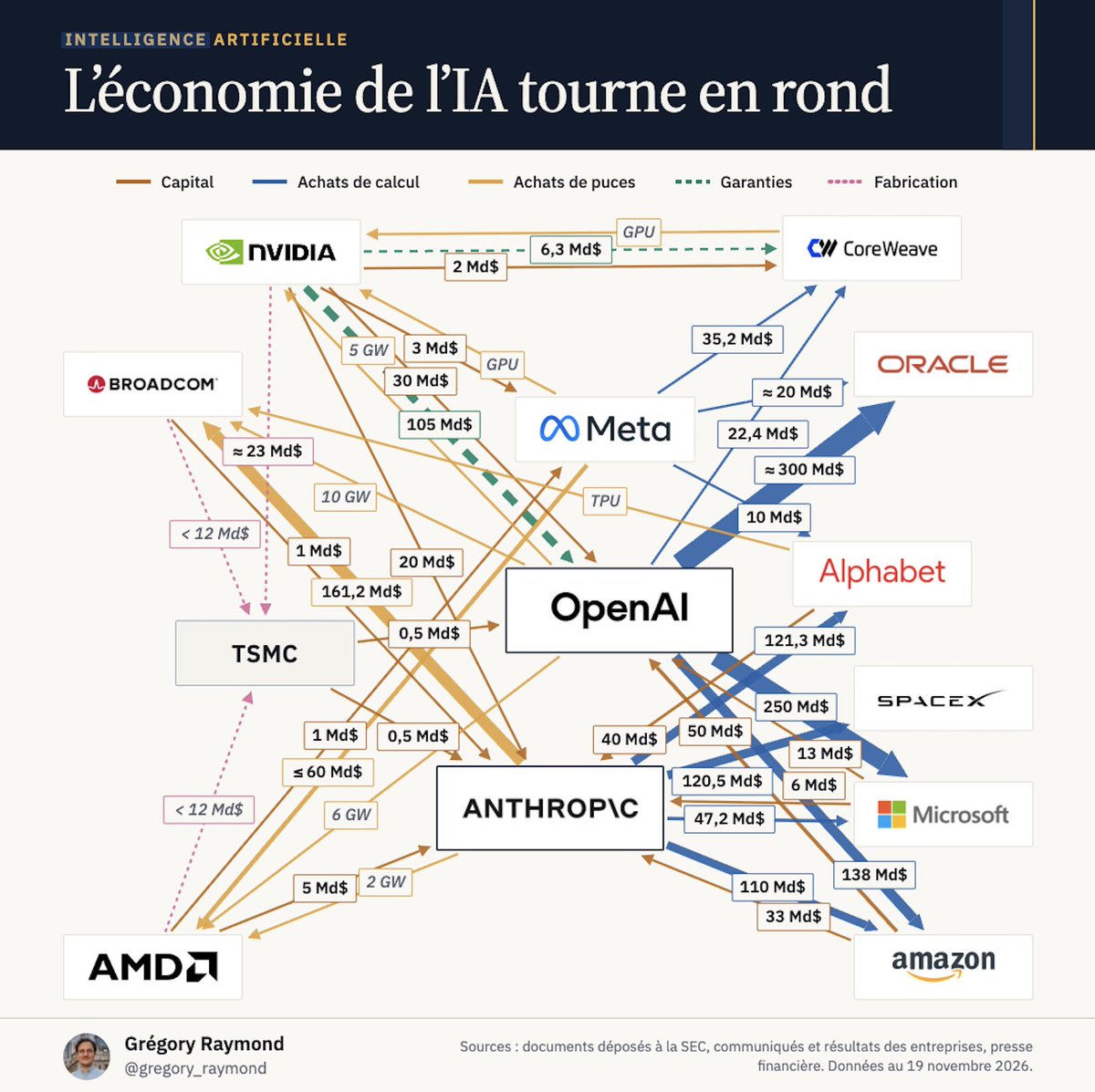
👉 L’argent qui tourne en rond (infographie ci-dessous)
Nvidia fabrique les puces. Il va investir jusqu’à 100 milliards de dollars dans OpenAI (ChatGPT), qui se sert de cet argent pour... acheter des puces Nvidia.
Un peu comme un concessionnaire qui prêterait à ses clients de quoi acheter ses voitures, avant de se féliciter de ses ventes record.
Résultat, tout le monde a l’air de vendre énormément, alors qu’une partie de la demande est financée par le vendeur lui-même.
👉 Des promesses, surtout
D’ici 2030, OpenAI s’est engagé à dépenser quelque 600 milliards de dollars en puissance de calcul. Son chiffre d’affaires 2025 ? 13 milliards. Si les revenus tardent à venir, c’est toute la chaîne qui risque de vaciller : OpenAI d’abord, puis ses fournisseurs, puis ceux qui leur ont prêté.
👉 Qui a prêté ?
Les Américains, pour l’essentiel. Pimco, le gérant d’actifs, a mis environ 10 milliards de dollars dans un seul centre d’Oracle. JPMorgan et le japonais MUFG ont monté pour Oracle un prêt de 38 milliards, et il leur a fallu des mois pour trouver d’autres prêteurs avec qui le partager.
Et l’Europe dans tout ça ?
Nos banques ont prêté environ 75 milliards d’euros au secteur, soit à peine 1% de leurs crédits aux entreprises, un risque que la BCE juge limité. Le point faible est ailleurs. Il se trouve du côté de nos fonds et de nos assureurs, qui ont placé jusqu’à un quart de leurs actions dans la tech américaine et achètent de plus en plus d’obligations émises par les géants de l’IA.
@TommyThornton Many people will think about analog of 2000, but few people to believe that was the case. It’s no doubt that we use the internet much more the 2000, but the market think about other ways .