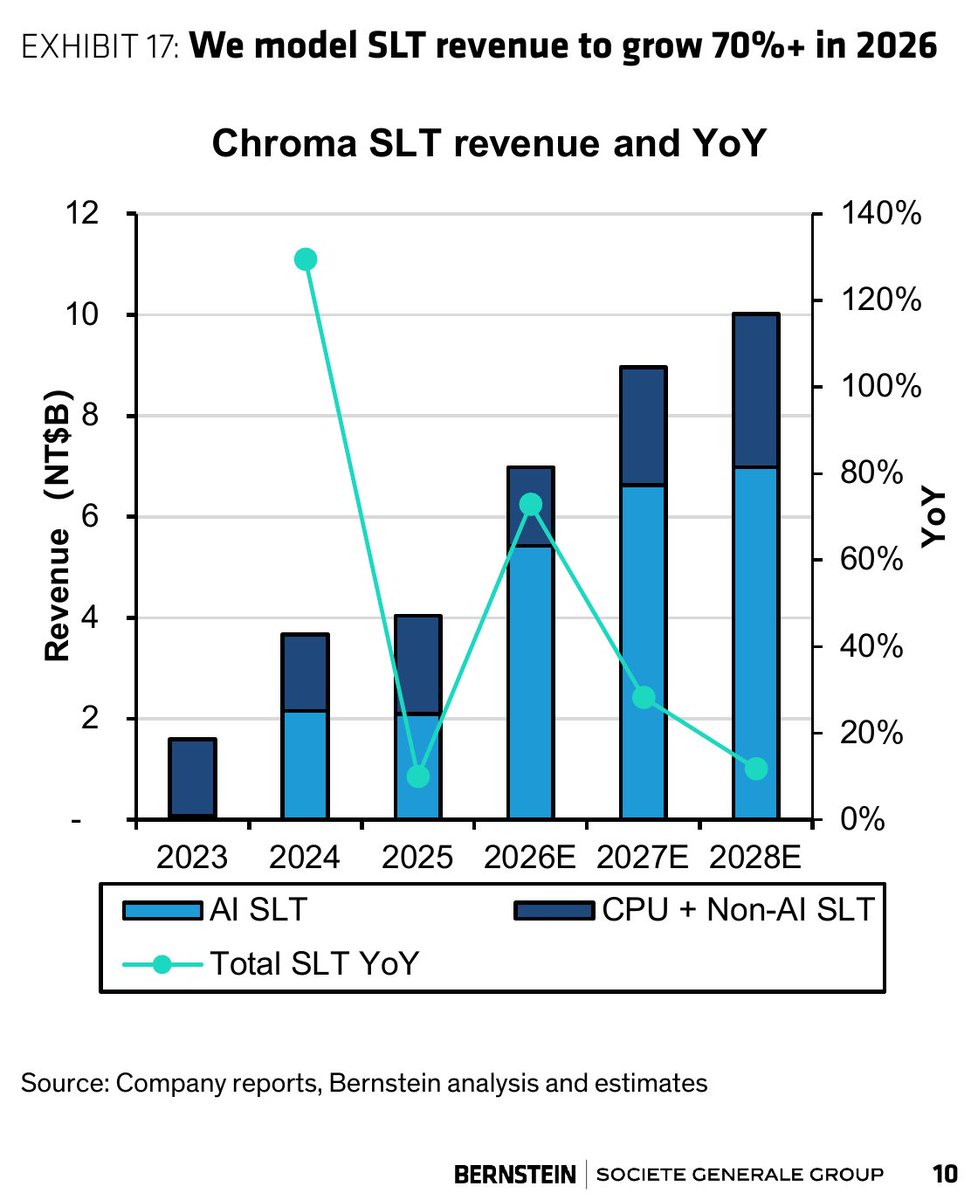
Chroma ($2360.TW) SLT revenue ramping from NT$4B (2025) to NT$9B (2027E) marks the structural shift from single-GPU dependency to platform diversification:
Multi-program ramp: Google/Marvell inference ASIC + Vera CPU + Rubin Ultra in 2H27
Physics driver: 1500W+ module TDP mandates high-precision Active Thermal Control (ATC) liquid handlers
Extended test duration per package directly multiplies tool unit requirements.
$2360.TW: Bernstein maps a 2027 CPU and GPU testing ramp
Bernstein expects Chroma ($2360.TW) to see 2027 system-level testing demand from $GOOGL/ $MRVL inference projects and $NVDA’s Vera CPU. It also forecasts Rubin Ultra GPU testing to ramp in 2H27.
That gives $2360.TW several potential program ramps to track, rather than a single AI-chip catalyst
The durability argument holds up because hyperscaler HBM 3:1 wafer cannibalization leaves zero margin for the Big 3 to re-enter DDR3/trailing DDR4.
At 1.6x runrate P/E, the key risk isn't pricing, it's PSMC wafer allocation ceilings. If their 19nm tape-out ramps smoothly into 2027, gross margin expansion survives even if foundry input costs climb further. $ESMT
6/6 [KV Cache & Physical AI] Beyond training logs, WDC is sampling dual-actuator high-bandwidth HDDs to hyperscalers to evaluate substituting expensive DRAM/SSD tiers for inference KV cache workloads.
Top 7 customers provide demand visibility to 2030, but near-term margin debates and CapEx creep will test valuation multiples in a risk-off tech tape. $WDC
1/6 Western Digital ($WDC) reported Q1 FY27: Rev +55% YoY, EPS +161%, gross margin 58.1%, and $1.4B FCF. Yet shares fell -12% across regular and after-hours trading.
Behind the sell-the-news tape: an Exabyte growth gap vs peers, head wafer bottlenecks, and CapEx intensity inflections. Key Q&A takeaways below. 🧵👇
5/6 [Head Wafer Physics & CapEx] Management reiterated zero incremental unit capacity additions: bit growth is 100% areal density driven.
However, HAMR magnetic heads require significantly more process steps and longer fab cycle times, creating throughput loss. To support HAMR heads and future 14-platter drives, CapEx will track above the historical 4-6% revenue baseline for the next two years. $WDC
While P&L was strong ($1.24B rev / $0.94 EPS), OCF turned negative this quarter as unbilled inventories and working capital expanded to support hyperscaler deployments.
On-site fuel cell EPC cycles take time to convert into cash. In a crowded trade where whisper numbers were already elevated, institutions simply used the post-earnings liquidity window to de-risk duration exposure. Cash conversion matters more than sell-side EPS beats.
Cloudflare CEO, Matthew Prince, on emerging cyber attacks:
"Hackers right now are exploiting this flaw at just incredible rates. Literally, we're seeing millions of attempted attacks using this flaw now across all of our network, every single minute of every single day. The flaws now known and if you are running PHP on your servers, you need to update PHP to the latest version. It's free, you can get it updated immediately, and that's the only thing that's going to keep you safe."
"Most of the frontier labs are working with companies like cloudflare in this way that when they found this flaw a couple months ago, they reached out to us and they said we've found this. They disclose it to us in a in a confidential way."
Via @technology
$NET
@pequityresearch OpenAI's models uncovering PHP zero-day variants marks a structural shift in offensive security. Because PHP still powers over 75% of web backends, automated bot scans hit millions of attempts per minute. Cloudflare's edge WAF is serving as the global virtual patch.
Expert Takeaways: Memory
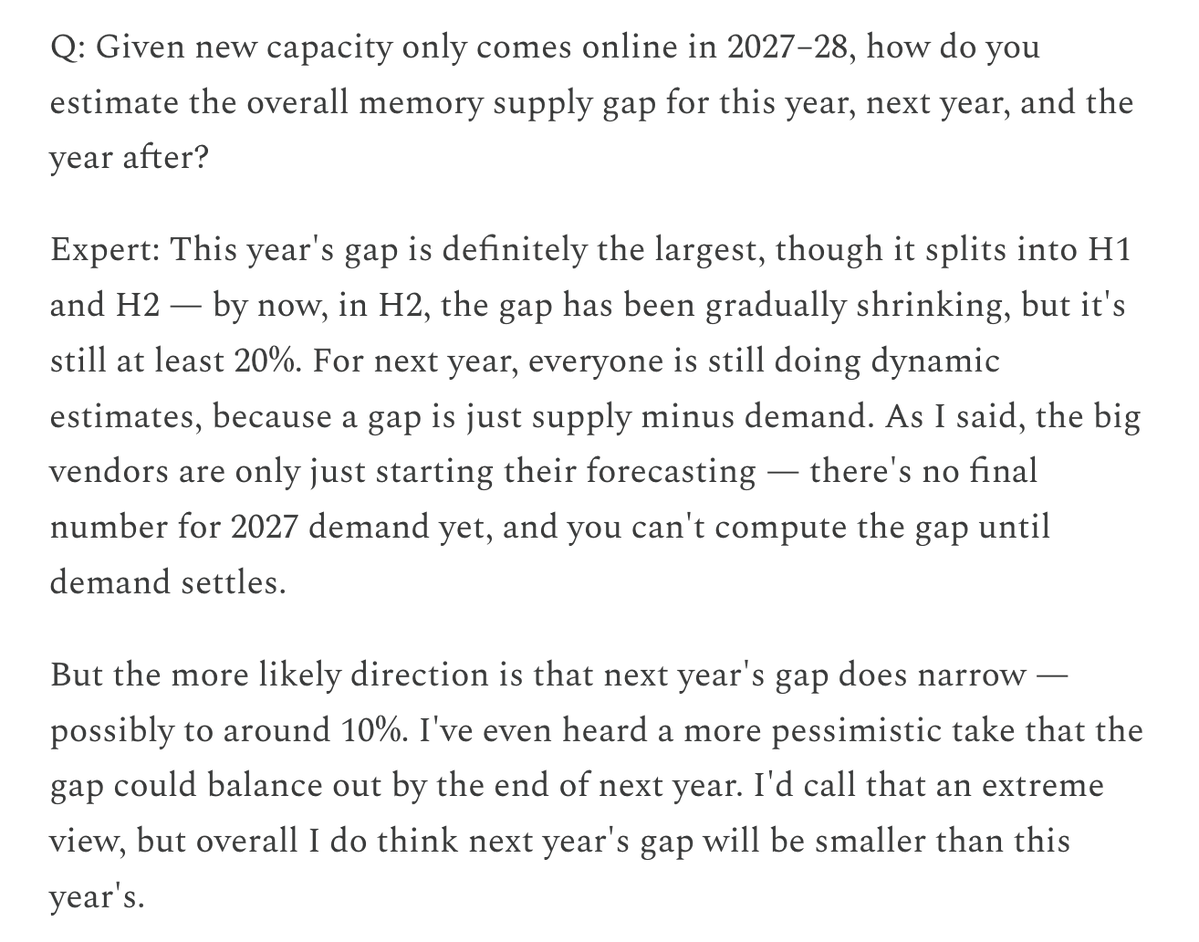
> S/D gap of at least 20% in second half of 2026.
> Big vendors have just begun forecasting since demand for 2027 has not settled yet.
> S/D gap for 2027 is possibly around 10%. A pessimistic take believing in balance by end of next year.
$MU $DRAM $EWY $SKHY
@pequityresearch A 10% S/D deficit in 2027 is still an aggressive seller's market. Because memory demand is price-inelastic, even a 5% shortfall maintains 50%+ gross margins. With cleanroom additions gated until 2028 and DUV backlogged, suppliers retain structural pricing power.
. @Intel_Foundry has the first major truss in at Ohio One, and Arizona Fab 62 tool install is fully underway for operations by the end of 2028.
The headlines say Ohio is five years late. I said back in 2024 that the original date was overly ambitious for a first fab in a new state. Pacing it to customer demand is the right discipline.
What matters now: Ohio is designated for 14A and beyond, and @intel says it can pull the schedule in if customers commit. We are inside the 14A decision window @LipBuTan1 laid out, the second half of 2026 into the first half of 2027.
The truss is the shell. Customers set the clock. $INTC
@PatrickMoorhead@Intel_Foundry Building the shell while gating tool install to commitments avoids idle EUV depreciation. But it also highlights the foundry dilemma: fabless customers hesitate to commit without high D0 yield data, while Intel waits for prepayments to tool the cleanroom. 14A is the real test.
8/8
Summary and Valuation Divergence:
The market is pricing Nokia through the lens of a legacy, low-growth telecom equipment vendor facing component inflation.
Underneath, the company is building a captive Western supply chain for 6-inch indium phosphide optical engines, backed by a €5B hyperscaler order book expanding at 25% to 30%.
As Fab 2 reaches steady-state yields in 2027, operating leverage will decouple high-speed optical hardware earnings from the broader telco cycle.
1/8
Nokia $NOK dropped 9.72% post-Q3 2026 earnings.
The tape reacted to gross margin dilution in Network Infrastructure (43% down to 41%) and component inflation.
Behind the quarterly miss lies an inflection in custom optical silicon and AI datacenter interconnect. Here is the institutional breakdown of the Q3 transcript. 🧵👇
7/8
Telco Stagnation and Portfolio Rationalization:
Traditional radio access network (RAN) demand remains flat globally.
Management confirmed no evidence of inventory pre-buying from wireless carriers. Cash generation is supported by internal restructuring:
- Reaching the upper ceiling of the €800M to €1.2B structural cost reduction target.
- Accelerating the integration of the China joint venture from 36 months down to 12-24 months to cut overhead in low-share geographies.
- Channeling savings directly into Fab 2 InP expansion and Co-Packaged Optics R&D.