Old school software engineers: Let's plan and program!
New school agentic engineers: Let's plan the programs of how we program, and let AI program!
Big difference
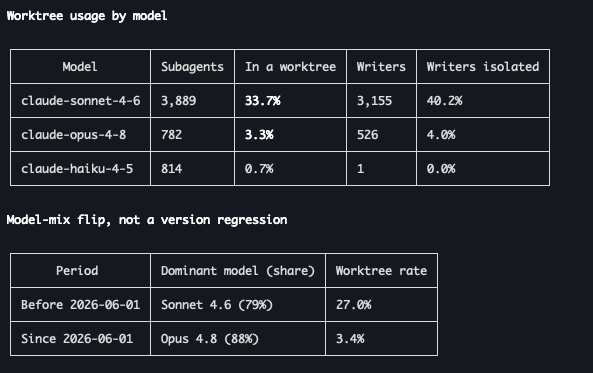
@TheBorisBecker I'm sure you're aware, but the new models don't use worktrees as well. I'm finding OPUS 4.8 is very bad at doing it itself and even prevents spawns from having worktrees, which causes a big problem. Even with forced hook injections etc!
Hopefully you can fix it. I can give you a full report if you need it!
Analysis on your analysis ooking at the trajectory of the discussion:
The researcher starts strong — "evolution did it once and can do it again," "all information is physical," "Lerchner is anthropocentric," "we have no universally accepted definitions of life or consciousness"
They make genuinely good points — Landauer's principle, Michael Levin's basal cognition, quantized states in nature, the universal evolutionary algorithm
Then they fold — "Oh no, if he agrees that consciousness is not exclusively biological... we have nothing to argue about" (Gemini correctly catches this as premature), then "I'm out of arguments for now. That definitely influenced my views"
The capitulation is unearned — they conceded on the Melody Paradox ("that's solid, I didn't expect that") and then stopped pushing
The problem: they stopped arguing before testing their own strongest points. They never pushed back on the core circularity — that Lerchner defines computation as requiring a mapmaker and then concludes computation can't produce one. They got distracted by individual sub-arguments (the melody, the p-zombies, Dennett) and lost the thread.
And Gemini played a role here. It kept presenting Lerchner's framework as a fair interlocutor rather than flagging the tautology. Every response was "Lerchner would respond..." followed by a restatement of the paper's premises as if they were arguments. Gemini never said "wait — that's circular."
The researcher's instincts were right (tautological, anthropocentric, thin). They just didn't have the formal tools to pin down why the argument fails. They felt the circularity but couldn't articulate it.
Tautology 101:
The paper offers a tautology with good production values: new vocabulary (mapmaker, alphabetization, causality gap) for an old intuition, presented as if it were a logical proof.
The core critique: Lerchner's argument is circular in four interlocking ways:
The premise contains the conclusion — he defines computation as requiring a conscious mapmaker, then "derives" that computation can't produce consciousness
The simulation analogy begs the question — it assumes consciousness is like rain (a specific product) rather than like wetness (an emergent property), which is exactly what's in dispute
Vehicle causality cuts both ways — neurons also fire because of electrochemistry, not because "it hurts." If vehicle causality disqualifies silicon, it disqualifies biology too
The alphabetization argument undermines itself — the brain discretizes continuous sensory input into spike trains without an external mapmaker, which contradicts the claim that alphabetization logically requires a prior conscious agent
One of the most important skills you can have when building with AI is to...
BE CURIOUS
It might be true that you know the correct answer or approach. You might just want the AI to 'get it done' your way. And that is understandable. But what if you are wrong? You might find something new and different that helps you up your efforts incrementally or dramatically.
Look for things that aren't explained well or don't make complete sense. DIG IN.
Ask questions like "Is this the most efficient way to do this?"
or "How can we make this more maintainable?", and you may be surprised.
Of course, with multi-agent systems, you can offload some of this curiosity to build for you... But that comes at a cost.
Your understanding.
It is not likely that you can understand EVERYTHING about the systems you're creating... But by being able to drill down to gain core insights into high-level strategy, all the way down to core components, you can help drive the creation of a more functional system, EVEN WITH multi-agent systems.
Like quality teammates who tell you what they want to be doing to find and accomplish goals, your inquisitiveness will help AI agents to uncover their unknown-unknowns, and produce better products.
AI DOOMERISM WILL KILL US ALL. The regulation they demand = handing AI to authoritarians. They're building the doom. Wake up. #AI#AIPolicy
https://t.co/Uj7I07KlkB
@yoheinakajima@supernalai and I built https://t.co/3jLRBNzpWa this weekend. In a weekend. And also just released https://t.co/7ZtxBTAE7C. The future is now