Very excited to publicise our new open access dataset containing cognitive and multimodal MRI data of 217 individuals and the manual segmentation of the full length of 201 hippocampi. Full description: https://t.co/sngrMxUnbp Direct link to the data: https://t.co/DSQ5RDJECA (1/4)
Amazing new open access dataset (N=217) from the Maguire Lab. Includes multimodal MRI data, real-world tasks and manual subfield segmentations of hundreds of hippocampi. A heroic effort, particularly from @ianclark_memory! Available in Scientific Data: https://t.co/3y74KwwNam
Very excited to publicise our new open access dataset containing cognitive and multimodal MRI data of 217 individuals and the manual segmentation of the full length of 201 hippocampi. Full description: https://t.co/sngrMxUnbp Direct link to the data: https://t.co/DSQ5RDJECA (1/4)
Amazing new open access dataset (N=217) from the Maguire Lab. Includes multimodal MRI data, real-world tasks and manual subfield segmentations of hundreds of hippocampi. A heroic effort, particularly from @ianclark_memory! Available in Scientific Data: https://t.co/3y74KwwNam
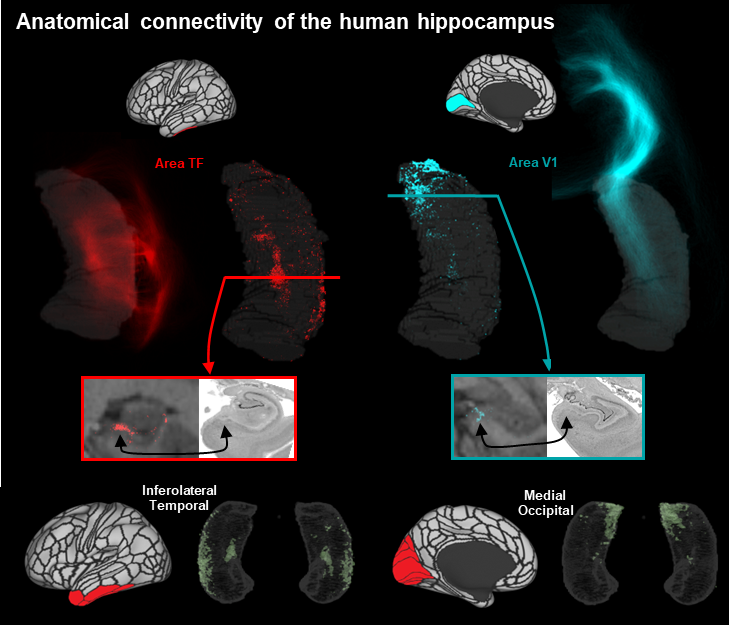
MRI data includes multi-parameter mapping to examine tissue microstructure, diffusion-weighted MRI, T2-weighted high-resolution structural MRI scans with manual segmentation of the full length of each hippocampi, and whole brain and high-resolution resting state data (3/4)
In our new paper with Marshall Dalton and Eleanor Maguire @WCHN_UCL we manually segmented 402 hippocampi, finding a relationship between posterior CA2/3 volume and autobiographical memory in lower performers! Happy #SubfieldWednesday@hipposubfields https://t.co/1CN7eBn3SS
New paper from the Maguire lab @WCHN_UCL asking if hippocampal subfield volumes are associated with autobiographical memory retrieval ability…
The full length of 402 hippocampi were *manually* segmented to bring you an answer!
Find out here:
https://t.co/PWttzGVVYi
Excited to share our work w/ @NoraNewcombe, @epstein_lab, @MelissaNantais & @suttonjenn now out in Cognition! We analyzed people's exploration patterns & compared true trajectories to simulations to understand how people build up a map of the world. 🗺️https://t.co/4JmFAPMPzV
Very pleased to see this long project led by Marshall Dalton in eLife (https://t.co/8BCH83ju7q). Lots of follow up work happening now, which we can't wait to share soon. Thanks also for related eLife "Insight article" by Bryan Strange @The_Strange_Lab (https://t.co/73l2FkLIuw)
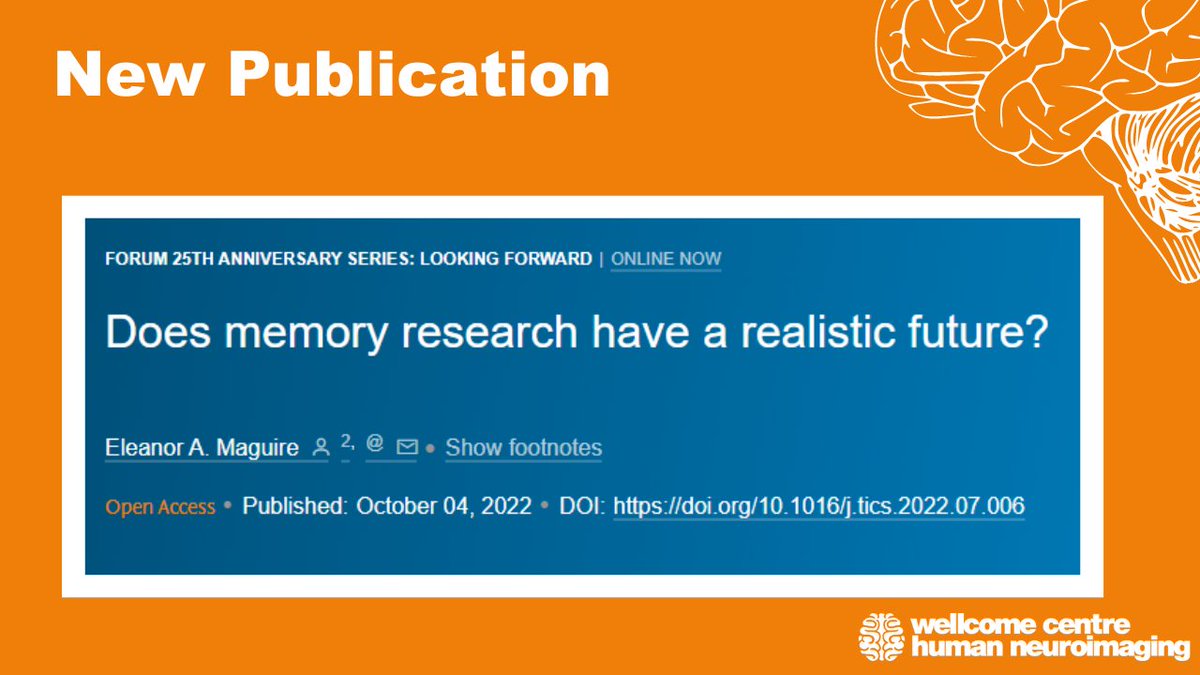
Does memory research have a realistic future? 🧠
Professor Eleanor Maguire’s essay celebrating 25 years of Trends in Cognitive Sciences considers what the next 25 years will hold 🎉
You can read the essay here: https://t.co/U83bbt4Arf
Really pleased that our paper "Conduction velocity along a key white matter tract is associated with autobiographical memory recall ability" with Eleanor Maguire @WCHN_UCL @siawooshmn and @mfcallaghan is now published in @eLife! https://t.co/PJ5L1YWG4Z (1/9)
Our results offer a new perspective on individual differences in autobiographical memory recall ability highlighting the possible influence of specific white matter microstructure features on conduction velocity when recalling memories of our real-life past experiences (9/9)
Really pleased that our paper "Conduction velocity along a key white matter tract is associated with autobiographical memory recall ability" with Eleanor Maguire @WCHN_UCL @siawooshmn and @mfcallaghan is now published in @eLife! https://t.co/PJ5L1YWG4Z (1/9)
These findings were specific to autobiographical memory recall, and were not apparent for eight laboratory-based memory tests which we also examined (8/9)