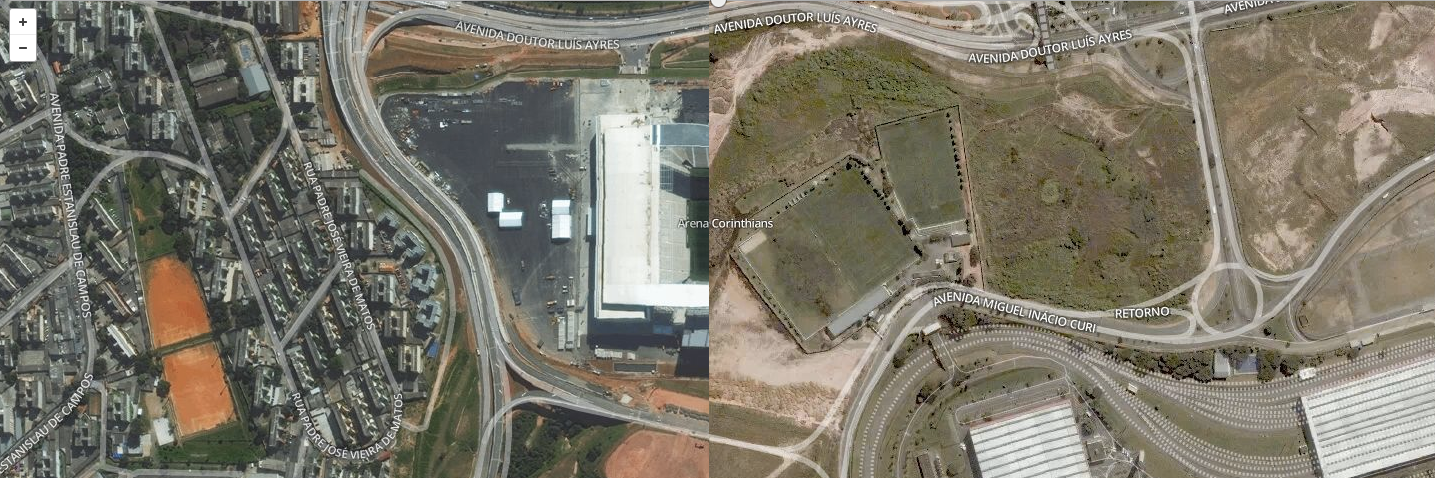
Coincidence?
Seriously though.. congrats to @earlkman & the whole @Satellogic team. Glad that the market is starting to notice your great work and vision
We enjoyed collaborating with our friends at @developmentseed to develop new functionality to quickly visualize & analyze massive datasets like mobile #AirQuality measurements with #Lonboard, an open-source #Python library for #Jupyter notebooks. https://t.co/E3gsnUwhLT
@mouthofmorrison@rabernat@betolink@EarthmoverHQ @steadyflux That said, it isn't 100% clear that NASA's best move is to immediately convert 10000+ data sets into cutting edge ARCO formats. Kerchunk and Virtual Zarr offer benefits of ARCO while keeping data in the native formats.
@mouthofmorrison@rabernat@betolink@EarthmoverHQ @steadyflux It may be Microsoft's eventual goal to build a massive foundation model on top of every pixel that NASA has ever published, but that isn't what is going on here.
@mouthofmorrison@rabernat@betolink@EarthmoverHQ @steadyflux Earth CoPilot isn't analyzing the pixels. It is looking through metadata to select the right pixels and presentation. You still need ARCO for visualizing the results, obvi, but any VEDA instance will have this.
NASA's repository of geospatial data contains key insights on everything from climate and air quality to urban planning and disaster response—but its scale and complexity make it difficult to parse. With Earth Copilot, they're making it easier than ever for anyone to access that data: https://t.co/kSEzYwze7d
SESSION HIGHLIGHT
Traditional formats like GRIB, NetCDF & GeoTIFF have served climate data well, but as data grows, we need scalable, cloud-native solutions. Learn how these innovations are reshaping climate science! 🛰️ #SatSummit
🔗 https://t.co/A6y4NIr5ZA
About 🚴 commuting: it gets dark early now. Helmets are great, but much better to avoid being hit.
Enter @redshift_sports & https://t.co/X4S6KVtnie
Not cheap, but v smart (auto on/off, red/white) & solid. Surprisingly long 🔋.
My bike is a festival of lights!
🚀 We’re hiring! Join us as a Technical Project Lead to advance open science in the cloud and help drive impactful NASA projects. Are you a proactive, independent leader with PM experience? Apply today: https://t.co/WVRBM0pkNN
Introducing the Founding CNG Editorial Board for the Cloud-Native Geospatial Forum (CNG)! This group of leaders from our community have graciously volunteered to guide our work.
https://t.co/86miHteByg
Ever lost track of POIs while navigating digital maps?
This is a common UI problem with directional markers.
In this short & sweet blog post, front-end engineer @danielfdsilva shares a workflow that uses trigonometry and CSS transforms to ease this issue. He shows how he did it for the @sat_summit map.
Get the full technical breakdown with code snippets and fun animations:
https://t.co/5SG4Pgp8br
#WebDev #UX #Maps
Our Analysis-Ready PlanetScope product is now available! This harmonized dataset makes it even easier for AI applications to run on top of our satellite data.🛰️
Planet users can now spend less time formatting data and more time analyzing how their AOIs are actually changing!🧑💻🌍
https://t.co/srOIhQKKEJ
New Python package to easily read/write/etc with object storage (S3, GCS & Azure)!
- Sync & async with streaming responses
- Seamless multipart file uploads
- Simple API & static type checking
- Easy to install with no Python deps
- Built on @rustlang
https://t.co/57fBC3N9DT
Zillow will soon add a “climate risk” section to listings, estimating a home’s vulnerability to floods, wildfires, etc.
But it’s not clear we can actually estimate climate risk for every property in the US.
I wrote a guide for homebuyers, with tips on how to use the feature: