The Bazooka He Never Fires
Now that we’ve all had 48hrs to process and digest the $STRC situation.. I’m sure many of us are thinking the same thing.
What’s Saylor's best next move? It’s not what you think.
It’s not raising the dividend rate on STRC to push it back to par. It’s also not selling $MSTR common (or Bitcoin for that matter) to refill the fiat reserve. His best move on the board is one he might never actually have to make — which is exactly what makes it the right one.
From Strategy's dashboard:
$54.1B in Bitcoin. Against it, $22.2B of claims sitting above the common — debt plus preferred. Net leverage: 10%.
While the number everyone’s obsessing over: 7.7 months of USD dividend coverage, against a $1.7B annual dividend.
This is despite holding ~31 years of Bitcoin coverage. Because after all, look at the carnage caused by selling just 32 Bitcoin (I’m only half joking). So the market discounts the whole stack for forced-liquidation risk.
So what’s this balance sheet missing?
There's a fix that doesn't sell any bitcoin, doesn't print a single preferred share, doesn't issue common into a weak market, and doesn’t create the unnecessary drag @saylor is allergic to: a Bitcoin-collateralized credit facility. And the best part, is that Strategy may never need to draw it.
The mechanics: $54.1B of collateral. A facility large enough to pre-fund two full years of dividends — call it ~$3.5B — is a 6% loan-to-value. But the cash was never the point. The option on the cash is the point. The instant a committed backstop exists, "forced seller below cost basis" stops being a tail risk the market feels the need to price.
You don't draw it. You announce it. And the spread does the work.
We've seen this movie before. July 2012, Mario Draghi: "whatever it takes." The ECB's bond-buying bazooka — OMT — was never actually fired. Not once. Its mere existence collapsed Italian and Spanish spreads, because it deleted the catastrophe from the left tail. The Fed ran the identical play in March 2020: credit facilities announced in the hundreds of billions, drawn at a fraction of that, spreads tightening on the press release alone.
The bazooka you never fire is the cheapest one you'll ever own.
The Pharaoh's view: Strategy doesn't have a solvency problem. The bear case prices a company that must sell Bitcoin. A credit line it never draws would prove it never has to. The cheapest dividend you can pay is one you borrow against an asset you'll never sell — and the most powerful facility is the one you never use.
For Reference:
#Metaplanet’s $500M bitcoin backed credit facility, at max drawdown would make up ~20% of their current Bitcoin treasury value. It costs them 7.25% p.a. on drawn funds.
Bitcoin Haters: "Bitcoin is just a glorified spreadsheet."
You're right.
And you just accidentally described every monetary system in human history.
Your dollars? A spreadsheet. Controlled by a committee of unelected economists in a marble building who have never met you and don't care that your grocery bill doubled.
Your bank account? A spreadsheet. One that can be frozen, seized, debanked, or restricted overnight while you're asleep and they're on a conference call discussing it.
Gold? A physical spreadsheet with a storage problem, a rehypothecation problem, and a "trust us, it's all there" problem.
Every monetary system ever invented is a ledger.
A record of who owns what.
The only question that has ever mattered, the only question worth asking, is: Who controls the ledger?
With dollars, the Federal Reserve helps oversee the ledger.
New dollars can be created. The purchasing power of existing dollars can be diluted. Trillions can be added to the system, and you're handed an explanation for why it's necessary.
With your bank, institutions control access to the ledger. Miss a payment. Get flagged. End up on the wrong list. Suddenly, the ledger becomes unavailable to you.
With Bitcoin? Nobody controls the ledger.
Not a government. Not a central bank. Not a billionaire. Not a regulator. Not a compliance officer in khakis.
The ledger is maintained by thousands of nodes distributed across the globe, each independently verifying transactions without requiring permission from anyone.
You cannot add a fake entry.
You cannot arbitrarily inflate the supply.
You cannot rewrite history.
The rules are enforced by math.
So yes, Bitcoin is a spreadsheet.
It is the first spreadsheet in human history that no single person can control.
That's not a bug.
That's the entire point.
Learn about Bitcoin to help secure your financial future.
Most people stretch to feel better—but few understand the power of 5 minutes a day.
Whether it's pain, posture, or stress, these daily moves can transform your body.
Here’s what happens when you stretch with purpose 🧵
I asked a millionaire what separates rich men from broke men.
I expect him to say:
Hard work
Save money
Invest early
Network
But what he said includes nothing above:
NEW: Sen. Sullivan and Sen. Lummis lead letter to the Fed, FDIC and OCC, calling for revaluation of Basel’s risk weighting for Bitcoin and digital assets.
“A 1,250% risk weight bypasses those calibrated frameworks entirely, applying a blunt penalty …to a transparent, globally traded asset with deep derivatives markets, continuous liquidity, and cryptographic auditability.”
This is a strong signal from Washington that legislators are looking closely at this issue as work on market structure continues. The letter has 6 signatories and 3 are on the Banking Committee.
It’s also great to see BPI’s brief on this topic cited in the third footnote! 😉
We’ll keep you posted on further updates.
Four ideologies shape the Bitcoin community. Maximalists bring conviction. Capitalists bring integration. Technologists bring innovation. Fundamentalists bring preservation. Bitcoin reaches its full potential when these four forces work in harmony.
In a world of infinite fakes, physics is the only proof left.
The AI-vs-Bitcoin fight used to be about one thing: electricity. Who gets the power — the data center or the mining rig. Now it's about two, and the second front is playing out this week: who gets the capital.
Look at what's lining up. SpaceX opens its roadshow at a ~$2T valuation, raising up to $75B. OpenAI (~$852B) and Anthropic (just repriced to $965B after a $65B round) are both moving toward listings this fall. Combined, that's ~$3.6 trillion of new equity — the GDP of France — asking the market for capital in a single year. Goldman sees 2026 IPO proceeds near $160B, four times last year.
Money is infinite — that's the whole reason Bitcoin exists. The bid isn't. At any given moment the risk capital willing to chase a story is finite, and right now that story is AI. Bitcoin is down ~22% on the week and more than 45% off its high, bleeding 3.2B from spot ETFs, while the AI pipeline swells.
But that's the trap in the framing. Capital rotation is the cyclical question. It reverses. The structural question is the one that compounds: when everything digital can be faked for free, what's left that can't?
The numbers on the "infinite supply" side are staggering. Europol projects up to 90% of online content will be synthetically generated in 2026. Deepfakes shared across social platforms went from ~500,000 in 2023 to an estimated 8 million in 2025 — roughly 900% growth a year. Voice cloning crossed what researchers now call the "indistinguishable threshold" in late 2025. Deepfake-enabled fraud losses hit ~$1B last year, up 669%.
AI is doing to trust what central banks did to money: driving the marginal cost of producing a convincing unit to zero. A fake face, a fake voice, a fake document, a fake "proof" — supply is now effectively infinite. And infinite supply means zero value. We've seen this movie. It's called inflation.
Now hold that against Bitcoin.
You cannot fake a Bitcoin. Not because a regulator says so — because thermodynamics says so. Every block is secured by ~800 exahashes per second of real computation, drawing ~175 TWh a year, more electricity than most countries use. That energy isn't waste. It's the receipt. Bitcoin is the one digital object whose scarcity is enforced by physics rather than by a promise: 21 million, final, un-forgeable, no matter how good the models get.
That's the whole thesis in one line: AI is an infinite-supply machine. Bitcoin is its thermodynamic opposite. The better AI gets at manufacturing fakes, the more valuable the one thing it provably cannot manufacture becomes.
The asymmetry:
• If AI stays niche → Bitcoin's scarcity story is unchanged. You lose nothing.
• If AI eats the internet → every form of digital trust gets debased, and the only natively scarce, physically verified digital asset becomes the reference point for what's real. You win enormously.
Heads you're fine. Tails you own the anchor.
People keep filing AI and Bitcoin under "tech." They're not the same category. One is a printing press for reality — the most powerful counterfeiting tool ever built. The other is the first form of money whose supply no human, model, or state can alter. The printing press makes the anchor more necessary, not less.
And here's the irony in what we're seeing this week: the ~$3.6T chasing AI is being valued on promises — projections, narratives, claims about a future that hasn't shipped. Every operator should be asking what they actually own when the story turns. Most "assets" are claims: entries in someone's database, honest only as long as the database is. AI is about to make every database suspect.
Bitcoin is the exception. It isn't a claim. It's proof. Settled in energy, checked by every node, impossible to print.
The Pharaoh's view: the AI era won't kill Bitcoin's energy use — it'll vindicate it. When fakes are infinite, the thing that costs real-world physics to produce is the only thing left worth trusting. Proof-of-work was never about mining coins. It was about manufacturing certainty in a world that's running out of it.
And yes — an AI helped write this. Fitting, isn't it? The infinite-supply machine can counterfeit my prose, my cadence, maybe even my conviction. It still can't print a single satoshi.
A Biology Professor Said:
"Your Belly Is A Storage Of Cortisol Waste. Clear It With One Routine Before Bed.. And Your Life Will Change."
Here's The 9 Minute Fix He Provided:
🔥SAYLOR AT COSTCO: A STRC ODYSSEY🔥
Want to understand STRC but need a normie explanation?
Think Strategy is a Ponzi scheme?
THINK AGAIN:
Costco is basically retail insurance.
You pay the membership premium.
Costco says:
“Give us $65 a year and we will protect you from the economic terrorism of buying toilet paper at CVS.”
In return, Costco takes risk.
They bet you won’t come in every day and bankrupt the hot dog counter like a suburban locust with a 401(k) loan.
You take risk too.
You might buy a membership, walk in for paper towels, black out emotionally, and leave with a kayak, 48 muffins, a generator, a brisket, and the financial soul of a divorced youth football coach.
But the risk is transparent.
You know the deal.
Costco says:
“We sell memberships. We use scale. We squeeze suppliers. We give you insane value. Please do not commit war crimes against the free samples.”
Now look at Saylor offering STRC.
Same basic skeleton, but instead of Kirkland Greek yogurt, it is a capital markets fever dream powered by Bitcoin and institutional yield hunger.
STRC buyers say:
“I will accept preferred equity risk for 11.5% yield.”
Saylor says:
“Wonderful. I will take that capital, buy Bitcoin, and continue building the most deranged orange balance sheet in corporate history.”
The STRC holder gets yield.
The MSTR common holder gets amplified Bitcoin exposure.
The business gets capital.
The Bitcoin network gets another industrial vacuum hose attached to the supply.
Everyone is accepting a transparent risk.
Costco member risk:
“I may not use this membership enough.”
Costco business risk:
“These people may eat too many rotisserie chickens and bankrupt poultry as an asset class.”
STRC buyer risk:
“I am accepting Strategy credit risk for yield.”
MSTR common holder risk:
“Saylor may keep issuing capital instruments to buy more Bitcoin, which either makes me rich or gives accounting professors nosebleeds.”
Strategy business risk:
“Bitcoin is volatile, dividends must be serviced, and the bears are outside screaming mNAV into a vape pen.”
But the magic is transparency.
Costco hides nothing.
The hot dog is $1.50.
The chicken is $4.99.
The membership is the engine.
Strategy hides nothing.
The Bitcoin stack is public.
The capital structure is public.
The yield is public.
The risk is sitting in broad daylight wearing orange body paint and quoting Austrian economics at a mall food court.
Costco monetized trust in bulk goods.
Saylor monetized trust in digital capital.
Costco sells access to cheap abundance.
Strategy sells yield to acquire scarce perfection.
Both models say:
“Here is the risk. Here is the machine. Here is the bargain. Enter voluntarily.”
🧵 Peter Lynch is one of the greatest investors in the world achieving an annual return of 29.2% (!) between 1977 and 1990. This means your investment would have increased 26x (!).
Learn how to improve your returns with these 20 golden investment rules:
John D. Rockefeller did not invent oil. Michael Saylor did not invent Bitcoin.
What they both understood was that controlling the best asset was not enough. You had to build the machine around it.
Rockefeller built refineries, rail deals, pipelines, and distribution. He took raw oil and turned it into an empire.
Saylor is doing the same with Bitcoin. He is building capital structures, preferred shares, debt markets, ETFs, and public equity around the hardest asset on earth.
Rockefeller accumulated oil before the world fully understood how valuable it would become. Saylor is accumulating Bitcoin before the world fully understands what it is.
One built the empire of industrial energy.
The other is building the empire of digital energy.
The playbook is the same: acquire scarce assets early, build the infrastructure around them, and let the rest of the world arrive late.
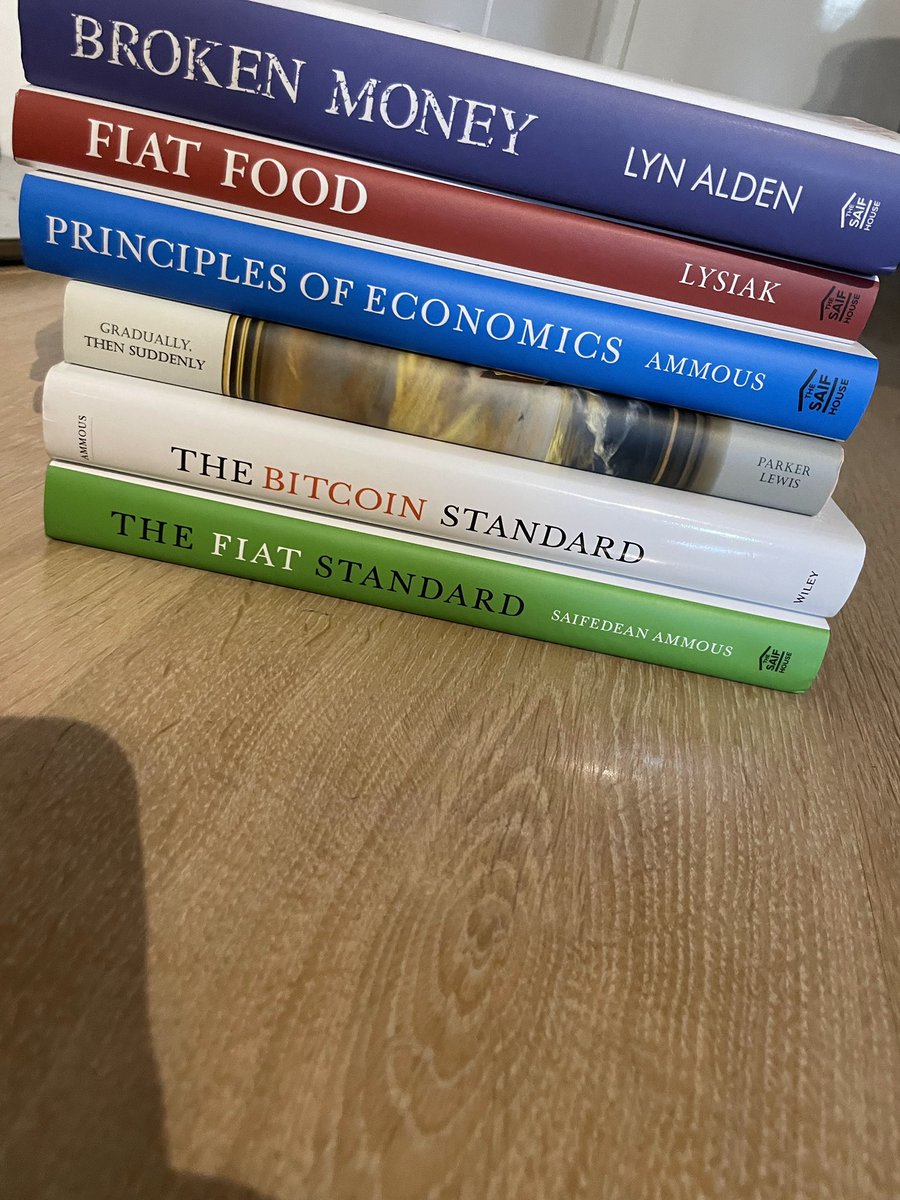
I've read roughly a book a week for 20 years.
These 5 changed how I think about money, freedom, and what it means to be alive:
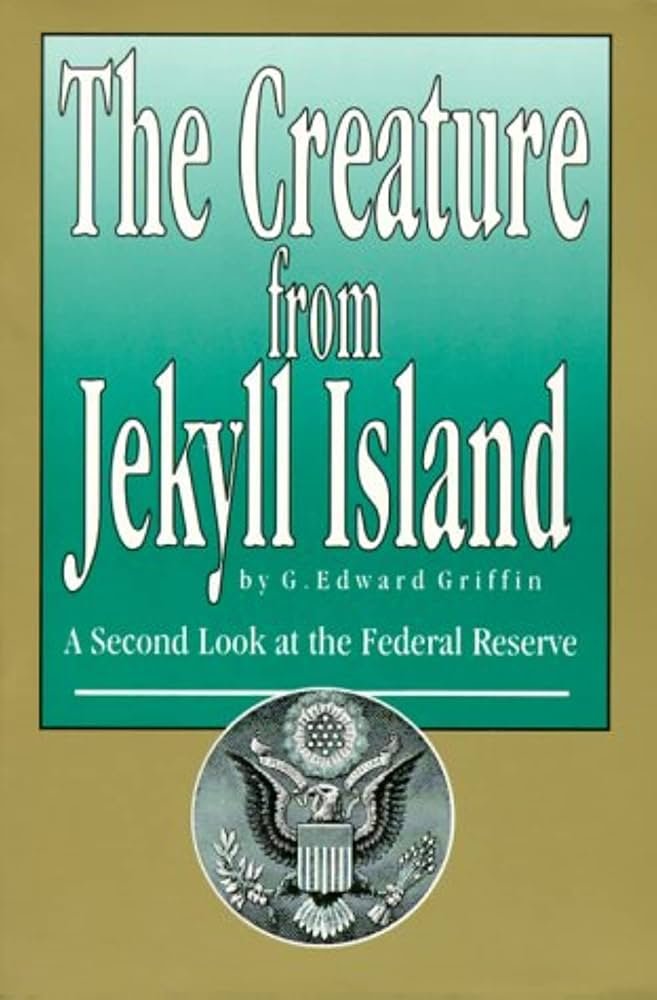
1. The Creature from Jekyll Island (G. Edward Griffin)