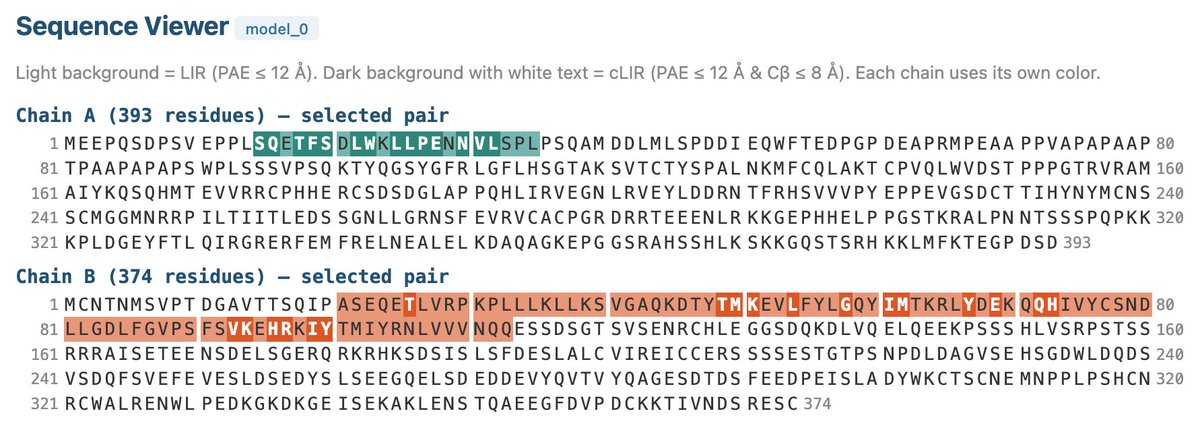
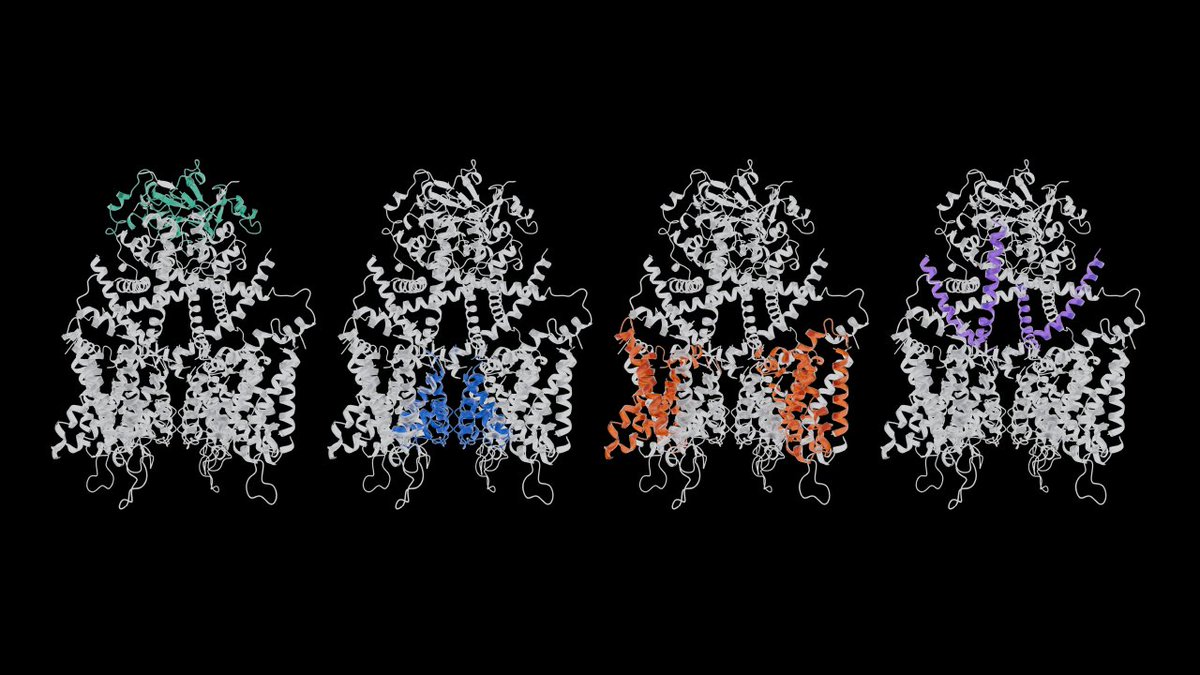
Our paper on ESMC, ESMFold2, and mechanistic interpretability for proteins is up on @biorxivpreprint!
We've made a few changes since the initial version went online last week.
1. We found an issue in the way we provided MSAs to OpenFold3. This led us to report lower performance of OpenFold3 on some benchmarks. This issue does not affect any of the other models evaluated.
2. We updated how we report results on Runs N' Poses to more closely match the original paper (counting only ligands with valid SuCOS similarity score). We also add a bar plot to the supplement that stratifies performance by similarity. This mostly changes the absolute values of the pass rate, not the relative performance of models.
3. Added some more BLI data to the supplement.
4. Added some missing citations, fixed typos, etc.
Check out the preprint here: https://t.co/wGoYhDz3gU
ESMC didn't learn protein biology from a textbook. It learned from 2.8 billion sequences—the full evolutionary record of what works in nature. That's what a world model of protein biology looks like.
Download the model and start building: https://t.co/FQ9JObZv6F
Today we're sharing new breakthrough results for Pearl, our foundation model for protein–ligand cofolding.
The OpenBind Consortium recently released the first public structure-affinity benchmark for molecular AI, evaluating six prominent cofolding models on the EV-A71 2A protease. We ran our full Pearl system against the same target.
Zero-shot, with no binding-site information and no tuning, the Pearl system reaches 78% on OpenBind's primary success criteria, far ahead of every cofolding model tested by OpenBind. We also assessed a stricter sub-1 Å accuracy threshold, which is more relevant for real-world R&D usage – the Pearl system’s success is still 60%, versus 1–27% for the other models.
What matters most to us: this is the same system setup our scientists use on live drug discovery programs, not a benchmark-specific configuration.
Thanks to the OpenBind Consortium for building a rigorous public benchmark, and to @NVIDIAHealth for the support on optimizations that enabled model scaling.