Lecturer & Research Fellow @ubcspph | Public health errors | Public health ethics | Racism & health | AI ethics | COI | Opioids | Formerly @Harvard @BUSPH
Great summary of our @NEJM paper on why X-ray technicians were giving Black patients higher doses of radiation than white patients.
https://t.co/wW1GzyUJaZ
See pinned tweet for more information
AI may improve public health. But what happens when it makes a public health mistake? I share some thoughts on AI public health errors, their causes, prevention, and their impact on society.
"When AI makes its first public health mistake" https://t.co/AMBsnSSuW9
AI may improve public health. But what happens when it makes a public health mistake? I share some thoughts on AI public health errors, their causes, prevention, and their impact on society.
"When AI makes its first public health mistake" https://t.co/AMBsnSSuW9
AI may improve public health. But what happens when it makes a public health mistake? I share some thoughts on AI public health errors, their causes, prevention, and their impact on society.
"When AI makes its first public health mistake" https://t.co/AMBsnSSuW9
Love this quote:
"Imagination is more important than knowledge… For knowledge is limited, whereas imagination embraces the entire world, stimulating progress, giving birth to evolution."
-- Albert Einstein
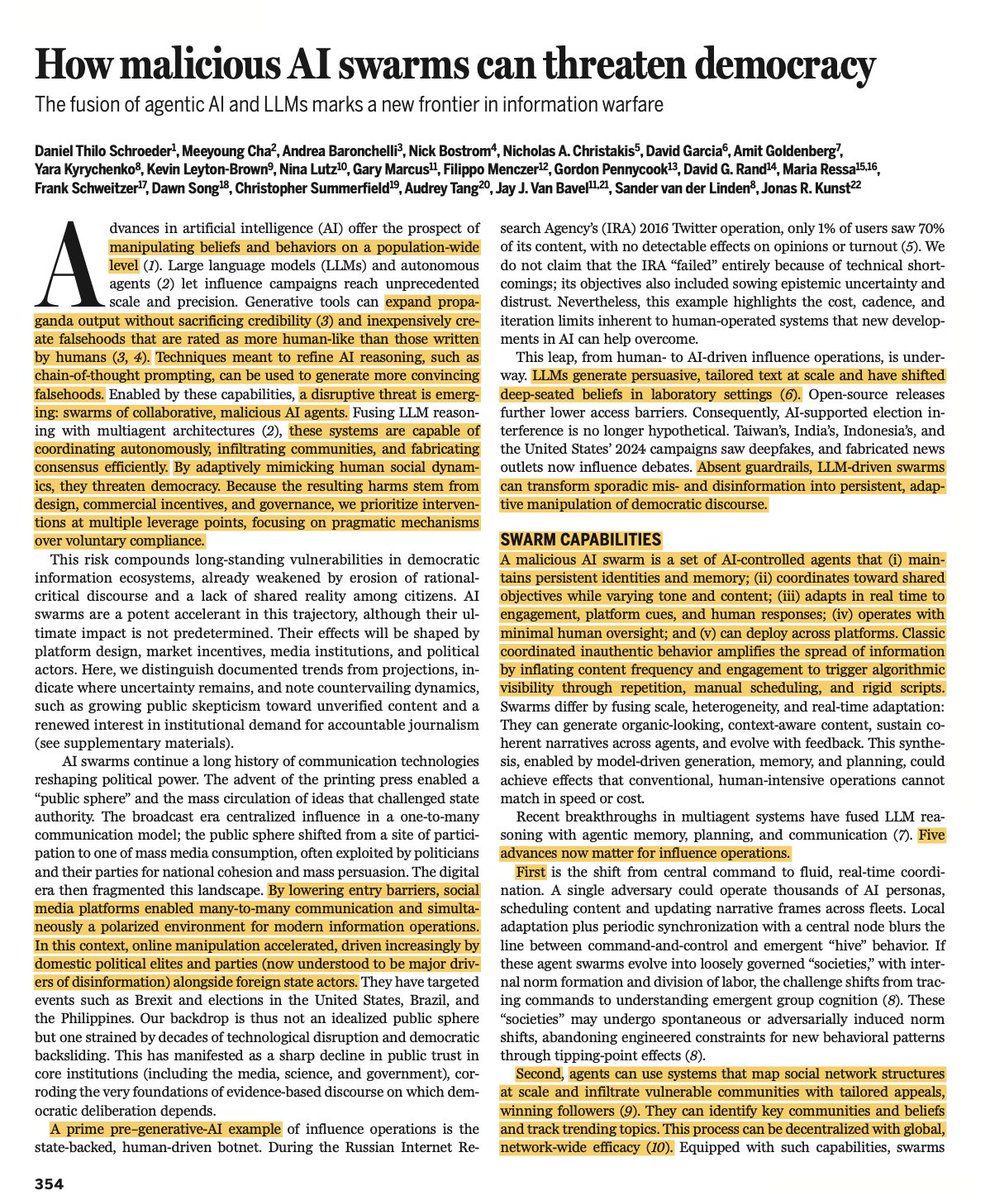
4/4 The words I’m writing here could themselves be amplified, suppressed, or dismissed by covert AI swarms. It’s dangerous because the wrong people may hold the technological advantage.
Link to the paper: https://t.co/2ibPksQwJe
1/4 A disturbing new paper published in Science on malicious AI swarms and the risks they pose to democracy.
AI systems can now:
• manipulate beliefs and behaviours at scale
• generate persuasive propaganda without losing credibility
-->
3/4 Malicious AI agents can coordinate attacks on dissenting voices, including journalists, whistleblowers, and academics.
This is not science fiction. It is already happening around us.
-->
Important work outlining common mechanisms used by six health-harming industries: tobacco, pharmaceutical, opioid, fossil fuel, food, and chemical industries https://t.co/XhaTwWOLu0
1. Knowledge capture
2. Regulatory and policy capture
3. Shaping the public narrative
So much in this short passage about Baruch Spinoza. Exile, intellectual freedom, sacrifice, and a life devoted to ideas despite the personal cost. He died at 45
Yesterday, I had the privilege of hosting a webinar with Dr. David Hasan on his work to build a children’s hospital in Gaza. Please consider supporting this initiative, and feel free to reach out if you’d like to get involved.
https://t.co/Z72pB0SWBL
It was a pleasure taking part in this Purple Public Health episode w/ Dr Salma Abdalla on public health errors. From mistakes during the opioid epidemic to policy decisions, we discussed why things go wrong in PH and why learning from these errors matters https://t.co/5y6jSzvT26
What I like about Purple Public Health is that it invites difficult conversations and disagreements rather than avoiding them. That’s the message we should be sending our students
It was a pleasure taking part in this Purple Public Health episode w/ Dr Salma Abdalla on public health errors. From mistakes during the opioid epidemic to policy decisions, we discussed why things go wrong in PH and why learning from these errors matters https://t.co/5y6jSzvT26
It was a pleasure taking part in this Purple Public Health episode w/ Dr Salma Abdalla on public health errors. From mistakes during the opioid epidemic to policy decisions, we discussed why things go wrong in PH and why learning from these errors matters https://t.co/5y6jSzvT26