@zachlloydtweets A tweet is not how you should be telling your customers you have been hacked and their data has potentially been leaked. The first I heard about potentially needing to rotate keys was four days later. Absolutely incredible you think this is an acceptable security policy.
Some research groups have great data. Some have great clinicians, or great methods, or a strong patient voice. It’s rare to find all of them in one team, inside one clinical service, working on the same questions. That’s what we’ve built in Edinburgh, and today it has a proper home: https://t.co/tgshCKkCni.
The people. Consultant gastroenterologists, research nurses, data scientists, laboratory scientists, PhD students and clinical and visiting fellows, embedded alongside the NHS Lothian IBD service, with patients as partners.
The data. The Lothian IBD Registry: more than 20 years of real-world records on about 10,000 people, now being linked through DataLoch. PREdiCCt: 2,629 people across 47 UK centres, with deep dietary, lifestyle, microbiome and biomarker data. Open-source tools such as landmaRk for dynamic risk prediction.
The record. 166 publications. Ten trials and studies recruiting now. Work that has mapped how inflammation behaves over time, shown that calprotectin predicts flares in people who feel well, and documented colectomy for ulcerative colitis in Lothian falling more than tenfold between 2004 and 2023.
The ideas. The graphic is where it starts. IBD is heterogeneous, dynamic, unpredictable and lifelong: four of the courses inflammation can take after diagnosis, from our trajectory research in Lothian and Denmark. Care should be built around the whole of that course, not single visits. That thinking runs through our four programmes, Longitude, Vantage, Continuum and Cairn, and into SENTINEL, our flagship platform for clinician-supervised, proactive care, now preparing for a feasibility study.
We call it writing the next decade of IBD care. If you’d like to be part of it, as a patient partner, a collaborator, a fellow or a supporter, the website is the place to start.
Take a look and let me know what you think: https://t.co/d7cVPeB9Vf @EdinUni_IGC
🚨I am excited to share our experience on dual targeted therapy using upadacitinib + risankizumab in refractory Crohn’s disease 💊📊
Recently published in JCC Plus: https://t.co/vJoSFn1ybI
🔥Adds real-world evidence to the emerging use of combination advanced therapies in IBD
20 years ago we started asking IBD patients in Edinburgh for a scoop of poo.
Sounds simple.
It was.
But it changed everything.
New Atomic IBD on the FC story — from triage to trajectories to what comes next with SENTINEL.
https://t.co/XkV3ePV0yd
* NEW PODCAST EPISODE *
What do the first PREdiCCt study results have to say about...
⭐️ Faecal calpro predicting future flares?
⭐️ How meat intake affects Crohn's vs UC patients?
⭐️ Women's reproductive hormones and #IBD symptoms?
🎧 Answers here! ➡️ https://t.co/DG19pI5Yzq
I had the pleasure of chatting with the fantastic @bottomlineibd and @Crohnoid about the clinical and dietary results of the PREdiCCt study on their patient podcast.
You can find it on all the main podcast apps under Wresting the Octopus.
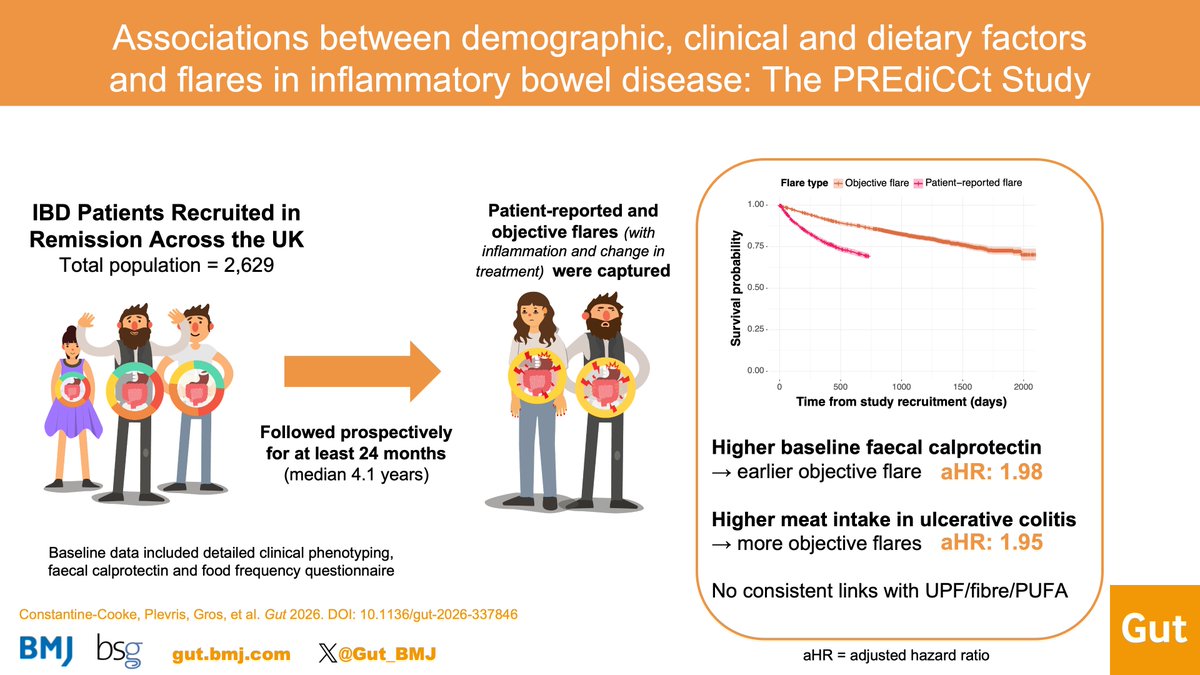
What can studying 2,629 #IBD patients in remission over 10 years reveal about predicting flares in Crohn's and UC?
In tomorrow's podcast episode, we chat with @IBDNathan about the first PREdiCCT study results and what they mean for patients.
Search "Wrestling the Octopus IBD".
What can (and cannot) predict flares in people with #IBD in remission❓
💡New insights from the PREdiCCt Study from @IBDNathan, @Bealoquebea, @charlie_lees & colleagues after following 2,629 people 🇬🇧 in self-reported remission for 4 years:
✅ Feeling well is not the same as being at low inflammatory risk
✅ Baseline faecal calprotectin was the strongest predictor of future flare
👉Even when symptoms are quiet, your flare risk increases if fecal calprotectin is within the 50–250 µg/g "grey zone" (also called subclinical inflammation)
✅ In ulcerative colitis, higher baseline meat consumption (red and white) was associated with a double risk of flare
✅ No consistent associations between flare risk and:
🍔🍦ultra-processed foods
🥦🍎dietary fibre
🐟🍣polyunsaturated fatty acids
🍺🍷alcohol intake
💡Altogether, these findings show the importance of monitoring fecal calprotectin (not symptoms) in order to know disease activity and not overlook diet as a driver of flare susceptibility.
📚Read the full research article in @Gut_BMJ: https://t.co/2SGozS3B7c
🔍Learn more about the PREdiCCt study: https://t.co/f7PqKOTkMT
We'll be shining a light on the PREdiCCt study in a forthcoming podcast episode!
@IBDNathan, one of the study authors (and an #IBD patient himself, to boot), will be joining Nigel and me later this week to discuss the results and what they mean for those of us with Crohn's & UC.
A study of this scale only happens because of the people behind the numbers. As we share the first results from PREdiCCt in @Gut_BMJ, it is vital to acknowledge the immense human effort that made this possible over the last decade.
Lisa Derr has been the brilliant engine room of this project. As our trial manager, she led the study with precision, making sure everything stayed on track and on budget across 49 different sites.
I want to extend my deepest thanks to every local Principal Investigator, every dedicated research nurse, and the administrative teams who worked tirelessly on the ground.
Most of all, we thank the 2,629 participants. Lisa and her team were in direct contact with many of you, sending out monthly questionnaires and answering your calls. Your commitment to this research is what will ultimately help us improve outcomes for everyone living with inflammatory bowel disease.
In this video, Lisa shares her perspective on what it takes to manage a national study and the highlights of working with such an incredible community.
@EdinUni_IGC
What really defines an IBD flare?
In the PREdiCCt study - published today in Gut - we explored the crucial disconnect between how a patient feels and what their biology says.
Nik Plevris, consultant gastroenterologist at the Edinburgh IBD unit, dives into our findings on patient-reported flares compared to objective flares.
We followed over 2,500 people for up to four years. The signal from baseline faecal calprotectin was undeniable across both Crohn's disease and UC. Even at levels currently considered a safe target, the risk of a future objective flare was significantly higher.
This data suggests we need to be more stringent with our monitoring targets to truly keep people in deep remission.
Watch the video to see how these different flare definitions impact our understanding of the disease.
One of the most common questions in any IBD clinic is: What should I eat?
Beatriz Gros, consultant gastroenterologist and researcher, shares the landmark dietary results from the PREdiCCt study, now published in Gut.
We studied the habitual diets of over 1,000 patients in remission for up to four years to find clear answers. While we found no consistent signals from fiber or ultra-processed foods, we identified a significant association between meat intake and flare risk in ulcerative colitis.
This research provides a much-needed evidence base to help clinicians and patients make informed choices about diet and long-term disease management.
Watch the video to learn more about how diet influences IBD flare risk.
The first PREdiCCt study paper is published tomorrow in #Gut! Watch our video on the study design with videos also forthcoming from Nikolas Plevris and Beatriz Gros describing key results.
Why do people with Crohn's and Colitis flare?
This is the fundamental question we set out to answer when we started the PREdiCCt study in 2016.
On Tuesday, the first major results will be published in @Gut_BMJ
We wanted to look beyond just the clinical data. We focused on the environment: diet, lifestyle, exercise, sleep, and stress. By combining these factors with the microbiome and genetics, we aimed to understand the true drivers of disease activity over time.
This has been a decade in the making.
We recruited 2,629 patients across 49 adult and pediatric sites before the pandemic halted recruitment in March 2020. Since then, our team has been busy assimilating years of follow up data. Most participants have now been followed for over four years.
In this video, I talk through the background and design of the study. It represents a massive collective effort from clinical trials units, statisticians, and project managers.
Most importantly, it represents the dedication of the people living with IBD who gave their time to this research. Our goal is to provide the evidence needed to help patients stay in deep remission and to help clinical teams provide better, more personalized care.
I look forward to sharing the findings with you this week.
@EdinUni_IGC@EdinburghUni@NHS_Lothian@IBDNathan@predicct@Bealoquebea @PlevrisN @UKRI_News