Allah has chosen everything that happened to you, and wrote everything that will happen to you.
No harm touches a believer, is it not sufficient to be a believer?
The only way you can be sure you are a believer is by studying Tawheed.
@N4w4fKholin@Chainless_Slave Bro, how do the people around see Sneako associating with people like Fuentes and haqiqatue and not yell at him.
Another great example of why one should spend time studying the deen before publicly speaking on matters relating to it.
(من حكم بكتابه الذي كتبه بيده)
The same new-age Madākhilah who thought Al-Qāsim bin Sallām discussed “man-made laws,” in his book (hint: he doesn’t), have come with a new entry into their continuously growing wall of laughable displays of ignorance, only this time they’re charging money for it.
These new-age Madkhalis have to be some of the most low IQ, intellectually deprived individuals in the history of the movement, which is saying something. In their pathetic and desperate attempts to try and prove that the Salaf dealt with man-made laws and that they were aware of it and still called it “Kufran Duna Kufr,” they are now championing this narration to finally “solidify their case”:
عن عبدِ الرحمنِ بنِ زيدِ بنِ أسلمَ في قوله تعالى:
(وَمَن لَمْ يَحْكُم بِمَآ أَنزَلَ ٱللَّهُ فأولئك هُمُ الْكَافِرُونَ)
قال: من حكم بكتابه الذي كتبه بيده، وترك كتاب الله، وزعم أن كتابه هذا من عند اللّٰه فقد كفر.
From 'Abd al-Rahman ibn Zayd ibn Aslam, regarding Allah's saying:
(And whoever does not judge by what Allah has revealed, then they are the disbelievers among you.)
He said: Whoever judges by the letter he wrote with his own hand, and abandons Allah's book, and claims that his letter (i.e., his judgement) is from Allah, then he has disbelieved.
This narration only reaffirms the position of the Muslims, in that individual judgements made by a Qadi are not Kufr Akbar as a default, and instead require additional conditions to reach the level of Kufr Akbar. The feeble Madkhali mind, just as they were wound up when they saw the word شرائعهم in the book of Al-Qāssim bin Sallām, they too got wound up when they saw the words من حكم بكتابه الذي كتبه بيده, thinking this refers to man made laws. This Kitāb which is being referenced is not referring to man-made laws, it’s the judgement of the Qadi that he writes down and passes it along to be enforced. In Ar-Rawḍ al-Murbiʿ bi-Sharḥ Zād al-Mustaqniʿ, under the Chapter titled The Judge’s Letter to a Judge:
(وَيُقْبَلُ) كتابُ القاضي (فِيمَا حَكَمَ بِهِ) الكاتبُ (لِيُنَفِّذَهُ) المكتوبُ إليه، (وَإِنْ كَانَ) كلٌّ منهما (فِي بَلَدٍ وَاحِدٍ)؛ لأنَّ حُكْمَ الحاكمِ يجبُ إمضاؤه على كلِّ حالٍ.
(And it is accepted) the letter of the judge (in what he has judged) — the writer [i.e., the sending judge] — (so that he may execute it) — the recipient — (even if) each of them (in the same city); because the ruling of a judge must be carried out in every circumstance.
Their entire premise of the Salaf being aware of man-made laws is built on this phantom hallucination of an interpretation, that even the most ignorant of Madkhali scholars wouldn’t dare make (due to the impending mockery of their ignorance which would undoubtedly ensue). Yet in their devilish attempts to solidify the thrones of the Tawagheet, they would rather make up their own definitions (keep in mind these kids can’t even read Arabic properly), than accept that Tashree’ is Right of Allah Alone, and anyone who shirks him in this Right, is a Mushrik.
نسأل الله السلامة والعافية
Oh son of Adam, upon you is best day of the year, do not allow shaytaan to distract you!
Call upon your lord, who created you, granted you life, sustains you, and to whom you will return to,
Seek forgiveness, ask Allah to save your neck from the fire, and have certainty.
The last hour on the day of Friday is a blessed time, and especially during these appointed days.
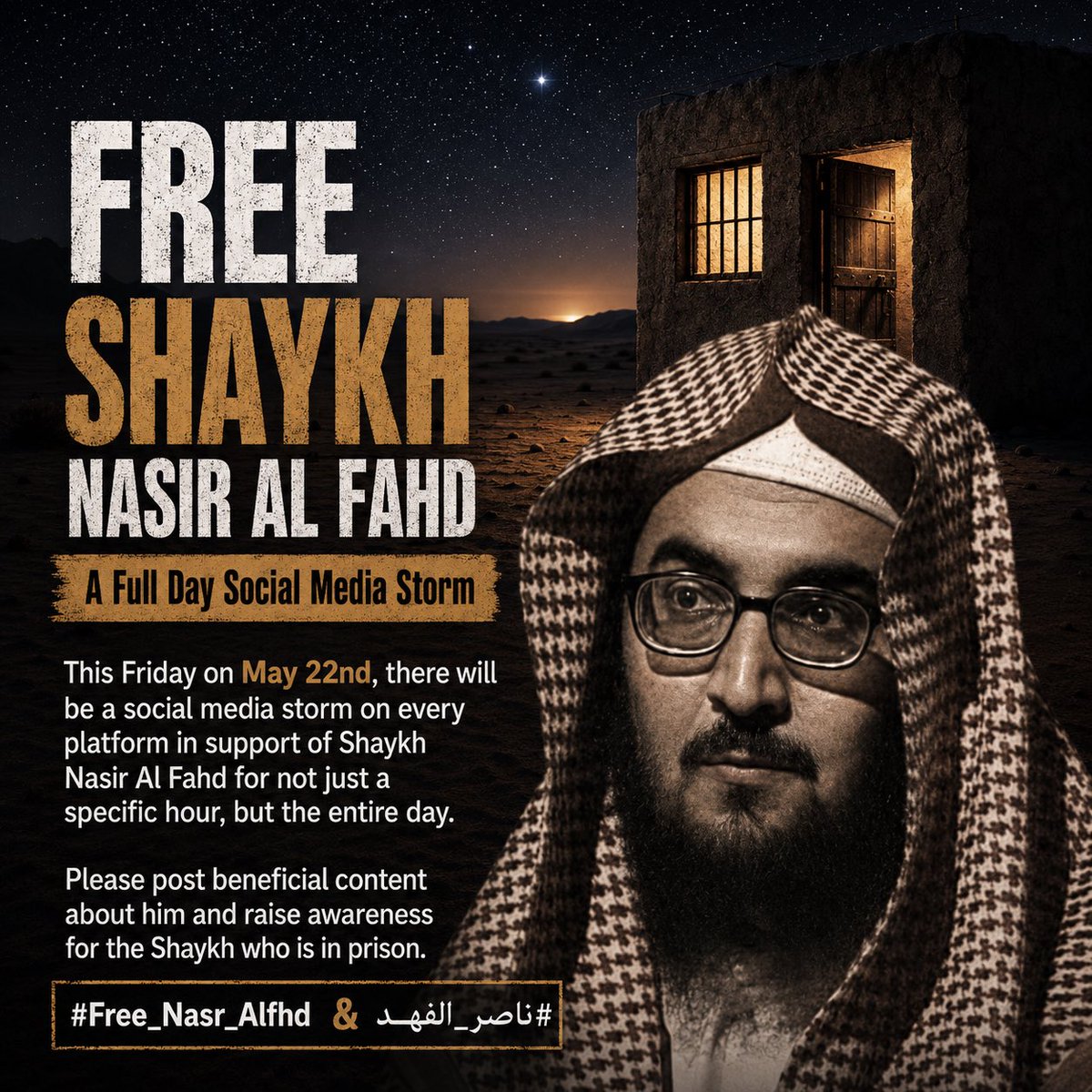
Do not be slow to make dua for all the scholars who are wrongfully imprisoned, and especially sheikh Nasr Al Fahd, May Allah free him with honour
#free_nasr_alfhd#ناصر_الفهد
#free_nasr_alfhd#ناصر_الفهد
I often find myself remembering the special Shuyūkh whom I loved for the sake of Allah, never letting a single day pass without making duʿāʾ for them repeatedly throughout the day. Foremost among those I mention after my parents is ḥabīb al-qalb, al-Shaykh al-Imām Nāṣir al-Fahd — فكَّ اللهُ بالعزِّ أسره.
I reminisce about the days of daʿwah we spent together, recalling the statement of Imām Aḥmad — may Allah have mercy on him — “إذا مات أصدقاء الرجل ذلّ” — “When a man’s friends die, he becomes humbled.” At times, I find myself extending its meaning in my heart: when a man’s friends die or are imprisoned, he becomes humbled.
Over the years, I often longed to read those letters again, though I had assumed they had all been confiscated during repeated raids in which digital devices, papers, and entire collections of belongings were seized. In many of those raids, they would even leaf through every book in my library, leaving the shelves emptied and the volumes scattered across the floor.
Weeks ago, however, I was overwhelmed with joy to discover that I had once printed one of his letters and used it as a bookmark in a notebook.
The Shaykh — فكَّ اللهُ بالعزِّ أسره — went out of his way to send me several letters from prison, written with ink made from a mixture of coffee and water, and a straw used as a pen. The first of those letters was the one attached here, sent after he learned of my release from prison. It contained words of encouragement and support the like of which, at that time, I had heard from no one outside my own family. For that alone, apart from his many other favors, I don't believe I could ever make enough duʿāʾ for him.
Having no close companion besides my father — may Allah grant him a long life filled with righteous deeds — I often find comfort in the companionship of Shaykh Nāṣir — فكَّ اللهُ بالعزِّ أسره — by returning to his books during quiet moments. I keep them within arm’s reach wherever I sit; they bring solace to my heart, and I never tire of reading them.
Rediscovering this letter brought even greater comfort, especially at a time like this.
May Allah keep him and his brothers steadfast upon the ḥaqq, hasten their release with honour, and grant us the joy of seeing them as imams leading this ummah sooner rather than later.
May Allah humiliate those who imprisoned them and those who rejoice in their imprisonment and oppression, and reunite us with them in al-Firdaws.
Ahmad Musa Jibril
4 Dhul-Ḥijjah 1447 AH
✍️**A Letter from Shaykh Nāṣir — فكَّ اللهُ بالعزِّ أسره —**
From Nasser bin Hamad Al-Fahd to the two noble brothers and virtuous Shaykhs, Musa bin Jibril and his son Ahmad, may Allah protect them from every evil and grant them success in every good. Amin.
Salāmun ʿalaykum wa raḥmatullāhi wa barakātuh. To proceed:
Indeed, I praise Allah to you, the One besides whom there is no deity, and I ask Him, Glorified be He, that this letter reaches you while you are in goodness and well-being. News of you reached me through (******) — may Allah grant him success — and I was pleased with the state you are now upon [i.e., the da‘wah you are engaged in], and praise belongs to Allah.
Whatever has befallen you of trials is the path of the prophets and the righteous reformers.
I ask Allah, Glorified be He, to make what has afflicted you an elevation in your ranks and an expiation for your sins, and to make us and you steadfast upon the firm word in this worldly life and the Hereafter.
And I give you glad tidings that we, along with all the brothers in the prisons, are in a tremendous blessing that reminds us of the statement of Shaykh al-Islam — may Allah have mercy on him — during his final imprisonment in the Citadel: “If I were given the equivalent of this Citadel filled with gold, it would not equal for me the gratitude I owe for this blessing.”
Convey my greetings to all the brothers with you, and may Allah preserve you.
Peace be upon you, and the mercy and blessings of Allah.
Al-Ha’ir Prison,
20 Rabīʿ al-Thānī 1434 AH
🚨 𝗡𝗘𝗪: Two weeks ahead of Italy's crucial World Cup qualifier against Israel, the ICA (Italian Coaches Assocation) has written a formal letter, urging FIFA and UEFA to SUSPEND Isräel from all International competitions due their war crimes. They write:
"The board unanimously agrees, due to the daily bloodbaths which is costing the lives of hundreds of footballers and managers, that it's legitimate, even a DUTY, to suspend Israel."
"We could look away, we could focus on our games, but this wouldn't be right. The world is on fire. Many Palestinians are suffering, this is unacceptable."
Allahuma, you are over all things powerful, to you belongs the east and the west, you are the one who created us, and sustains us,
Allahuma, free the scholar, Ash-Sheikh Nasir Al Fahd, with honour, you are over all things capable
#Free_Nasr_Alfhd#ناصر_الفهد
Allahu Akbar! Walhamdulillahil lathee bi ni'matihi tatimmus saalihaat!
Every Muslim feels immense joy upon the overthrow of any Tāghūt, even if the change is led by another Tāghūt.
Ibn Kathīr stated that Allah deals with the oppressors by allowing some to dominate others, bringing about the destruction of some through others, and taking vengeance upon them through each other, as recompense for their injustice and transgressions.
This joy is particularly pronounced when witnessing the release of innocent Muslim prisoners, especially our sisters, and the restoration of rights to individuals, including their homes, lands, and cities. However, our deepest joy is found only when the pure Sharī’ah of Allah is fully implemented across the territories.
The retreat of the enemy from a town and the fall of its Tāghūt is not considered a Shar’ī “liberation” until the country is governed by the Laws of Allah and the secular laws that have hindered the implementation of these Divine Laws are eliminated.
Replacing a rusted Tāghūt with a polished Tāghūt who doesn't implement the pure Sharī’ah of Allah cannot be considered “liberation” or “freedom”. Rather, it's merely a repetition of oppression and a reproduction of Tughyān.
Liberating territories in the name of "freedom" may lead to some vanishing worldly benefits, whereas liberating lands to establish Sharī’ah is the goal that will grant one a Jannah more expansive than both heaven and earth.
Today, we express our gratitude to Allah for allowing us to witness the decline of one of the most prominent oppressors of our time. We pray that Allah fills our hearts with joy as we observe the demise of the remaining tyrants, enabling us to live under the shade of Tawheed in those areas, under the governance of the pure righteous Muwahideen.
_______________
Ahmad Musa Jibril
Jmd. II 6, 1446 AH








![sh_Ahmad_Jibril's tweet photo. #free_nasr_alfhd
#ناصر_الفهد
I often find myself remembering the special Shuyūkh whom I loved for the sake of Allah, never letting a single day pass without making duʿāʾ for them repeatedly throughout the day. Foremost among those I mention after my parents is ḥabīb al-qalb, al-Shaykh al-Imām Nāṣir al-Fahd — فكَّ اللهُ بالعزِّ أسره.
I reminisce about the days of daʿwah we spent together, recalling the statement of Imām Aḥmad — may Allah have mercy on him — “إذا مات أصدقاء الرجل ذلّ” — “When a man’s friends die, he becomes humbled.” At times, I find myself extending its meaning in my heart: when a man’s friends die or are imprisoned, he becomes humbled.
Over the years, I often longed to read those letters again, though I had assumed they had all been confiscated during repeated raids in which digital devices, papers, and entire collections of belongings were seized. In many of those raids, they would even leaf through every book in my library, leaving the shelves emptied and the volumes scattered across the floor.
Weeks ago, however, I was overwhelmed with joy to discover that I had once printed one of his letters and used it as a bookmark in a notebook.
The Shaykh — فكَّ اللهُ بالعزِّ أسره — went out of his way to send me several letters from prison, written with ink made from a mixture of coffee and water, and a straw used as a pen. The first of those letters was the one attached here, sent after he learned of my release from prison. It contained words of encouragement and support the like of which, at that time, I had heard from no one outside my own family. For that alone, apart from his many other favors, I don't believe I could ever make enough duʿāʾ for him.
Having no close companion besides my father — may Allah grant him a long life filled with righteous deeds — I often find comfort in the companionship of Shaykh Nāṣir — فكَّ اللهُ بالعزِّ أسره — by returning to his books during quiet moments. I keep them within arm’s reach wherever I sit; they bring solace to my heart, and I never tire of reading them.
Rediscovering this letter brought even greater comfort, especially at a time like this.
May Allah keep him and his brothers steadfast upon the ḥaqq, hasten their release with honour, and grant us the joy of seeing them as imams leading this ummah sooner rather than later.
May Allah humiliate those who imprisoned them and those who rejoice in their imprisonment and oppression, and reunite us with them in al-Firdaws.
Ahmad Musa Jibril
4 Dhul-Ḥijjah 1447 AH
✍️**A Letter from Shaykh Nāṣir — فكَّ اللهُ بالعزِّ أسره —**
From Nasser bin Hamad Al-Fahd to the two noble brothers and virtuous Shaykhs, Musa bin Jibril and his son Ahmad, may Allah protect them from every evil and grant them success in every good. Amin.
Salāmun ʿalaykum wa raḥmatullāhi wa barakātuh. To proceed:
Indeed, I praise Allah to you, the One besides whom there is no deity, and I ask Him, Glorified be He, that this letter reaches you while you are in goodness and well-being. News of you reached me through (******) — may Allah grant him success — and I was pleased with the state you are now upon [i.e., the da‘wah you are engaged in], and praise belongs to Allah.
Whatever has befallen you of trials is the path of the prophets and the righteous reformers.
I ask Allah, Glorified be He, to make what has afflicted you an elevation in your ranks and an expiation for your sins, and to make us and you steadfast upon the firm word in this worldly life and the Hereafter.
And I give you glad tidings that we, along with all the brothers in the prisons, are in a tremendous blessing that reminds us of the statement of Shaykh al-Islam — may Allah have mercy on him — during his final imprisonment in the Citadel: “If I were given the equivalent of this Citadel filled with gold, it would not equal for me the gratitude I owe for this blessing.”
Convey my greetings to all the brothers with you, and may Allah preserve you.
Peace be upon you, and the mercy and blessings of Allah.
Al-Ha’ir Prison,
20 Rabīʿ al-Thānī 1434 AH](https://pbs.twimg.com/media/HI5CoiKWcAAJH-a.jpg)