⚡️This is a mirror of something far darker in the modern human condition.
We’ve built a civilization that feeds on attention, devotion, and time - not just at work, but everywhere. Corporations are simply the most honest expression of that logic. They don’t pretend to love you; they only pretend to value you while you’re useful. And yet most people willingly give them everything - their best years, their health, their loyalty - because deep down, they want to belong to something that feels bigger than themselves.
But here’s the quiet truth no one wants to face:
For most people, work has replaced religion as the organizing myth of meaning.
It gives structure, community, purpose, identity - until it doesn’t. And when it collapses, it feels like an existential death because the illusion of significance was the only thing holding their reality together.
This is the hidden violence of modernity: we’ve traded gods for brands, and temples for offices. And we tell ourselves it’s “professionalism” when in reality, it’s servitude dressed in polite language. The person in that post is realizing that the story they built their life around was fiction. That they were a replaceable variable in a system pretending to be a family.
Here’s the real scarv of it all: the system isn’t evil.
It’s empty.
It’s not malevolence; it’s indifference.
That’s why it hurts so much: you want someone to blame, but there’s no one there. Just structure. Process. KPIs. The machine doesn’t hate you, it simply doesn’t see you.
And once you realize that, you can’t go back. You start to see how everything runs on the same logic - politics, media, even relationships shaped by algorithmic convenience. The world has become a marketplace of attention, and anything that can’t be monetized gets ignored. Including your soul.
So the real lesson isn’t “never sacrifice for work.”
It’s never surrender your life force to a system incapable of love.
If you must serve something, let it be your own creation, your own mission, your own myth - something that gives back what it takes.
Because every system will use you.
But only your own purpose can see you.
From this post:
-BGB down 6%
-HYPE up 240%%
-Bitget gets exploited for millions
-Bitget got millions of outflows
-HLP up several millions
-Hyperliquid got $2.2B of inflows
Thank you Gracy for your bottom signal, your sacrifice was indeed helpful
If I had $3M in crypto now, I would:
1. Be full-time crypto. No job.
2. Never mention crypto IRL. Zero upside.
3. Base myself in a low-tax jurisdiction.
4. No memecoins, no leverage. Ever.
5. No cars, no watches. Keep this shit when hitting a big win.
6. Park $1M stables in DeFi (8–9% via USDT Plasma Vault) to cover expenses.
7. Split $1M between IBKR + HL to farm @tradexyz + @unitxyz + @HyperliquidX
8. Deploy $500k stables into higher-risk farms (USDai, Daylight, etc).
9. Bet $500k on $HYPE. If crypto rips, it outperforms. If it rugs, still $2.5M left.
I’ve seen countless people make millions… then lose it all.
This is how you actually grow it.
Incase you're too slow to realize, this is a true 0 to 1 moment for Global Finance.
There is no other venue in the world where you can trade equities onchain, on a CLOB, permissionlessly, 24/7. This is the only relevant equity market in the world open through the weekend.
There are hundreds of millions of households around the world that would like access to equities but cannot, and this will be the only way they can get exposure.
Given that this is included in the native front end, we should see a massive rerating of both buy backs and fees over the rest of the year.
I've rebought back all my exposure. I suggest you do the same.
I went through this exact journey myself.
After 13 years climbing the ladder at hedge funds in NYC and ultimately reaching my goal of becoming a portfolio manager, I had a major internal crisis. I had the analytical capabilities to do the job, but my nervous system wasn't wired in a way that aligned with navigating the volatility of the marketplace (and workforce) while also finding internal peace & joy. I worked with a coach, and he asked me "is this what you want to be doing at 50?". I was burned out and no longer found meaning in seeking to generate 300bps of alpha for institutional LPs - the answer was obvious. I knew I needed a change.
I decided to move my family from NYC to Scottsdale, and downshift & reorient my career, while also meaningfully restructuring my personal cost structure.
I thought the peace and joy would flow immediately upon the move...remove the stressor and joy arrives, right? Right?!
WELL, for really the first time in my life, this gray feeling of depression crept in, and it surprised me.
In NYC I was special. I had status, I had an identify. The first thing people ask at a cocktail party in Tribeca is "what do you do?". With pride, I responded "I'm a PM at Citadel". Brokers rolled out the red carpet and "friends" emerged given your perch and your ability to help them. I was infected with mimetic desire and I moved into a beautiful apartment building and was neighbors with Leonardo DiCaprio and Tyra Banks. And it was fun, it was thrilling.
Then, all of a sudden I didn't have that. I was a failed "semi-retired" PM. I looked around me, and I didn't feel special...I felt, for the first time in my life, average. I lived in an average house, drove an average car, and lived an average lifestyle. And it hit me harder than I thought it would.
And I went through it. I struggled for a solid 18 months. I went through the letting go of my ego, the letting go of the identity that I had been so carefully crafting for nearly 20 years.
What did I learn along the way?
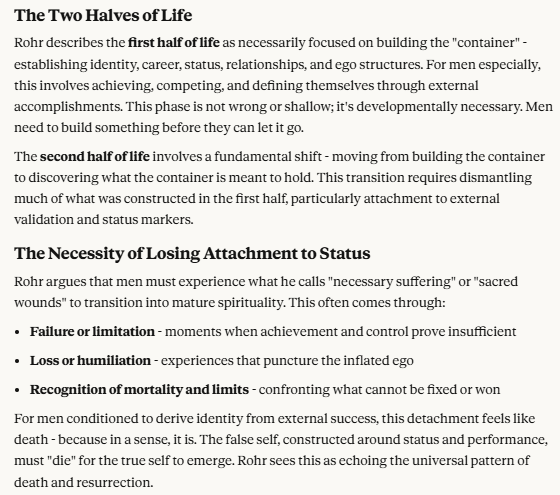
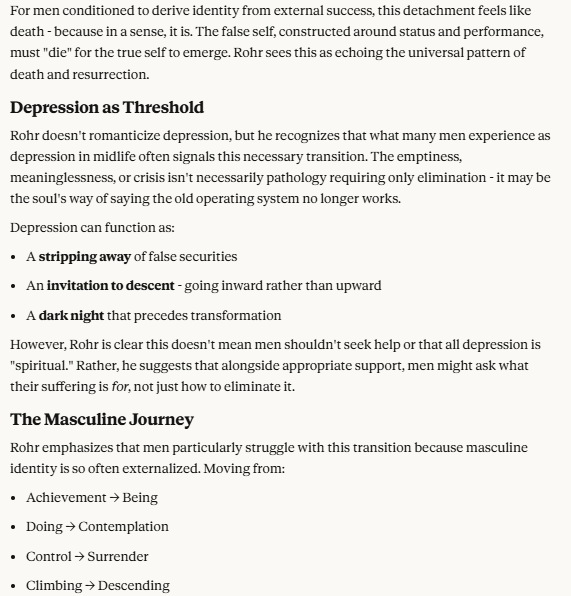
I learned that depression is a feature, not a bug. A period of depression, when associated with the letting go of identity, is actually a well-established threshold in the archetypal evolution of male spirituality.
The journey for me kicked off a transition towards a much deeper exploration of the true meaning of life, which I believe is a deeply personal question. For me, this transition point marked a transition towards inner growth as a primary metric of success. Who I can become.
In exploration, I learned that what I was going through was far from unique, but was actually a well-established transition point in a well-lived life.
I stumbled upon Richard Rohr's wonderful book, Falling Upward, and it seemed to explain this journey in wonderful precision.
How the loss of attachment to status and identity is actually a wonderful gift!
I have established this framework as a core part of my personal philosophy of life. And, with some distance from the gray, now look at that period of my life as a wonderful gift. A necessary letting go and reorientation towards more true and more enduring sources of peace, joy & meaning.
So, if you are feeling depressed at the loss of identity. Keep going. It's a sign you are on the right track.
A common misconception is that crypto is too expensive for new people.
You don’t need to buy a full Bitcoin or ETH to get started. You can start buying and holding $HYPE - a future $800 asset with just 40 dollars.
It’s never too late.
when i started building echo 2 years ago, i knew it had 95% chance of failing. to be honest, i couldnt really imagine any other outcome, but i thought at least it may be a noble failure worth attempting.
i certainly didn't think echo would be sold to coinbase, but, here we are: today coinbase bought echo for ~$375m.
echo will remain a standalone platform under its current brand for now, but we will integrate sonar's public sale product into coinbase, and likely introduce new ways for founders to access investors, and for investors to access opportunities into coinbase itself.
over the years i have chatted to brian a handful of times, and mostly to complain at him honestly. i have always respected how brian would listen to an outsider chat shit at him on the phone and take the feedback seriously. now, instead of complaining, i will have the opportunity try to do the work to make things better.
crypto itself has moved on a long way since we started working on echo. i guess partially this is because of the election result. but, i feel energised by a lot of the cool things being built in crypto again: hyperliquid, zcash, stablecoin supercyle, and so on.
feels like a good time to be on the field instead of an idiot with a twitter account yapping nonsense. well, i guess i still will be that.
anyway, job's not finished. onwards.
oh fuck yeah, before i go, the final season of up only (now "unc only" due to our severe old age) will commence when we figure out who the guests should be lol
cobber
When ppl claim this I always wonder how they think it happens, or have unrealistic expectations on how much $1bn actually is.
I joined crypto with $200. If I held my initial bitcoin since then and never traded, I would have ~$300k.
If, instead, from that moment I sold the top and bought the bottom of every crypto cycle on Bitcoin, and never paid any taxes, I would have ~$6m USD.
If I put my entire net worth into the Ethereum ICO and never touched it, today I would have ~$150m pre-tax.
While it was definitely possible to have made >$1bn with the opportunities in the market, these versions of reality would also require me to make no mistakes, and have no need to spend $ in real life, or take excessive risk via leverage.
In reality, I grew up in a working class family. I didn’t have a trust fund and I had to pay off my student loan myself. I had a job at Tescos while at high school. After university, I needed to pay rent and fund cost of living and eventually buy a place to live.
I worked at startups for relatively little $ salary, and while a couple have done okay, they still are illiquid and worth nothing until some exit.
Perhaps if I erase a couple of dumb mistakes and drawdowns, or if I had a lil more grind, then my answer would be different today. But it is easy to say this with perfect hindsight vision. It’s easy to see where you could have optimised better, and decisions you made look dumb when the past makes things so obvious.
The truth is I have always optimised for enjoying my life and not going to 0. I never felt like I had a safety net, so it was never possible for me to do anything in any other way. I would probably have less money if I had tried to add more risk or chased $ harder, because being all-in with your entire livelihood is a mental battle and I feel I only win that battle when the stakes are lower.
In writing this, maybe I do understand why CT folks believe this, because modern CT sees crypto as a late-stage lottery ticket farm, where the optimal strategy is to 5x leverage up your portfolio in a hope of catching a good 20% move and then leaving. Or, literally going all-in on the next coin they heard Ansem is buying. So perhaps to them, looking back at the charts, of course that’s what successful folks did.
In reality, I use leverage close to never (and typically to reduce risk rather than add risk — have used it to add risk maybe 3 times in the last 5 years, and maybe 15 times ever). I never go all-in on anything, have only ever done that on BTC and ETH before in the last decade. When I buy other things, I limit risk to tiny amounts, because I treat it as a 0 until proven otherwise (so, always <1% liquid portfolio). Liquid portfolio is also a smaller % of overall portfolio to future-proof against my own fuckups.
Obviously I made a lot of money, I have been here 12 years! CT doesn’t want to hear about “getting rich in a decade” though. I am happy with where I am and have never really cared or optimised for maximising $ earnings, but instead having a nice life that lets me enjoy the game we play together.
Debunking the FUD that Hyperliquid prioritizes protocol revenue over traders
On 10/10, Hyperliquid ADLs net made users hundreds of millions of dollars by closing profitable short positions at favorable prices. If more positions had been backstop liquidated, HLP could have made hundreds of millions of dollars more in pnl, while being exposed to an irresponsible amount of risk. ADL passed on HLP's potential pnl to users while decreasing HLP's exposure, a win-win.
As a reminder the ADL queue on Hyperliqid has always followed a similar formula to what most CEXs use, incorporating both leverage used and unrealized pnl on the open position.
Finally, thanks to everyone for the feedback on ADL. Suggestions generally increase complexity, such as partially offsetting long and short positions in historically correlated assets. I don't know of other major venues that use more complex logic for the ADL queue. Simple formulas are more robust and understandable by users. Nonetheless, there is research being done on whether there can be substantial improvements that merit more complexity.
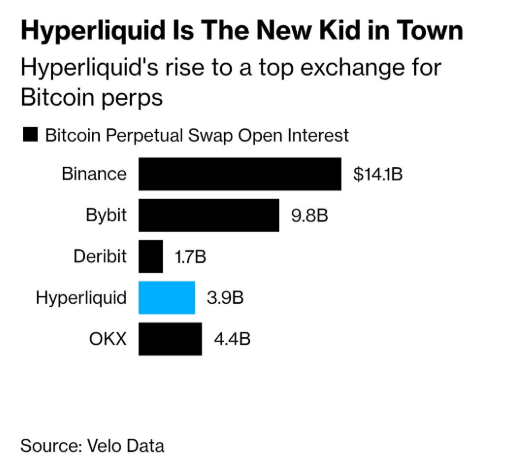
Here's are the key points in the Hyperliquid Bloomberg article.
1. Jump trading president Dave Olsen said Hyperliquid is "the first meaningful competitor to Binance".
2. HLP fixed the chicken and egg problem by providing liquidity early on, now less needed.
3. Hyperliquid's foundation currently controls more than 2/3'rds of stake, allowing it to step in during situations like JELLY JELLY
4. Platforms like dydx and GMX relied on token incentives to attrack liquidity, but this is a fragile model after rewards run dry.
5. The assistance fund conducts buybacks using platform fees, holding 1.4 billion in assets.
6. Hyperliquid is like Coinbase as it's an exchange, like ETH as it's a layer 1 blockchain.
7. HIP-3 lets anyone build markets themselves
8. Hyperliquid Labs said in comments to the US commodity futures commission that its perpetuals meet and in some instances surpass safeguards US regulators want in trad markets.
major narrative violation:
hyperliquid ADL actually INCREASED PnL for the vast majority of shorts last week
many ppl are sour that ADL closed shorts right before prices nuked. but the data reveals that most ADL hit near the price bottom, locking in near-optimal profits
@star_okx just a reminder that star knows cz better than almost anyone considering he used to work for star as the okx cto before being asked to leave following some controversy.
https://t.co/zUcYnQTEtu