HOW TO BUILD API VERSIONING STRATEGIES
→ API versioning is the practice of managing changes to an API without unexpectedly breaking existing applications and integrations.
WHY API VERSIONING MATTERS
→ Prevents breaking existing clients
→ Supports continuous API improvements
→ Maintains backward compatibility
→ Allows gradual migration to new versions
→ Simplifies long-term API maintenance
→ Gives developers control over API upgrades
UNDERSTAND WHEN TO VERSION
→ Not every API change requires a new version.
→ Breaking changes:
→ Removing existing endpoints
→ Renaming response fields
→ Changing data types
→ Modifying required request parameters
→ Changing authentication requirements
→ Non-breaking changes:
→ Adding optional fields
→ Adding new endpoints
→ Introducing optional query parameters
→ Improving internal performance
CHOOSE A VERSIONING STRATEGY
→ URL PATH VERSIONING
→ Include the version directly in the endpoint URL.
→ Example:
→ /api/v1/users
→ /api/v2/users
→ Easy to understand, document, and maintain.
→ HEADER VERSIONING
→ Specify the API version through an HTTP request header.
→ Example:
→ Accept: application/vnd.company.v2+json
→ Keeps URLs clean while allowing different API versions.
→ QUERY PARAMETER VERSIONING
→ Pass the version as a query parameter.
→ Example:
→ /api/users?version=2
→ Simple to implement but can make URLs less consistent.
→ CONTENT NEGOTIATION
→ Use HTTP content negotiation to select different representations or API versions.
→ Example:
→ Accept: application/vnd.company.user-v2+json
→ Useful when clients need to request specific representations.
DESIGN BACKWARD COMPATIBILITY
→ Keep existing endpoints working whenever possible.
→ Avoid removing fields unexpectedly
→ Preserve existing response structures
→ Maintain established request formats
→ Introduce optional fields instead of required ones
→ Support older clients during migration
MANAGE MULTIPLE API VERSIONS
→ Run different API versions when necessary.
→ /api/v1/users → Legacy clients
→ /api/v2/users → Updated clients
→ /api/v3/users → New integrations
→ Route requests to the correct version and maintain consistent behavior within each version.
CREATE A DEPRECATION POLICY
→ Communicate when an API version will be retired.
→ Announce deprecated endpoints
→ Publish migration documentation
→ Notify affected developers
→ Provide a migration timeline
→ Monitor usage of old versions
→ Retire versions after the announced support period
DOCUMENT API CHANGES
→ Maintain clear documentation for every version.
→ Available endpoints
→ Request and response schemas
→ Authentication requirements
→ Breaking changes
→ Migration instructions
→ Deprecation dates
→ Tools: OpenAPI and Swagger.
TEST API VERSION COMPATIBILITY
→ Verify that existing clients continue working.
→ Unit testing
→ Integration testing
→ Contract testing
→ Regression testing
→ Automated API testing
→ Test old and new versions before deployment.
MONITOR API VERSION USAGE
→ Track how clients use different versions.
→ Requests per version
→ Error rates
→ Response times
→ Active clients
→ Deprecated endpoint usage
→ Use monitoring data to determine when old versions can safely be retired.
EXAMPLE API VERSIONING LIFECYCLE
→ Release API v1
→ Introduce breaking improvements
→ Release API v2
→ Maintain v1 and v2 simultaneously
→ Announce v1 deprecation
→ Give clients time to migrate
→ Monitor v1 usage
→ Retire v1
API VERSIONING BEST PRACTICES
→ Choose one consistent versioning strategy
→ Version only when necessary
→ Avoid unnecessary breaking changes
→ Maintain backward compatibility
→ Document every major change
→ Communicate deprecation timelines
→ Automate compatibility testing
→ Monitor usage before retiring versions
→ Never remove an actively used version without a migration plan
THE GOLDEN RULE
→ API versioning is not just about changing URLs.
→ It is about evolving your API without disrupting the applications that depend on it.
→ Design → Version → Document → Test → Release → Monitor → Deprecate → Retire
Grab the complete API Design Handbook:
https://t.co/t2KOeauy6O
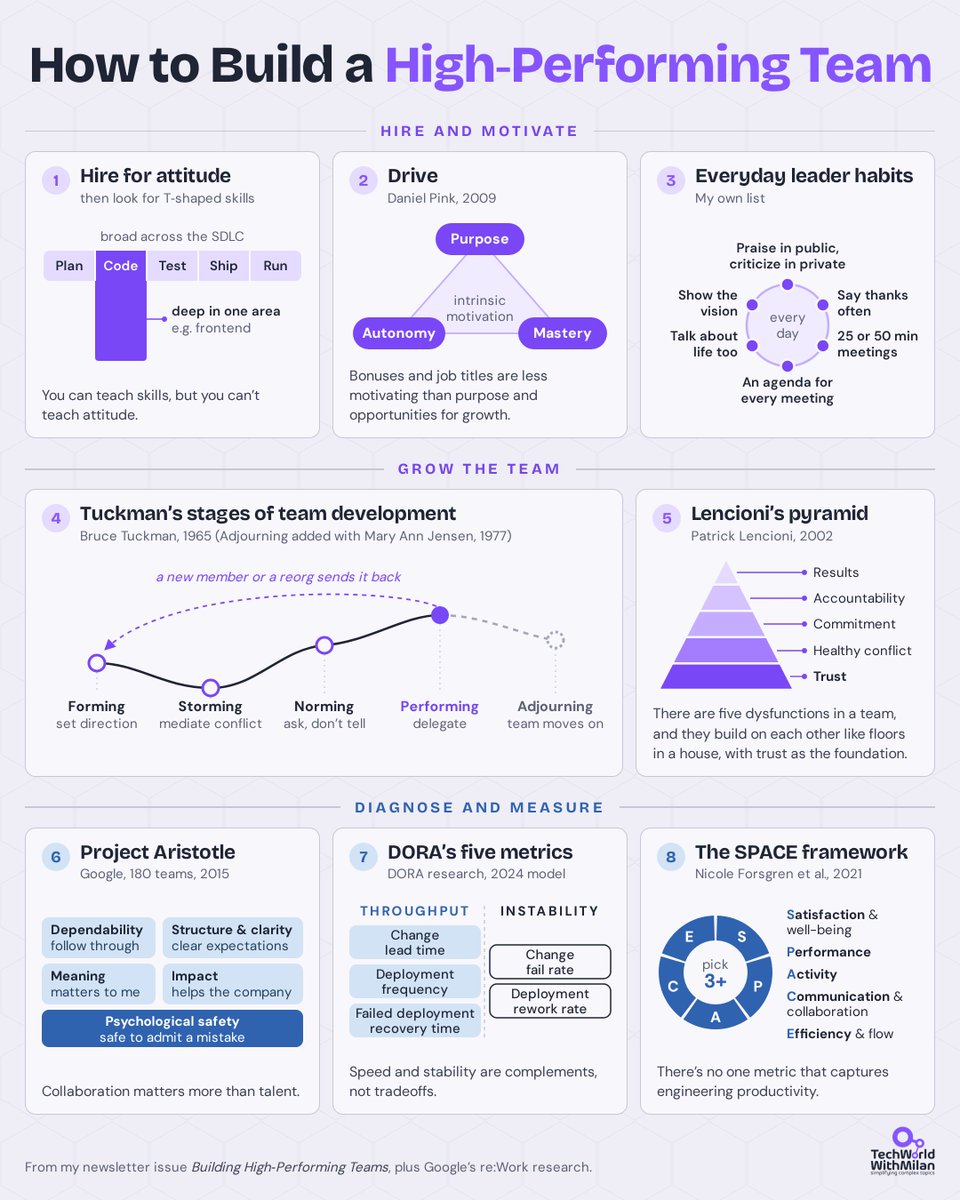
𝗛𝗼𝘄 𝘁𝗼 𝗯𝘂𝗶𝗹𝗱 𝗵𝗶𝗴𝗵-𝗽𝗲𝗿𝗳𝗼𝗿𝗺𝗶𝗻𝗴 𝘁𝗲𝗮𝗺𝘀?
We are all working in teams and our daily work and the results depend very much on the internal happiness of the teams. As the team is happier, they will be more productive and stay more in your company. But, how to build such teams?
The first step in building a great team is building 𝘁𝗿𝘂𝘀𝘁 inside. And this is important because we want to build psychological safety where people will not fear failure and be encouraged to experiment. Such teams need autonomy for their software engineers. To do this, we need to build a such culture in our company.
One way how we can build a culture where success is not the only rewarding factor, but 𝗲𝘅𝗽𝗲𝗿𝗶𝗺𝗲𝗻𝘁𝗮𝘁𝗶𝗼𝗻 too, is to build a product and entrepreneurial mindset with our people, where experimentation is rewarded. We can do this by creating an environment to motivate people on that path.
But some could argue, how we could know if our team is happy and productive? I'm not a big fan of surveys, they may be only a starting point, but you need to go and know your people very well. How we can do this? The best way is to 𝗹𝗲𝗮𝗱 𝗯𝘆 𝗲𝘅𝗮𝗺𝗽𝗹𝗲, invite people for lunch, ask them something personal, and remember what is important to them, and how they feel about different stuff. Share your things also with them. And don't forget to reward initiatives from your people, such as starting a community of practice or being proactive.
We should also encourage 𝗼𝗽𝗲𝗻 𝗰𝗼𝗺𝗺𝘂𝗻𝗶𝗰𝗮𝘁𝗶𝗼𝗻, 𝗳𝗲𝗲𝗱𝗯𝗮𝗰𝗸 𝘀𝗵𝗮𝗿𝗶𝗻𝗴, 𝗮𝗻𝗱 𝘁𝗿𝗮𝗻𝘀𝗽𝗮𝗿𝗲𝗻𝗰𝘆. In this way, teams could work more and be more productive. With this, you need to have regular people sync and share information during all-hands meetings. Teams also need to have clear ownership, mission, and vision. The mission could be "Build the best online experience for your customers".
One of the ways how you can make your developers happier is to make it a less frustrating developer experience. This can be done by 𝘀𝗲𝘁𝘁𝗶𝗻𝗴 𝘂𝗽 𝘃𝗮𝗿𝗶𝗼𝘂𝘀 𝗽𝗹𝗮𝘁𝗳𝗼𝗿𝗺 𝘁𝗲𝗮𝗺𝘀, that could reduce developer churn (take a look at the book "Team topologies").
What worked for you and what not? What do you find that motivates your people?
AI Agents are much more than just LLMs.
A language model can understand and generate text, but an AI agent needs an entire architecture to reason, make decisions, use tools, and execute tasks autonomously.
Here are the 7 core components behind AI Agents.👇
1️⃣ Reasoning & Planning
↳ Break complex tasks into smaller steps.
↳ Analyze situations and decide what to do next.
↳ Plan actions to achieve specific goals.
2️⃣ Memory & Context
↳ Remember previous interactions.
↳ Maintain context across multiple tasks.
↳ Store relevant information for future decisions.
3️⃣ Orchestration
↳ Coordinate multiple agents and workflows.
↳ Manage task execution and decision-making.
↳ Connect different components into one system.
4️⃣ RAG (Retrieval-Augmented Generation)
↳ Retrieve information from external knowledge sources.
↳ Access company documents and databases.
↳ Generate context-aware and relevant responses.
5️⃣ Tools & APIs
↳ Interact with external applications.
↳ Execute code and query databases.
↳ Connect agents with real-world systems.
6️⃣ Guardrails & Evaluations
↳ Prevent unsafe or unwanted actions.
↳ Monitor accuracy and reliability.
↳ Evaluate agent performance and outputs.
7️⃣ Deployment
↳ Run agents in production environments.
↳ Monitor performance and scalability.
↳ Optimize latency, infrastructure, and costs.
The key takeaway:
An LLM provides the intelligence, but the surrounding architecture gives an AI agent the ability to plan, remember, interact, execute, and complete tasks.
The future isn't just about building more powerful AI models.
It's about building reliable, scalable, and autonomous AI systems.
That's the real foundation of Agentic AI.
Repost to help others understand AI Agents.
Follow for more AI & Tech content.
@SaurabhDub28465
Networking is everywhere.
Every API call, page load, database request, and real-time message depends on a few core networking concepts working together.
Here are 8 concepts every developer should understand:
→ 𝗗𝗡𝗦 𝗥𝗲𝘀𝗼𝗹𝘂𝘁𝗶𝗼𝗻
Converts domain names into IP addresses so clients can find the correct server.
→ 𝗛𝗧𝗧𝗣 / 𝗛𝗧𝗧𝗣𝗦
Handles web communication through methods, headers, status codes, and secure TLS transport.
→ 𝗧𝗖𝗣 𝘃𝘀 𝗨𝗗𝗣
TCP focuses on reliable, ordered delivery. UDP prioritizes speed, low latency, and minimal overhead.
→ 𝗥𝗘𝗦𝗧, 𝗚𝗿𝗮𝗽𝗵𝗤𝗟 & 𝗴𝗥𝗣𝗖
Each API style offers different trade-offs around simplicity, flexibility, typing, and performance.
→ 𝗪𝗲𝗯𝗦𝗼𝗰𝗸𝗲𝘁𝘀
Create persistent two-way connections for chat, live dashboards, collaboration, and real-time applications.
→ 𝗧𝗟𝗦 & 𝗘𝗻𝗰𝗿𝘆𝗽𝘁𝗶𝗼𝗻
Protect data in transit through authentication, encryption, session keys, and integrity checks.
→ 𝗥𝗲𝘃𝗲𝗿𝘀𝗲 𝗣𝗿𝗼𝘅𝗶𝗲𝘀
Handle routing, caching, TLS termination, rate limiting, and load balancing before traffic reaches backend services.
→ 𝗖𝗼𝗻𝗻𝗲𝗰𝘁𝗶𝗼𝗻 𝗠𝗮𝗻𝗮𝗴𝗲𝗺𝗲𝗻𝘁
Uses pooling, keep-alive, timeouts, and backpressure to reduce latency and improve throughput.
You do not need to become a network engineer to write better software.
But understanding how requests actually move across a network makes APIs, backend systems, distributed applications, and cloud architecture much easier to design and debug.
Which networking concept took you the longest to understand?
P.S. Preparing for a software engineering role? Check out my book, System Design and Behavioral Intelligence.
It will help you:
* Build strong System Design foundations and approach design problems with confidence
* Develop practical frameworks to navigate complex behavioral and leadership challenges
📘 Paperback available on Amazon internationally:
US: https://t.co/tkmGPyI7IC
UK: https://t.co/XhgGCeRzI0
India : https://t.co/RoOZPwiFcY