Excited to share our new paper @NatureComms on the impacts of Arctic warming on Svalbard glaciers! We observed significant glacier retreats and widespread seasonal calving patterns since 1985 driven by rising oceanic and atmospheric temperatures. Read at https://t.co/a74ncMUoI5
A new study has exposed for the first time the huge loss of glaciers in a global warming hotspot over the past four decades.
It also shows the biggest retreat has occurred in recent years.
Find out more❄️⬇️
https://t.co/w1tyZ0GfVt
#ClimateChange#glaciology#Arctic
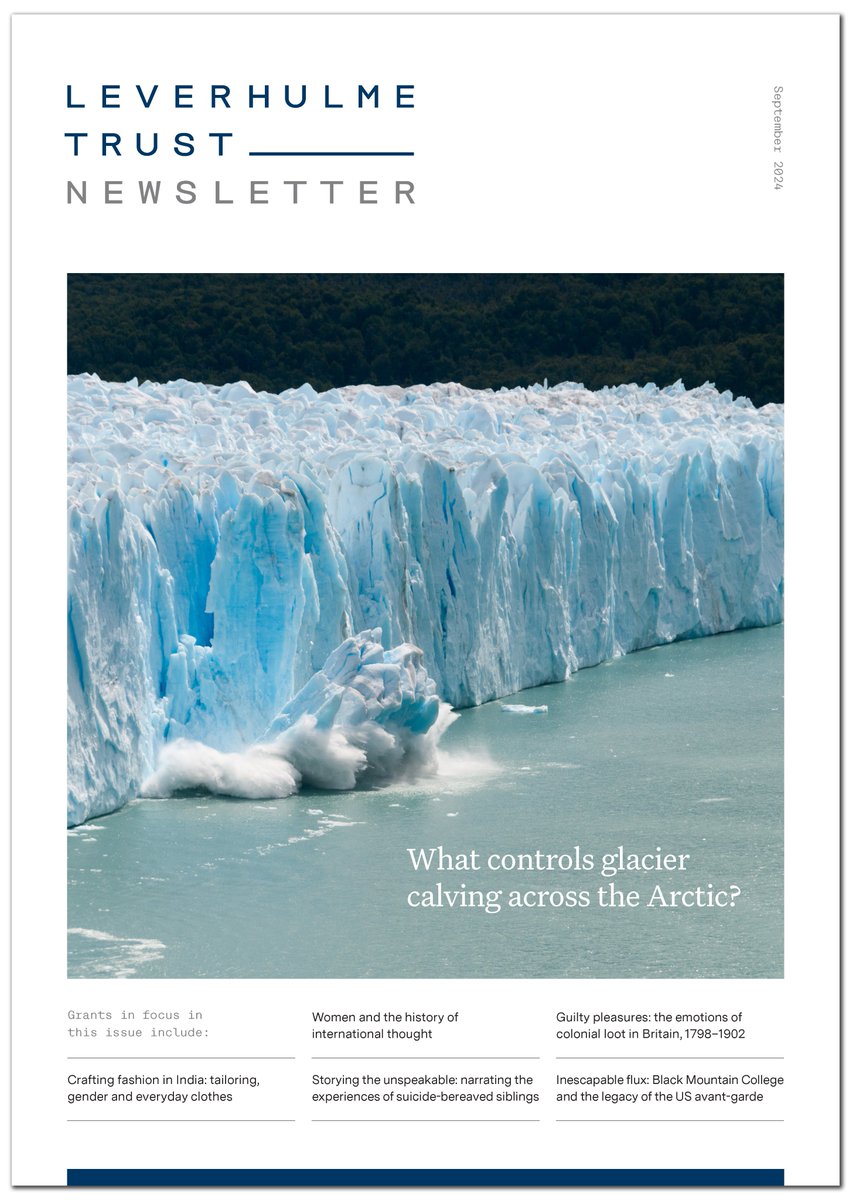
Happy to share that I will start the Leverhulme Early Career Fellowship @Bristol_Glac, excited to see my project on Arctic glaciers featured as the cover story in the latest newsletter. Thank you to everyone who has supported me along the way!
The Trust’s September Newsletter is out! Read about women and the history of international thought, neurodiverse children and families in temporary accommodation, hydraulic contribution to the control of insect wing movement and much more: https://t.co/vNsbBc6ZFT
@QMULsed@UshaIntl@UEAPsychology@LSBU_ENG @LewRyder
Read the full paper here: https://t.co/nQVax66xGF.
And stay tuned for more exciting scientific results on Arctic climate change! (4/4)
#ArcticResearch#ClimateScience#DeepLearning
🚨New paper in @ESSD_journal ! Using deep learning, we created a new calving front dataset for Svalbard with an unprecedented spatiotemporal resolution. It includes almost 125000 terminus traces from 149 marine-terminating glaciers, covering the years 1985 to 2023. (1/4)
Our team, incl. @mnky9800n_ and @icetianli is super excited to announce the first release of our spatio-temporal modelling s/w package, 4DM. Check out the examples and tutorials here https://t.co/gZnuQUJRr7
In East Antarctica the ice sheet has retreated by 3 to 14 km over the past 24 years. Wonderful work from @icetianli combining grpunding line observations from insar and repeat altimetry
🚨East Antarctica needs your attention! Using ICESat, ICESat-2, and Sentinel-1a/b, our latest research published in TC today shows grounding lines have been retreating across the fast-flowing ice streams of Moscow University and Totten glaciers in Wilkes Land.
New research article: Grounding line retreat and tide-modulated ocean channels at Moscow University and Totten Glacier ice shelves, East Antarctica https://t.co/5t9Pcw5OIH
We also found two tide-modulated ocean channels that might open new pathways for the warm ocean water to enter the ice shelf cavity.
Read the paper here:
https://t.co/tB5YG37bIx
@jlbamber @Bristol_Glac
Our preprint on a long term sea ice thickness proxy for the Canadian Arctic is now open for discussion on EgUsphere. We present a continuous winter sea ice thickness record for a full 25 years and also covers the channels in the Canadian Arctic Archipelago! 🧊🛰️💻🇨🇦