One of my blackboards from this semester’s Data Sciences course: explaining the asymptotic consistency of the maximum likelihood estimator. I’m teaching it in English this year—should I put the whole course on YouTube? :)
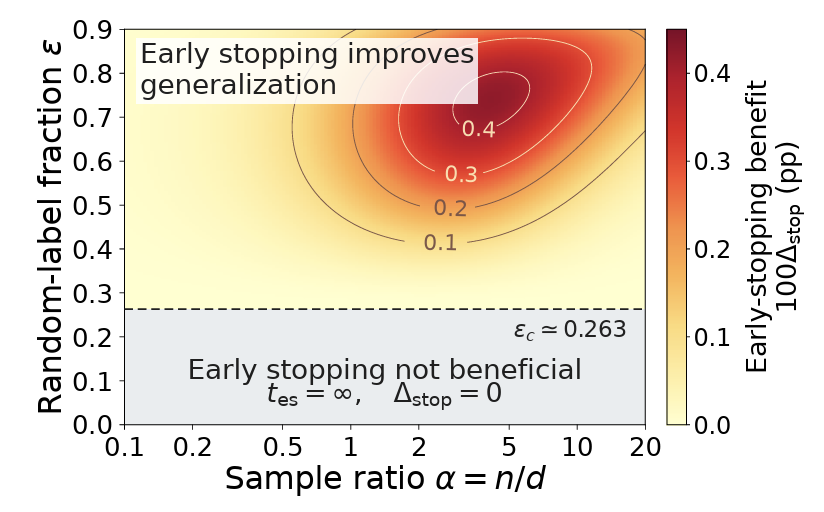
When is early stopping beneficial under label noise? You might think: always!
Eeee… not quite. Large, deep neural networks with competitive test performance do not benefit from it!
Our kernel theory gives a phase diagram for when interpolation wins.
https://t.co/qujdBDb2Wa
LightOn releases SlideOn & mSlideOn: open SOTA sparse retrievers at 174M and 339M params.
Dense retrieval works, but at enterprise scale it gets expensive. Every document becomes a vector, and fast vector search usually runs on GPUs.
Sparse retrieval changes the economics. Documents go into an inverted index, and each query only reads the documents that share its active features.
→ Search that scales to billions of documents
→ Fast search that can run on CPU
→ A smaller index to store
And quality holds up:
→ SlideOn: 56.68 on BEIR-15, above our dense model DenseOn (56.20)
→ mSlideOn vs mDenseOn: +4.76 on multilingual (MIRACL), +10.18 on long documents (MLDR), +3.25 on code (MTEB Code)
→ Prune vectors at inference to fit your latency and storage budget, with no retraining
Under the hood: we converted DenseOn and mLateOn into sparse retrievers through SAE pretraining and fine-tuning. Both models learn their own vocabulary of 32,768 concepts instead of using the tokenizer’s vocabulary.
Fully open: models, intermediate SAE checkpoints, training data and scripts.
👏🏻 Kudos to @paulomouraj and @raphaelsrty
Models: https://t.co/UNK78RhTNv
Blog: https://t.co/uVVs9JX5pb
Introducing LightOn Suite! 🚀
Enterprise AI needs more than powerful models. It needs access to the right information, and a way to turn that information into useful applications.
Today, we're launching LightOn Suite, bringing together two complementary products:
🔷 LightOn Core : transforms enterprise documents into structured, searchable knowledge that AI can use. From parsing and indexing to retrieval, with access permissions and traceability back to the original sources.
🔷 LightOn Apps : builds on Core to let teams create and deploy AI applications using their own company knowledge. From internal search and contract analysis to supplier comparisons and document workflows.
Together, they provide a shared knowledge foundation that can support multiple AI applications, without rebuilding the document infrastructure for every use case.
🤝 And we're teaming up with @Scaleway to make it available on European cloud infrastructure.
LightOn Suite is now available on @Scaleway 's French cloud, in SaaS and Managed VPC deployments. Scaleway is also making LightOnOCR-3 available through its Generative APIs, bringing our document intelligence models directly to developers.
👉🏻 Explore LightOn Core : https://t.co/F64QagU1EZ
👉🏻 Discover LightOn Apps: https://t.co/2GZeHTZSBV
Got a complex document full of charts, tables, or tricky layouts? 📊
Put LightOnOCR-3 to the test!
From extracting text to understanding visual content and turning complex documents into structured, usable data, see what our latest OCR models can do.
🚀 Our demo is featured in Hugging Face's Spaces of the Week!
Try it yourself 👇
🔗https://t.co/UEc2yWJGvO
(1/7) I'd like to provide some additional context for the remarks that can be found in this interview.
(2/7) My discomfort with the attention being paid to existential risk---and with the ongoing dominance of the public discussion of such risks by a few so-called thought leaders---is that there's an elephant in the room that is being missed. That elephant is the effect of all of this discussion on young people, and indeed the effect---beginning with social media a decade ago---of information technology on young lives broadly speaking.
(3/7) I recently read an interview by Jill Lepore in which she reports on discussions that she had recently with a group of college students: "They had just three things to say. One, social media completely destroyed their childhoods. Two, AI is destroying their college education and their likely prospects for employment. And three, what the hell are we all doing?" To add a fourth bullet that I've heard in similar discussions: "I'm not going to have children, because the existential risk is just too high."
(4/7) Please contemplate such a statement, those of you who think that it's OK that the public, widely diffused, discussion coming from seemingly authoritative figures is so adamant about existential risk.
(5/7) Let me add that I have little interest in a debate about what "superintelligence" might mean, or whether we're currently seeing the emergence of superintelligence. For what it's worth, I would certainly agree that the solution of extremely challenging math problems (for example) exhibits a very impressive form of intelligence, although I would want to argue that such intelligence is impossible to dissociate from the collective of humans that provided data to the machine learning system (which itself has become a kind of collective).
(6/7) Such philosophical debates are entertaining and even important, but when they then head in the direction of "when such superintelligence emerges, there's a good chance that it will want to kill all humans", I say "science fiction". Again, I don't think that it's bad to consider such thoughts, but I strongly believe that it's bad for society, and especially young people, for such thoughts, unaccompanied by any serious real-world analysis, to become a dominant form of discourse of the era.
(7/7) We are damaging human lives, and the consequences of that damage will no doubt be a major theme of the next several decades.
The one and only Michael Jordan was interviewed last week by the French newspaper Libération. Here is an English translation. Enjoy!
https://t.co/hvyMrS3FKE
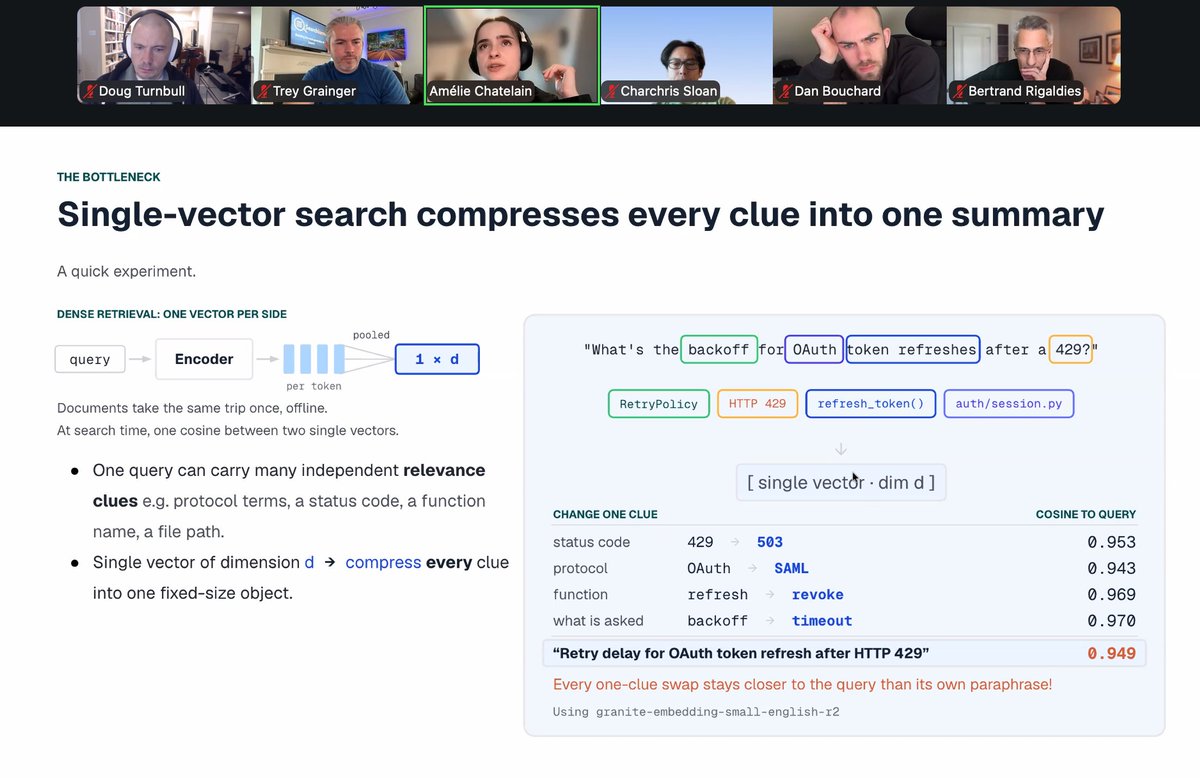
🔎 Is one vector enough to capture everything that matters in search?
Traditional single-vector search compresses information into a single embedding.
But what happens to the context that's lost along the way?
On October 19, our @AmelieTabatta , Head of Training & Inference at LightOn, will join @treygrainger and @TurnbullDoug for a technical session on Late Interaction in 2026, hosted on Maven.
They'll explore:
🔹 Why token-level embeddings can improve retrieval quality
🔹 Where late interaction makes the biggest difference 🔹 How approaches like NextPlaid are making retrieval more efficient
🔹 What it takes to scale late interaction in production
📅 October 19, 2026 | 5 PM CEST
💻 Online | Free registration
👉 Join the discussion: https://t.co/Xt9QIxk8jz
Michael I. Jordan, machine learning demigod, UC Berkeley
... the young people who work at these companies operate in a world [Silicon Valley, Berkeley, etc.] where these kinds of discussions are commonplace. Many of them aren’t really engineers; they come from the humanities, philosophy, or other disciplines. They’re 25 years old, they’re naive, they don’t do engineering work, they’ve never worked at large companies where real products are developed for real people, with discipline. And they get together, a bit like in Parisian cafés in the 1920s, to talk about these grand science-fiction ideas. When these young people resign, they know they’re going to attract attention. It allows them to feel virtuous and to be seen as very important figures. They claim to be giving up money, but in reality, they already have their stock options. So all of this is a grand moralizing performance that doesn’t serve the real objective it claims to pursue. There’s a great deal of naiveté here, which goes hand in hand with a certain cynicism…
https://t.co/GwP9zcz7vZ
Today we’re releasing LightOnOCR-3, the third generation of our OCR models—a joint effort with @staghado and @baptaubertin!
Here’s how we built its grounding data, and how intermediate checkpoints helped improve the annotations used for subsequent training. 🧵
🚀 LightOnOCR-3 is out! 🦉
This time we go beyond OCR: text transcription, document layout, image descriptions and chart extraction, all in one model.
We release 3 sizes: 0.8B, 1B and 4B, all under Apache 2.0!
World-leading document recognition. Beyond text extraction.
Introducing LightOnOCR-3, our new family of state-of-the-art AI models for document intelligence.
Building on LightOnOCR-2, it recognizes text and handwriting, describes images, extracts data from charts and preserves document structure, all in a single processing step.
🏆 Leading benchmark results : ahead of Chandra-OCR-2, Mistral OCR 4.1 and dots.mocr on OlmOCR-Bench, and first among open-weight models on ParseBench.
📊 More information from every document : turn text, tables, images and charts into content your business applications can use.
⚡Compact and efficient: 0.8B and 4B versions, with document processing up to twice as fast as LightOnOCR-2.
🔓Apache 2.0 license: use, adapt and deploy the models on your own infrastructure.
From handwritten administrative files to financial reports and technical documents, make more of your information searchable and usable.
👉 Explore the models and benchmark results: https://t.co/xXJD1Eo9XA
👉🏻Explore the model page on our Website : https://t.co/y5ZWMpMOL9
#LightOn #DocumentIntelligence #OCR
@KrzakalaF "It seems that at one time computers were designed directly by human beings. Those were simple computers, of course, this being before the time of the rational use of computers to design more advanced computers had been established."