This literally the road to my farm. Second time this year that this is happening on that road. Now I’m too afraid to visit my farm despite all I’ve spent this year
🤦🏽♂️
Yes, the data shows modest improvement. Nigeria's real GDP grew 3.89% YoY in Q1 2026 (up from 3.13% in Q1 2025), continuing the 2025 full-year trend of ~3.9%. Services drove 57.73% of GDP, with non-oil sectors at 96%.
This reflects ongoing macro stabilization from recent reforms (FX unification, subsidy removal), boosting services, finance, and non-oil activity while oil output hovers ~1.5-1.6M bpd.
Inflation has eased toward 15% (still elevated but trending down), supporting projections of 4.1% growth for 2026. Challenges remain in agriculture, manufacturing, poverty, and per-capita gains. Sustained progress needs consistent policy and diversification.
The corner shop doesn't have to understand digital assets to benefit from it.
“Mama Nkechi” gets paid instantly in local currency, exactly how she wants. 🛒💜
Welcome to the future of money: https://t.co/yAnoi5eHPf 💸
Spent last weekend helping a friend move his fintech off DigitalOcean. $760/month bill at 2,000 daily users. We got the new infrastructure for about $170. $590 saved a month, roughly $7,000 a year on a tiny stack.
Same architecture, same code. Just deleted things the team had never had time to question.
The Vault droplet was the funniest one. $14/month for a server that wasn't storing anything. Someone provisioned it two years ago, wanting to be thorough about secrets management, and the team never circled back. $168/year to do absolutely nothing.
A Kubernetes cluster at $125/month was a close second. No workloads deployed. They thought they'd grow into it. Two years later, the bill kept ticking.
The Postgres standby node bothered me more. $94/month extra for a failover, on a team
with no on-call rotation. If the primary went down at 3 am, nobody was awake to do anything about it. They were paying for an availability guarantee they couldn't cash in. The actual database, by the way, was running at under 10% CPU.
Migrated everything to AWS on Graviton (ARM) instances, which run 20% cheaper than the equivalent x86 boxes for Go and Node workloads. One CI config line.
The trap nobody warned them about: when we hit AWS's "Easy Create → Production" button in the RDS console, it wanted to put us on a db.r7g.xlarge at $1,400/month for a workload at under 10% CPU. AWS's "Production" defaults assume you're already a unicorn. We didn't take the bait. Budget alerts and quota caps were set first so a leaked credential couldn't burn six figures overnight.
If your cloud bill is over $500/month and you're under 10k users, the savings are sitting in lines nobody on your team can explain. Spend an afternoon and read it line by line.
One more thing, while I'm here.
This team had a pg_dump from 36 hours before their DigitalOcean account got terminated mid-migration. They'd never restored it. We got lucky; it worked. If it had been corrupted, the company would have lost everything.
A backup you've never restored is a hope. Test your restore tonight. If it doesn't come back clean, fix that before anything else this week.
July last year, Governor Seyi Makinde announced that his government bought SURVEILLANCE AIRCRAFT to combat insecurity.
However, during the Governor's press briefing yesterday, he said the SURVEILLANCE AIRCRAFT was at the AIR FORCE BASE in Lagos.
He went on to say that the Chinese Engineers who will assemble it came in THREE DAYS ago and they will need TWO WEEKS to do the job.
Probably what Governor Makinde bought was a kind of DRONE.
It was purchased since in July 2025. But close to one year after, it is still at the Air Force base in Lagos, and the Governor didn't remember to tell the people of Oyo State anything until the terrorists attack in Oriire LG happened.
N7.7bn Oyo State money invested over to protect the citizens lying UNUSED in Lagos since July last year!
Just the way he has kept the N30bn he received from the FG as compensation for the victims of the January 2024 Ibadan explosion.
This same Seyi Makinde will mount podium and be talking about Operation Wetie!
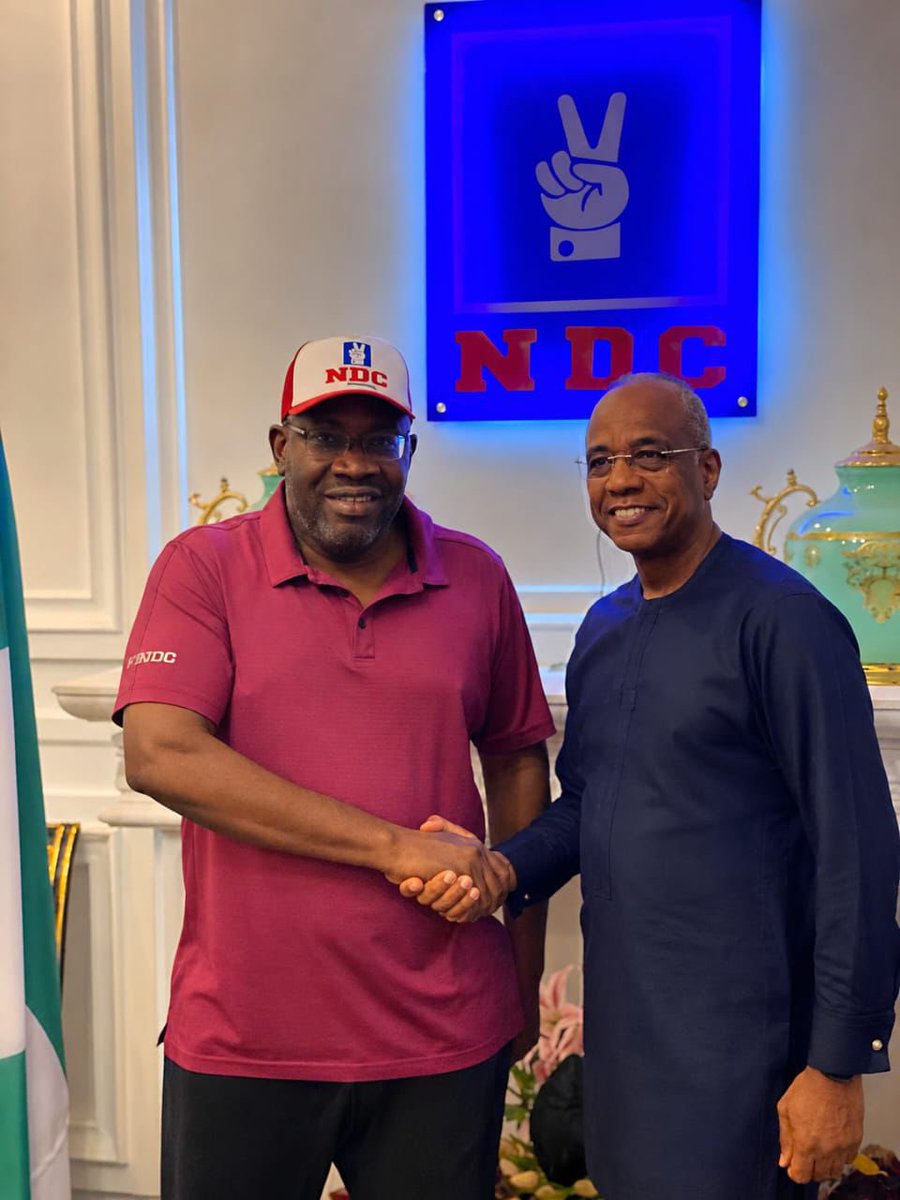
I had a very productive and inspiring meeting with the National Leader of the NDC.
Our discussions were frank, constructive and aligned around a shared purpose, that will lead to a better Lagos, and a better Nigeria founded on competence, inclusion, accountability and service to the people.
I left even more convinced that meaningful progress is possible when leaders unite around principles, purpose, and the public good.
#OTiYa
#ItIsTime
What happened at the University of Uyo Teaching Hospital yesterday is a national disgrace and must not be treated lightly!
Calling on @officialEFCC to promote lawful conduct; to publicly call the officers involved in the act to order, @Fmohnigeria@nighealthwatch to protect our healthcare system, and the presidency @NGRPresident and @NGRSenate to look into this, so this doesn’t happen to any healthcare worker again.
@UN@WHO@WHONigeria@UNICEF_Nigeria
Justice must prevail. Say NO TO VIOLENCE AGAINST MEDICAL PRACTITIONERS. Enough is Enough.
Obidients, look at the full picture. This Global LeadHaus graphic is not just “good news for Obi.” It is a loud warning siren.
Raw support says Peter Obi is far ahead:
Peter Obi: 67% — about 2,307,150 respondents
Tinubu: 23% — about 792,350 respondents
Atiku: 6% — about 206,700 respondents
Others: 4% — about 137,800 respondents
On popularity alone, Obi is eating the field alive. Tinubu is far behind. Atiku is distant. Amaechi, Makinde, Sowore and the rest are barely breathing in the numbers.
But elections are not won by popularity inside a survey. Elections are won by people with PVCs.
That is where the danger starts.
Only 18% of Obi’s supporters in the sample had PVC, giving him about 415,287 PVC-ready supporters.
Tinubu, with only 23% raw support, had 79.6% PVC ownership, giving him about 630,311 PVC-ready supporters.
Atiku, despite just 6% raw support, had 72.6% PVC ownership, giving him about 150,064 PVC-ready supporters.
Others had 46% PVC ownership, giving them about 63,388 PVC-ready supporters.
So the real PVC-ready race in this dataset becomes:
Tinubu: 630,311
Peter Obi: 415,287
Atiku: 150,064
Others: 63,388
That means Obi can be massively popular and still be electorally exposed. Tinubu can be less popular and still be better positioned because his voters are ready to vote. Atiku’s base may be smaller, but it is also more PVC-prepared than Obi’s by percentage.
This is the message:
Obi is winning preference. Tinubu is winning voter readiness. Atiku’s smaller camp is also more PVC-ready. The smaller candidates are not the threat. The PVC gap is the threat.
No more comfort in crowd size. No more social media chest-beating. No more “we are many” without proof of registration.
The assignment is simple: convert sympathy into PVCs, convert noise into ward-level structure, convert support into actual voters.
Because on election day, INEC will not count passion. INEC will count accredited voters.
No PVC, no power.
ONLY 42 WORKING DAYS LEFT TO INEC FINAL PVC DEADLINE!!!
cc: @PeterObi@KwankwasoRM@1MMCSpace@EmirSirdam@ruffydfire@firstladyship@RealQueenBee__@Peter4Nigeria@AishaYesufu@EstherUmoh10@NaijaPrez@Sports_Doctor2@UnkleAyo@ifesalakooffice@tudobams@DrOaikhena@iamHSDickson@NigeriaNDCHQ@n6oflife6
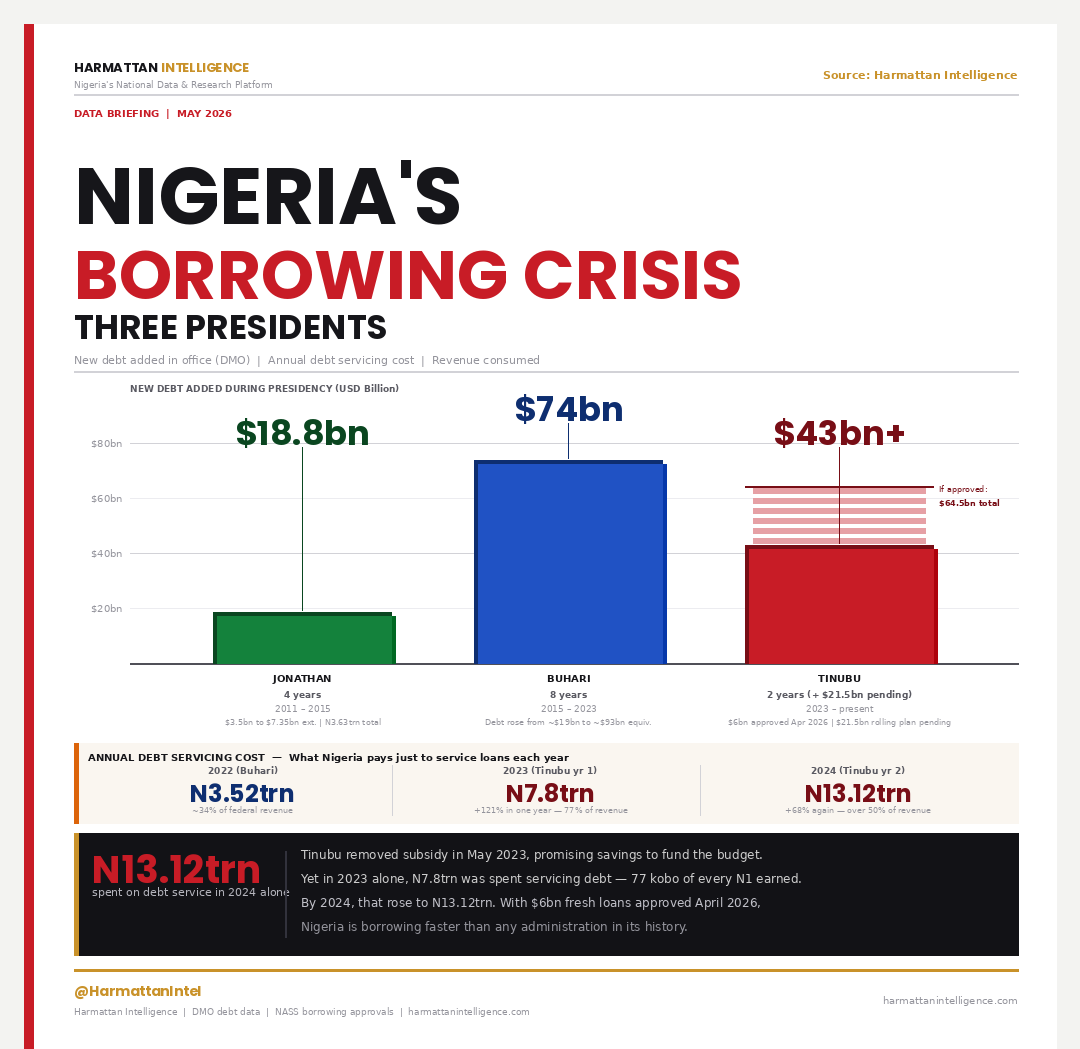
"We removed subsidy to save money" but the Loan request from @officialABAT has tripled @GEJonathan in 3 years.
@GEJonathan added $18.8bn in debt over 4 years.
@MBuhari added $74bn over 8 years.
@officialABAT has added $43bn+ in just 2 years with $21.5bn more pending in 2026.
The subsidy savings are not in your pocket. They are in a debt repayment schedule.
We track Nigeria's fiscal data, borrowing, governance and public opinion. Our national dashboard launches July/August 2026.
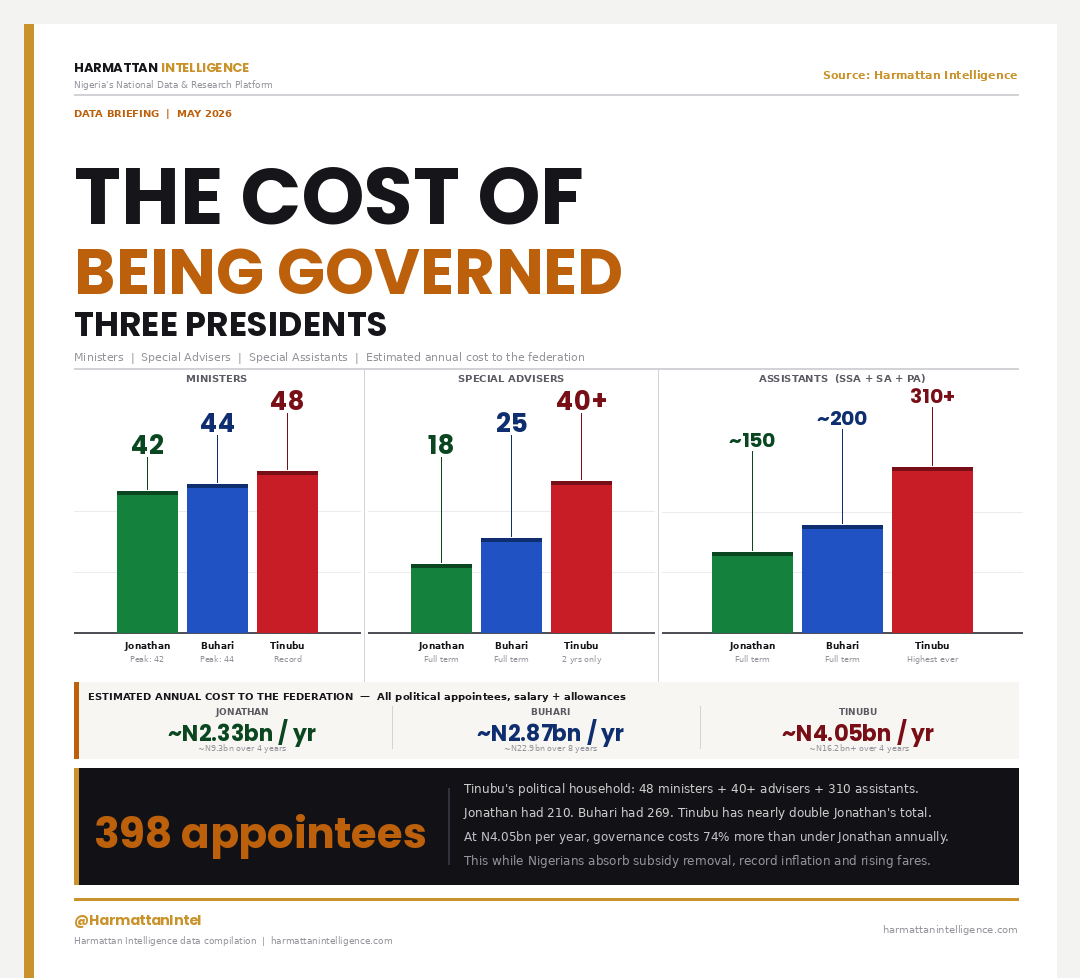
48 ministers. 40+ special advisers. Over 310 assistants.
@officialABAT runs the most expensive political household in Nigeria's democratic history with nearly double the number of appointees @GEJonathan governed with, at an estimated cost of N4.05 billion every single year.
We track Nigeria's governance, economic data and public opinion — continuously and independently. Our national dashboard launches July/August 2026.