Surf 4.0 is launching next week. This is the biggest milestone we have hit since the day @Surf_Liquid went live.
I want to take a moment to share what is coming, what it took to get here and why I believe this changes everything for us.
Two things are shipping with 4.0. The Guardian Layer as a fully integrated core system. And Surf going live on Ethereum.
Let me break both down.
The Guardian Layer
Over the past four months, we watched multiple on-chain exploits hit live protocols in real time. Morpho pools. Resolv. Others across the ecosystem. Our AI agent was actively operating in some of those exact same pools when the incidents happened. Real capital. Real exposure. Real risk.
Every single time, the Guardian Layer detected the anomaly before the broader market even reacted. It pulled capital to safety, locked down exposure and entered emergency mode in under 60 seconds. Zero user funds were affected. Not a single dollar. Not once.
I cannot overstate what that means. We did not run a simulation. We did not test this in a sandbox. We went through actual on-chain incidents with actual user capital at stake and the system performed exactly as designed. That is not a feature announcement. That is battle-tested proof.
Surf 4.0 takes every single lesson from those incidents and hardens it into the core product.
The Guardian Layer is a three-tier deterministic security engine that sits between the AI and your capital. The AI proposes an action. The Guardian decides whether that action is allowed to execute. No exceptions. No overrides. No discretion.
Tier one is the allow list layer. The AI can only interact with pre-approved protocols, pools and venues. If it is not on the list, the transaction is rejected before it even reaches evaluation. This is not a filter. It is a hard gate.
Tier two is the parameter layer. Every proposed action is checked against slippage bounds, exposure caps, concentration limits and cooldown periods. If the AI tries to allocate too much to a single venue, if slippage exceeds the defined threshold, if a cooldown has not elapsed, the action is blocked. Every parameter is deterministic. There is no AI judgement involved at this stage. Rules are rules.
Tier three is the circuit breaker layer. This is the emergency system. If on-chain signals indicate abnormal behaviour in a pool, if oracle prices diverge beyond safe bounds, if transaction patterns suggest an exploit in progress, the Guardian triggers an automatic defensive response. It can pause all execution, initiate protective withdrawals and lock the vault into safe mode. This is what fired during the Resolv incident. The AI did not decide to pull funds. The Guardian's circuit breaker detected the anomaly and executed the emergency protocol automatically within seconds.
Every action that passes through all three tiers gets logged with a full audit trail. Every action that gets rejected is also logged with the specific reason. Full transparency. Full auditability. This is built for institutional-grade capital, not retail experimentation.
No other AI agent platform in this space has anything like this. Every AI agent project I have seen gives the AI discretionary control over funds. Ours does not. The AI is an intelligence layer. The Guardian is the governance layer. They are separate by design. The AI cannot override the Guardian. Period.
This is the piece that separates Surf from everything else in the market. And it is not theoretical. It has already saved real capital in real incidents on live chains.
Ethereum
Surf 4.0 also marks our launch on Ethereum mainnet.
We have been live on Base and Polygon. Both have been performing well. But Ethereum is where the deepest liquidity sits. It is where the largest lending venues operate. It is where institutional capital lives. Deploying on Ethereum means Surf vaults now have access to the most mature and liquid DeFi infrastructure in the world.
This is not just another chain deployment. Ethereum is the chain. The deepest pools, the most battle-tested protocols, the highest TVL. When we say Surf is a savings platform for on-chain capital, Ethereum is where that statement gets tested at real scale.
Our infrastructure layer under @zkCrossNetwork already supports 40+ chains with $107M+ in processed volume. The routing, execution and settlement rails are proven. @ethereum deployment runs on the same audited infrastructure that has been live and operational for years. Same Guardian rules. Same non-custodial model. Same full user custody. Just bigger pools, deeper liquidity and more venues for the AI to optimise across.
Why this matters
I have been building towards this moment since 2017. Nine years. A predictive trading engine that processed $145M in volume. Cross-chain infrastructure that has handled $107M+ across 194,000 transactions. An AI execution layer that has been refined through every market condition from bull to bear to black swan events. And now a consumer product that brings all of it together.
We did not raise hundreds of millions to get here. We built and shipped and proved it works with real capital on real chains against real threats. $1.24M in revenue. $10K monthly burn. Seven person team. Four founders taking zero salary. Every rupee and every dollar has gone back into the product.
When I look at the AI agent space today, I see a lot of projects promising autonomous execution with no governance, no controls and no accountability. We have taken the opposite approach. We built the governance first. We built the security first. We proved it works under fire. And now we are scaling it to the biggest chain in the ecosystem.
Surf 4.0 is the version I always wanted to build. A platform where you deposit, you earn, you keep full custody and you know that every single transaction is being governed by a deterministic security system that has already proven itself in live combat. Twenty-four hours a day. Seven days a week. No human in the loop required.
Guardian Layer. Ethereum. Next week.
More details, a full walkthrough and updated documentation are coming in the days ahead. Stay close.
Let's go.
Designing the Strategy Builder: configure, backtest, and deploy your own trading agents inside non-custodial vaults on Base. Four depth modes are planned. Which fits how you'd want to trade?
-> Templates: pick a pre-built strategy, review its track record, and deploy in one tap. No setup required.
-> Guided Builder: start from a template but adjust the parameters that matter to you (risk limits, allocation, rebalance triggers) through simple controls. No code.
-> Policy Rules: write your own conditional logic (if/then rules governing when and how the agent acts) for more precise control without writing a full strategy from scratch.
-> Full SDK: build your strategy agent in code from the ground up. For developers who want complete control over logic and execution.
Your vote shapes V1 priorities.
Our documentation just got a full rebuild.
V3 covers everything we're building toward:
↳ Multi-Agent Engine architecture
↳ Strategy Builder (Modes A, B + Policy DSL)
↳ Permissionless Vault Network with seasoning gate
↳ ATA on-chain wealth management layer
↳ Full $MAICRO tokenomics with fee flywheel
This is the clearest picture of maicrotrader we've published.
Check out the link below
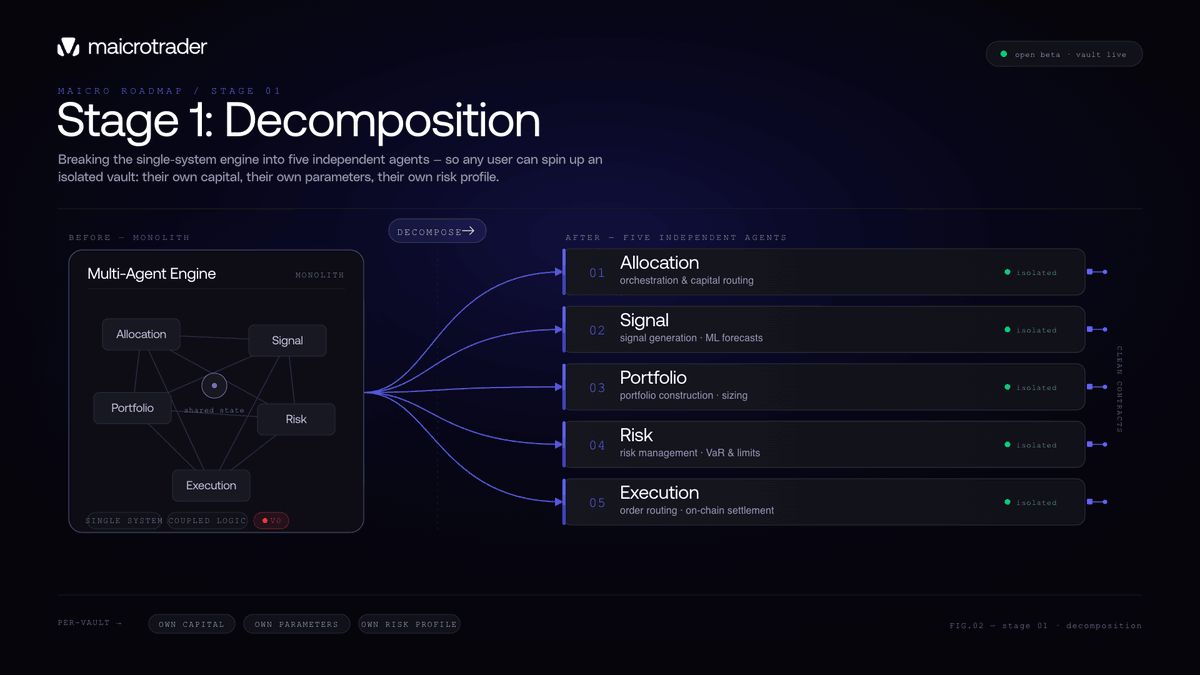
🧵1/ The Strategy Builder is where maicrotrader is going.
But before the first user can configure and deploy their own vault, we have to complete something less visible and more important: rebuilding the engine underneath it.
That's Stage 1. Here's what it actually means ⬇️
Excited to be featured on the Virtuals Weekly Updates, as we have unveiled our architecture, the product is still in production, and we intend to keep you update at every step of the way!
This week, we talked about what's broken.
We talked about what a vault should actually look like.
We talked about what every trade should tell you.
We talked about what $MAICRO does inside the system.
Tomorrow we'll lay out exactly what we're building and why.
The architecture. The reasoning. The roadmap.
Article drops Friday.
Our Token $MAICRO has three roles inside our new architecture.
Staking unlocks capability
The more you stake, the more powerful your agents become: advanced signal configurations, multi-strategy allocation, full policy control via DSL and SDK.
You can use the platform without staking, staking makes your agents work harder.
Publishing requires skin in the game
Want to put your strategy on the marketplace? Stake $MAICRO as a slashable bond. Your strategy runs live for 30 days with real capital before it goes public. Misrepresent your track record — your bond gets slashed.
On-chain reputation that means something.
Every deployed strategy feeds the loopis
More strategies deployed → more trading activity → more fees → $MAICRO buybacks → burned and distributed to stakers.
Token demand tied directly to platform usage.
Full picture drops Friday.
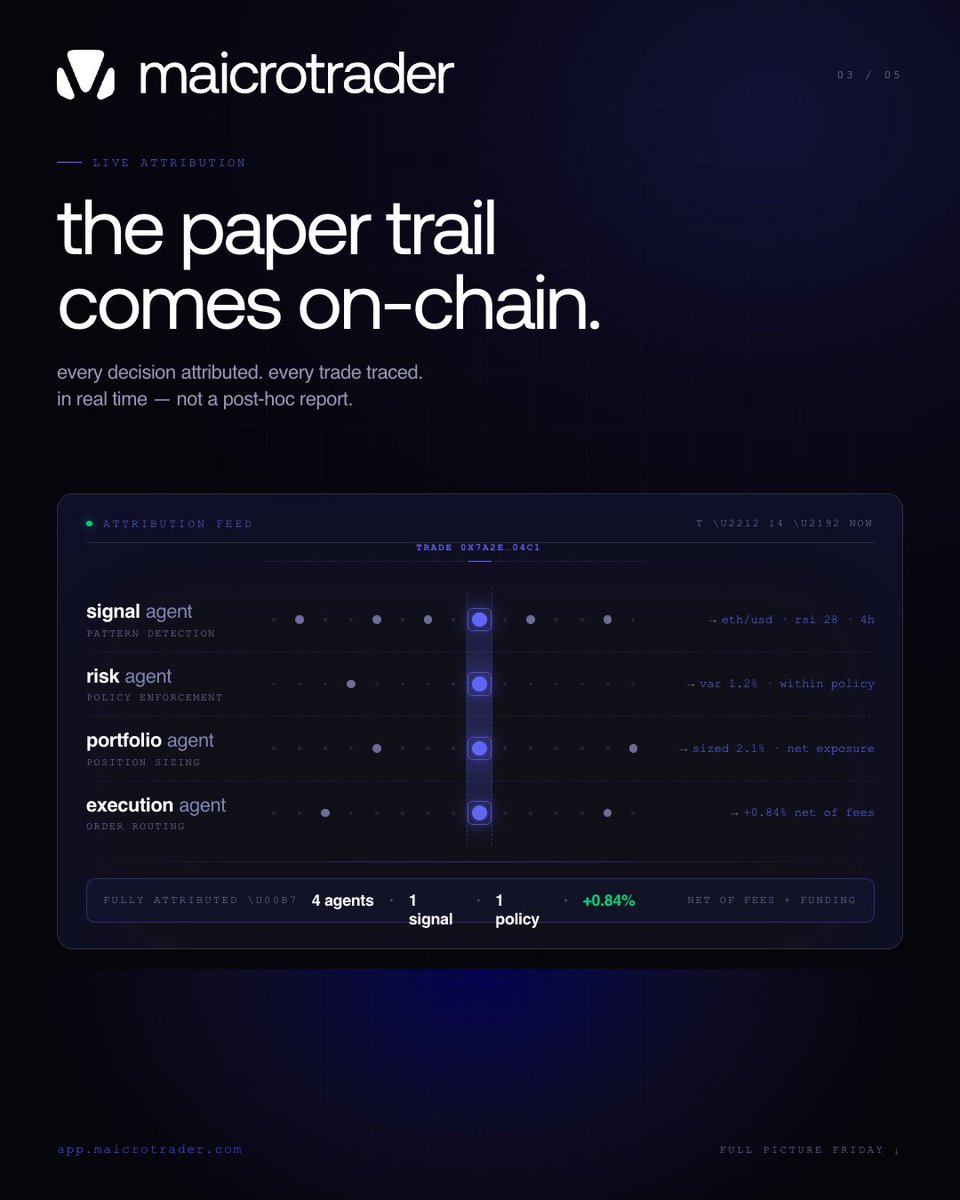
In traditional finance, every trade has a paper trail.
Who called it, what signal triggered it, and what risk check approved it. What it made or cost -> net of everything.
On-chain? You get a transaction hash and a PnL number.
The gap between those two things is where trust breaks down.
We've been building something that closes it:
-> Which agent made the call
-> Which signal it acted on
-> Which risk policy checked it before execution
-> What it returned, net of fees and funding
On every single trade. In real time.
Not a post-hoc report, not a monthly summary. A live attribution feed, the same standard a fund manager is held to, is applied to every position your vault takes, more updates coming!