Physicist. "We shall not cease from exploration. And the end of all our exploring will be to arrive where we started and know the place for the first time."
📢 Big news coming up from @km3net!
🗓️ Tune into it on Wednesday 12th of Feb, at 16:50 CET to hear about some exciting KM3NeT results!
🔗 Details can be found on the website: https://t.co/WYTy5mtkVi
One of the issues of cosmological neutrino-mass determinations is that we see the combination of many different effects, so understanding what physics are we really measuring is tricky.
See this thread on how we break down different effects, with interesting conclusions! 👇🏻
🚨New paper !🚨
📰https://t.co/A0YKweDN0g
Together with @tbertolez, @iesteban_ph, Olga Mena and Jordi Salvadó, we break down the cosmological CMB measurement that places bounds on neutrino masses: it is mostly constraining the evolution of the average energy in neutrinos!
🚨New paper !🚨
📰https://t.co/A0YKweDN0g
Together with @tbertolez, @iesteban_ph, Olga Mena and Jordi Salvadó, we break down the cosmological CMB measurement that places bounds on neutrino masses: it is mostly constraining the evolution of the average energy in neutrinos!
@LucienHeurtier @HostertMatheus @km3net@DMOPalmer This is indeed an option! We expect cosmic rays as such high energies to be extragalactic, and if the neutrino were galactic we would naively expect gamma rays with comparable energies from the galactic center; but in astrophysics few things are 100% certain :-)
@LucienHeurtier @HostertMatheus @km3net@DMOPalmer Unfortunately, not: the IceCube detection efficiency approximately flattens out at high energies, and indeed they've conducted (null) searches for very-high-energy neutrinos https://t.co/MOZ5k3N2FN
@LucienHeurtier @HostertMatheus @km3net My point was statistical: in principle, we expect several sources of such cosmic rays, ~isotropically distributed. IceCube has been observing for a longer time, so on average it should've seen more (unless, as @DMOPalmer pointed out, IceCube got unlucky and KM3net lucky)
Lo mismito que mi universidad diciéndome que no me van a aplicar los incentivos por intensificación investigadora porque en los rankings aún consta mi afiliación anterior, y el objetivo de esos incentivos es que el nombre de la universidad figure en los rankings...😂
La Universidad de Zúrich, que actualmente aparece en la posición 80 del QS, ha decidido dejar de participar en los rankings internacionales por sus efectos negativos en la educación y la ciencia.
https://t.co/vIqHMtKdaG
@VivPoulin@nu_phases A related point: to exclude a hierarchy, one always excludes it _with respect to the other hierarchy_. So the important comparison is not between IH and the peak of the posterior, but between IH and NH. This usually has a much lower significance (https://t.co/mAzo0kwf3Q) 🙂
Breaking news!🎉 Today we announce the most precise measurements of our expanding Universe using the BAO signal in 6.1 Million galaxies and quasars from Year 1, tracing dark energy through cosmic time. See @BerkeleyLab PR at https://t.co/3BZm4VQU9A 1/10
📸 Credit: @ClaireLamman
@Lafe_Nelson@upvehu @ehuscientia @joachimkopp@ProfJohnBeacom Good question! I'm no expert in the topic, but there might be 2 potential avenues:
* The details of the signal depend on the neutron star mass and radius
* Neutron-star common envelope *is* very important o understand neutron-star mass growth, see https://t.co/f33pEbagIC
New paper! https://t.co/7rolm5RbdR
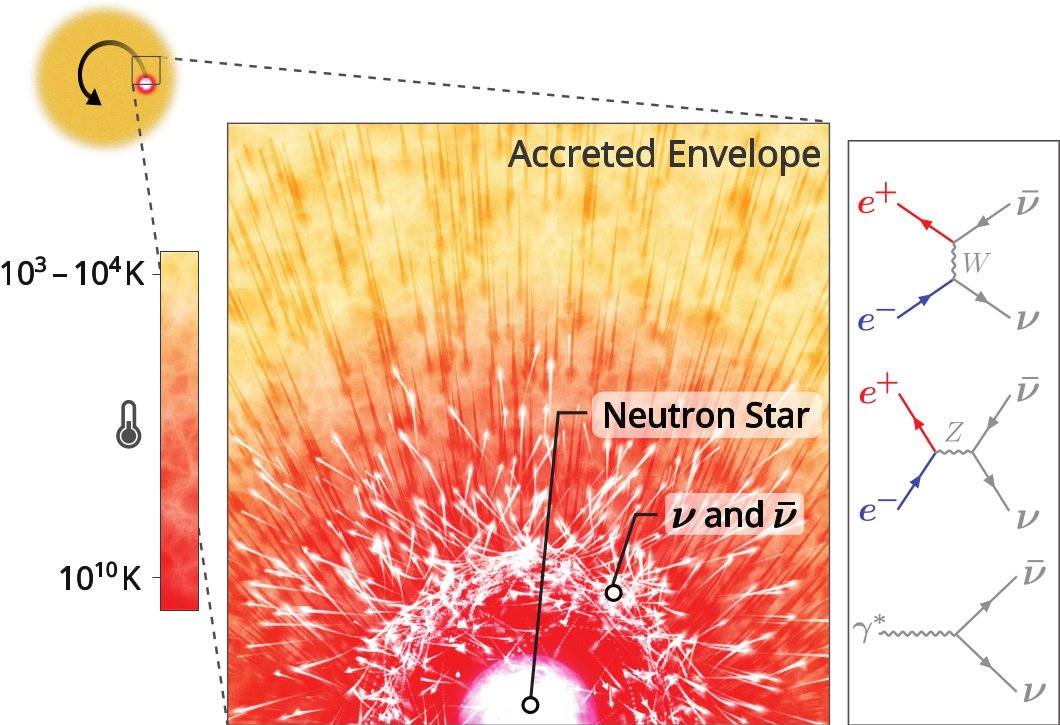
Together with @ProfJohnBeacom and @joachimkopp, we unveil a potential new source of low-energy astrophysical neutrinos: giant stars engulfing a neutron star!
Thread below 🧵
@AndrzOdrz@ProfJohnBeacom@joachimkopp Very interesting question! The common-envelope energies are larger, plus of course for a pre-supernova you get supernova neutrinos later.
This is also my first paper with my new affiliation, @upvehu, my alma mater where I'm now assistant professor. It's been an incredibly hectic time, but I'm very excited about this career stage! #EHUpaper @ehuscientia
And kudos to my collaborators! @joachimkopp@ProfJohnBeacom
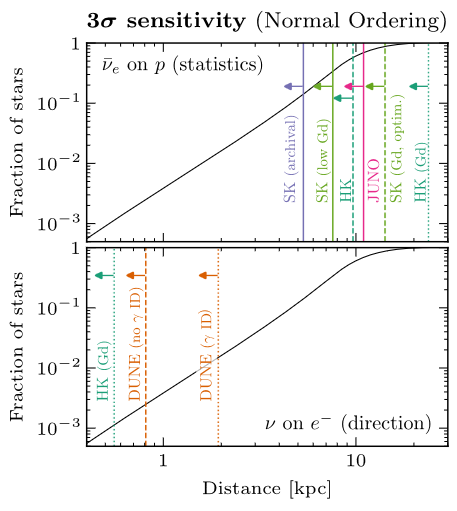
The rate of these events is uncertain. It is definitely rarer than a supernova (~1/century), but theoretical estimates are not extremely small, ~0.1/century. And upcoming detectors could be sensitive to the whole galaxy.
The only way of getting a signal is by looking for it!