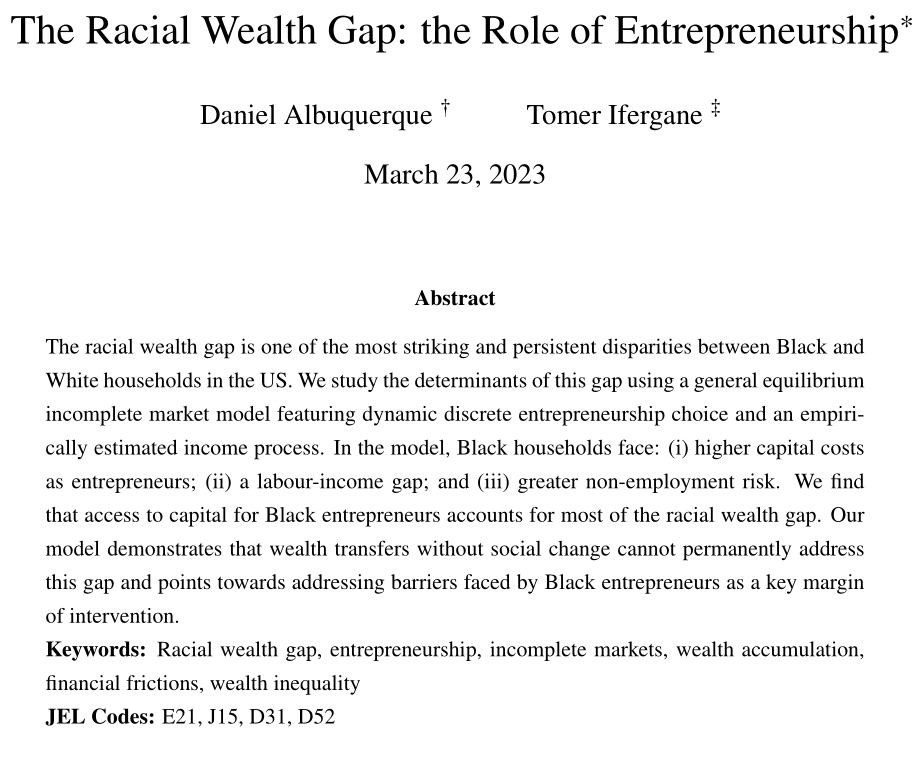
🚨 New draft out! 📜 🚨 “The Racial Wealth Gap: the Role of Entrepreneurship”
@albuquerq_dan
Q1: What are the determinants of the racial wealth gap?
Q2: What is the potential role of policies in closing it?
Barriers to entrepreneurship are the key determinant
👇 Summary 🧵
🏆 PSE & @ENS_ULM are pleased to announce the #DanielCohenAward 2026 winner: @AnanyaKotia, PhD student @LSEEcon, for his Job Market Paper "When Competition Compels Change: Trade, Management, and Productivity". 🔗 https://t.co/zTgeIMogV8
Funded by Boussard & Gavaudan and AFPSE
For those interested, here are my slides from yesterday's Cowles Lecture at the Econometric Society Meetings @YaleCowles@econometricsoc
https://t.co/HilQnlxMEG
Thanks so much for listening and for the great discussion and comments!
At @SOLE_Labor_Econ 2019, @san_muly and I met for the first time. Both graduate students, both with a JMP about first jobs.
We started working on our paper on FSU immigrants and firms in Israel shortly after.
7 years later it is wonderful to see it come out @JEEA_News 🙏
1/3👇
New CEPR Discussion Paper - DP21455
Land Reforms in Developing Financial Markets: Lessons from England's Land Enclosures 1750-1830
Tomer Ifergane @TelAvivUni, Walker Ray @ChicagoFed, Karine van der Beek @bengurionu, Lior Farbman @bengurionu
https://t.co/FhcqY0ySk9
#CEPR_EH #CEPR_MG #EconTwitter
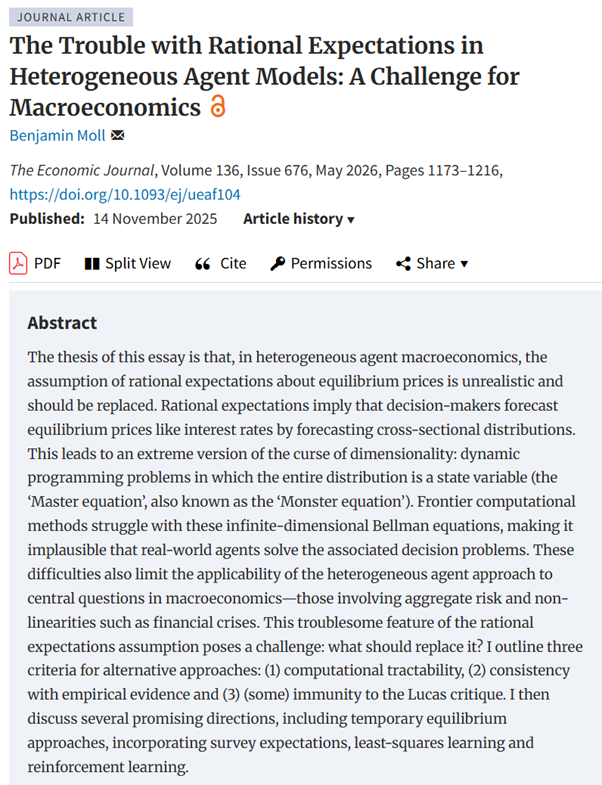
In the May 2026 issue: ‘The Trouble with Rational Expectations in Heterogeneous Agent Models: A Challenge for Macroeconomics,’ by Benjamin Moll https://t.co/RWvehwIsA8 @ben_moll@RoyalEconSoc#EconTwitter
📢 Call for papers! SITE 2026 Session 15: "Causes & Consequences of Misallocation" at Stanford GSB, Aug 31–Sep 1. Theory + empirics welcome.
Deadline: June 15 Submit: https://t.co/d5YRxEyLzl
w/ @TheMichaelBlank@PeteKlenow@sarapfmoreira
Super interesting!
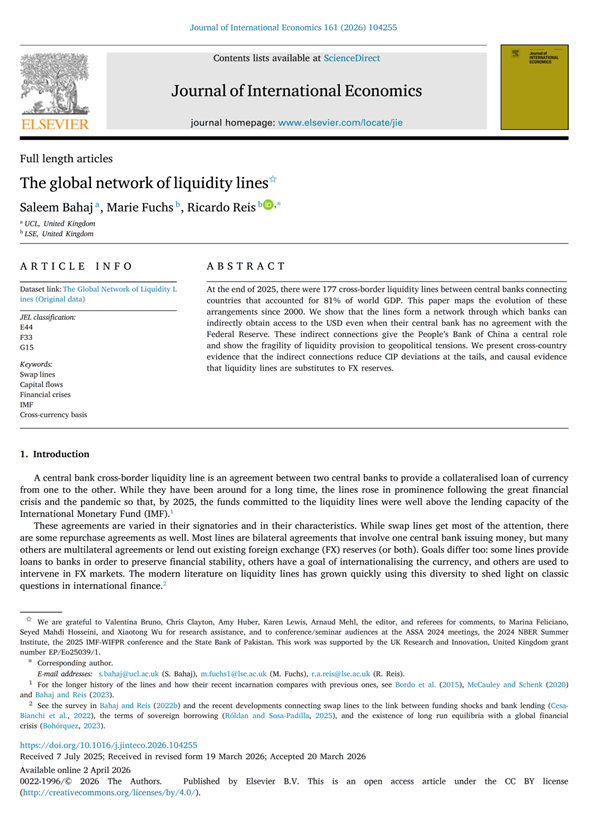
"The global network of liquidity lines" by Saleem Bahaj, Marie Fuchs, and Ricardo Reis.
"At the end of 2025, there were 177 cross-border liquidity lines between central banks connecting countries that accounted for 81% of world GDP. This paper maps the evolution of these arrangements since 2000. We show that the lines form a network through which banks can indirectly obtain access to the USD even when their central bank has no agreement with the Federal Reserve. These indirect connections give the People’s Bank of China a central role and show the fragility of liquidity provision to geopolitical tensions. We present cross-country evidence that the indirect connections reduce CIP deviations at the tails, and causal evidence that liquidity lines are substitutes to FX reserves."
https://t.co/VwyW7WkmFP
According to University of Minnesota economist Ellen McGrattan, many US fims have assets that don’t show up on any balance sheet. She has spent her career trying to measure these intangible investments. Find out more in her interview with #EconFocus: https://t.co/alAi1jGdQ1.
Another reminder the applications for our course "Tools in Macroeconomics" is still open (will likely close by the end of June): https://t.co/Lp4ItiM80h
This is a course that teaches students key computational methods used in macro, as well as the more advanced stuff. 1/3
Really glad we had the opportunity to host @lugaricano for the applied econ workshop at TAU. Hope we can host you in person in the near future!
Luis presented exciting work on the role of AI for professional training and human capital acquisition. Check out the paper👇
I just presented at the @TelAvivUni my paper with Luis Rayo on Training in the Age of AI (by Zoom).
Thanks to all who attended-next time hopefully in person. Here is the latest link to the paper: https://t.co/mmiJkZROMh
How did enclosures affect financial markets in England?
🚨🚨Check out our new draft!👇
"Land Reforms in Developing Financial Markets: Lessons from England's Land Enclosures 1750-1830"
🧵coming up soon
Forthcoming in AEJ: Macroeconomics: "Wage Adjustment in Efficient Long-Term Employment Relationships" by Michael W. L. Elsby, Axel Gottfries, Pawel Krolikowski, and Gary Solon. https://t.co/U2XoL6eqsj
Famously (there is a beautiful Works in Progress piece on this) in 2016, Geoffrey Hinton told an audience in Toronto that medical schools should stop training radiologists, since AI would soon outperform them at reading scans. Ten years later, there are more radiologists than ever, and they earn more than they did then.
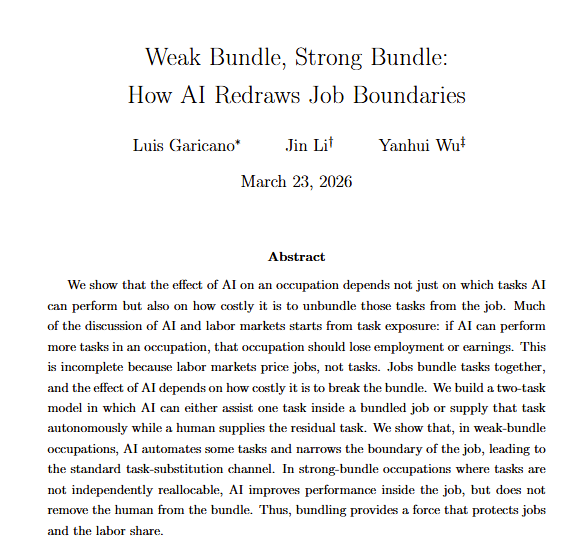
Hinton was right about the task, but he was wrong (so far!) on the future of the radiology profession. Times have never been better for them. The gap between those two claims, the difference between tasks and jobs, is the subject of a paper I have written with Jin Li and Yanhui Wu, and that we release today: "Weak Bundle, Strong Bundle: How AI Redraws Job Boundaries." (Very relatedly we are also finishing the first draft of our book "Messy Jobs" on AI and Jobs!! You will be the first to hear).
We start from the observation that the growing literature on AI and labor markets measures the AI shock by task exposure: people count how many tasks AI can perform in a given occupation AI can perform, and infer that more exposure means more displacement. Eloundou et al. published a paper in Science in 2024 that started this literature, and many follow the same logic. The inference they make is that the more exposed tasks, the worse the outcomes.
This is incomplete, because labor markets price jobs, not tasks. A radiologist does not just sell image classification, but does many other jobs: triages cases, communicates with other physicians, trains residents, makes the difficult decisions, and signs a diagnosis. The market buys a bundled service. The question AI poses is not whether it can do one task inside the bundle. The question is whether that task can be pulled out.
Thread (1/3)
https://t.co/wEYMfjGbeX