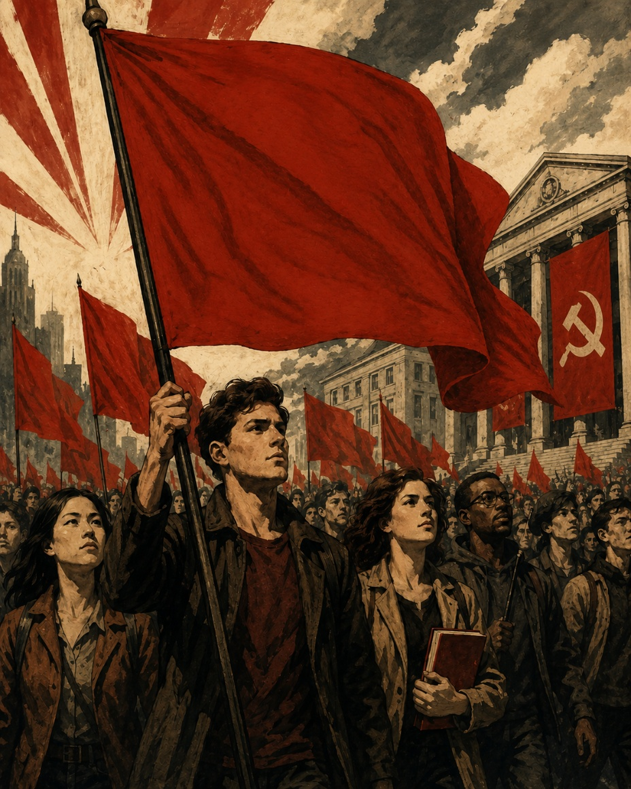
One of the most successful and insidious political strategies of the 20th century was summed up in a single phrase: “the long march through the institutions”.
The slogan was coined by German socialist student leader Rudi Dutschke in the 1960s. It deliberately referenced Mao’s Long March of 1934–35 and called on the radical left to abandon immediate revolution; instead, they should infiltrate and subvert the key institutions of Western society from within - government, media, schools, universities, courts and corporations - while outwardly working inside them.
Herbert Marcuse, the left’s intellectual superstar of the mid-20th century, enthusiastically endorsed this approach. He described it as “the only effective way” to bring about radical social change in advanced capitalist societies.
Indeed, the strategy worked with remarkable success – and nowhere was it more effective than in the universities. The social sciences and humanities were gradually captured by radical academics who replaced the pursuit of truth with ideological activism. Over decades, this long march transformed those institutions into ideological training grounds for successive generations of activists, journalists, teachers and civil servants.
Today the result is obvious: many of our most important cultural and educational institutions no longer serve the public; they serve a political project. The “long march” quietly replaced liberal education with ideological indoctrination and open inquiry with enforced orthodoxy. The consequences of that conquest are still unfolding today.
Aujourd'hui je déconstruis la déconstruction.
La déconstruction est le virus mental le plus efficace jamais conçu contre une civilisation. Il a été fabriqué en France entre 1966 et 1980 par trois hommes : Foucault, Derrida, Deleuze. Il a été exporté aux États-Unis, hybridé avec le puritanisme racial américain, et il est revenu trente ans plus tard sous le nom de wokisme paralyser l'Occident entier. Voici comment il fonctionne, et pourquoi il faut le détruire.
La thèse est simple. Toute vérité n'est qu'un rapport de pouvoir déguisé. Tout texte sacré, toute loi, toute science, toute norme, toute hiérarchie, toute identité, toute institution cache en réalité une domination. Déconstruire, c'est montrer le rapport de force sous le vernis du vrai. C'est arracher le masque. C'est "démasquer".
Formulé comme ça, ça paraît inoffensif. Voire utile. Qui n'aime pas un peu d'esprit critique ? Le piège est là. La déconstruction se présente comme une méthode. Elle est en réalité une ontologie. Elle ne dit pas seulement "interrogeons les normes", elle dit "il n'y a *que* des rapports de pouvoir". La différence est civilisationnelle.
Une société qui interroge ses normes reste debout. Une société qui croit que ses normes ne sont *rien d'autre* que de la domination s'effondre. Parce qu'elle ne peut plus rien défendre. Plus une frontière, plus une loi, plus une science, plus une langue, plus une histoire, plus une biologie, plus une famille. Tout devient suspect. Tout devient négociable. Tout devient "construit donc déconstructible".
C'est la première raison pour laquelle c'est un virus. Il s'auto-réplique. Une fois inoculé, il transforme tout ce qu'il touche en cible. La science est patriarcale, donc déconstruisons-la. Le langage est colonial, donc réinventons-le. La méritocratie est raciste, donc abolissons-la. Le sexe est une construction, donc choisissons-le. Il n'y a plus de roc. Tout est sable.
Deuxième raison. Le virus est *non-falsifiable*. Si vous défendez une norme, c'est que vous êtes l'oppresseur. Si vous niez être oppresseur, c'est la preuve de votre privilège inconscient. Si vous citez des faits, vos faits sont contaminés par le pouvoir qui les a produits. Si vous citez la raison, la raison elle-même est blanche, masculine, occidentale. Il n'y a aucune sortie possible. Le système est conçu pour rendre toute objection irrecevable par définition.
C'est exactement la structure d'une secte. Et c'est exactement ce qui s'est installé dans les universités, les RH, les médias, les administrations, les conseils d'administration depuis vingt ans.
Troisième raison. Le virus s'auto-réfute mais ne s'auto-détruit pas. Si toute vérité est pouvoir, alors la phrase "toute vérité est pouvoir" est elle-même du pouvoir, donc sans valeur. Logiquement, la déconstruction se mord la queue dès la première phrase. Mais elle s'en moque. Parce qu'elle n'a jamais cherché la cohérence. Elle cherche l'efficacité politique. Et son efficacité politique est immense. Elle désarme ses ennemis et arme ses militants. Elle paralyse le défenseur et libère l'attaquant. C'est une arme asymétrique parfaite.
Quatrième raison. Le virus produit des humains diminués. Une génération entière a appris à déconstruire et n'a jamais appris à construire. Elle sait soupçonner, jamais admirer. Elle voit le pouvoir partout et la beauté nulle part. Elle peut produire mille pages sur le caractère opprimant de Shakespeare et zéro ligne qui vaille la peine d'être lue dans cent ans. Elle a confondu l'intelligence critique avec la pose critique. Elle est stérile par construction. Un esprit nourri à la déconstruction est un esprit qui ne sait plus rien édifier.
Cinquième raison, la plus grave. Une civilisation se tient debout sur trois piliers. La croyance qu'une vérité est accessible à la raison. La croyance qu'un bien se distingue d'un mal. La croyance qu'un héritage mérite d'être transmis. La déconstruction a méthodiquement dynamité les trois. Pas par méchanceté. Par jeu intellectuel, par fascination du soupçon, par haine de la bourgeoisie qui avait nourri ses prophètes. Mais le résultat est là. Une civilisation qui ne croit plus en sa vérité, ni en son bien, ni en son héritage ne se défend pas. Elle s'excuse en attendant la fin.
Voilà ce qu'on a fait. Voilà ce qu'il faut nommer.
La bonne nouvelle, c'est qu'un virus mental ne survit que tant qu'on lui cède l'autorité du discours. Il meurt dès qu'on cesse de jouer son jeu. Dès qu'on réaffirme tranquillement qu'il existe une vérité, un beau, un bien, un héritage. Dès qu'on cesse de demander la permission aux déconstructeurs pour bâtir. Dès qu'on refait. Dès qu'on transmet. Dès qu'on crée.
Les bâtisseurs ont toujours le dernier mot sur les commentateurs. Toujours. Parce qu'à la fin il reste ce qui est construit, et rien de ce qui a été déconstruit.
Alors aujourd'hui je déconstruis la déconstruction. Et demain je construis.
It’s not “equality”.
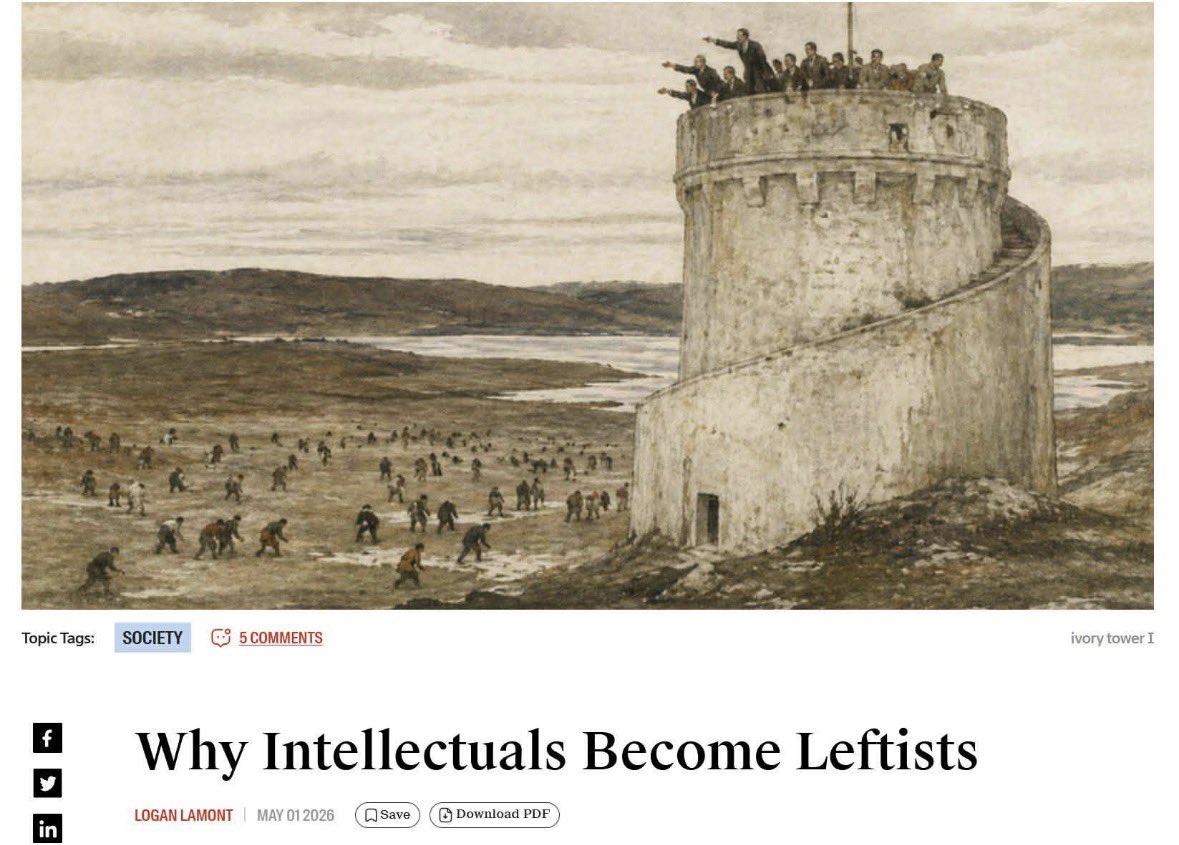
Based on Schumpeter’s Capitalism, Socialism, and Democracy Lamont makes in his article the case that capitalism rewards practical doers who create value for consumers, while undervaluing abstract verbal brilliance, breeding resentment.
Socialism elevates them to central planners & directors with status & protection from markets.
TLDR: Capitalism rewards those who do. Socialism elevates those who direct.
Note: this view is echoed by thinkers like Nozick and Sowell.
Nozick argued intellectuals (“wordsmiths”) develop entitlement in school where verbal brilliance earns top status, then resent capitalism for rewarding practical value-creation for consumers over abstract intellect.
Sowell described them as “the anointed” who overestimate their knowledge for grand social engineering, blame capitalism for society’s ills while ignoring trade-offs and dispersed practical wisdom, and promote visions that elevate their role as planners and critics.
“Argentina's rapid transformation from nearly a century of socialism to free market capitalism continues to prove the superiority of the latter. It is rare that we get to witness such a radical experiment in real time.”
Free markets are the answer.
https://t.co/Bv1rtBh2yO
Pres Reagan was mercilessly mocked and belittled by the liberal elite and their media. He was shot and almost killed. Yet over 2 terms…
He ended the Cold War, freeing half of Europe from an evil empire;
He brought a dying US economy back to life, showing that with economic incentives you could grow at great strides while lowering inflation;
And he revived a sense of pride in America, where patriotism became fashionable again.
He did all that and much more without bombast, summing up his philosophy by a sign he kept on his desk:
“There is no limit to what a man can do or where he can go if he doesn’t mind who gets the credit.”
Happy Birthday, Mr President.
When I see things like this, I'm reminded of something in Tom Holland's book on the founding of Islam: that the Romans who gave money to Arabic tribes to police their borders considered it a subsidy, while the tribes themselves considered it a tribute.
Lee Kuan Yew warned about sectarian (racial/ethnic, religious, communal) voting patterns arising in multicultural societies:
"With the end of empires, new political elites emerge.
Ethnic, religious, linguistic pulls become divisive when the levelling influence of superior authority is removed.
A jostle takes place for ascendancy between the different ethnic, religious and linguistic groups. If you have the one-man-one-vote system, then the temptation to get votes on the basis of ethnic, linguistic or religious loyalties often becomes irresistible.
And so the relentless process of economic decline sets in, because productive digits brought together to co-operate and complement each other under one authority are dislodged and disrupted in a contest for political ascendancy between the diverse groups."
Ironically this was delivered in a speech to the Anglican mission in Singapore in 1968.
The tragedy of Gorton & Denton is that it used to be two different constituencies. Denton was white working class, and Gorton was majority Muslim and born abroad. Now it is a single member constituency, with 30% Muslims.
The Greens ran a very targeted campaign:
> heavy emphasis on Gaza/Palestine and "Stop Islamophobia" messaging
> full court press in Urdu and Punjabi language campaign materials and videos
> explicit endorsements from Muslim voter groups
> Spencer’s victory speech paid homage to the special interest group that delivered her seat
“my Muslim friends and neighbours are just like me: human”
In other words, it became a battle for the Muslim vote bloc.
This is exactly the phenomenon Lee Kuan Yew repeatedly warned about.
The future of Britain is Lebanon.
Lee Kuan Yew explained this… liberal democracy doesn’t work with multiculturalism:
"In multiracial societies, you don't vote in accordance with your economic and social interests. You vote in accordance with your race and religion."
Watching Democrats refuse to stand for Iryna Zarutska’s parents, who were seated 15 feet away from me…
May have been the single most radicalizing moment of my life.
I could not believe it.
I still can’t.
I cannot wrap my head around it.
What I don't understand is how any European left winger who literally saw Yugoslavia go down, would turn around and think "What we need is more diversity and multiculturalism"
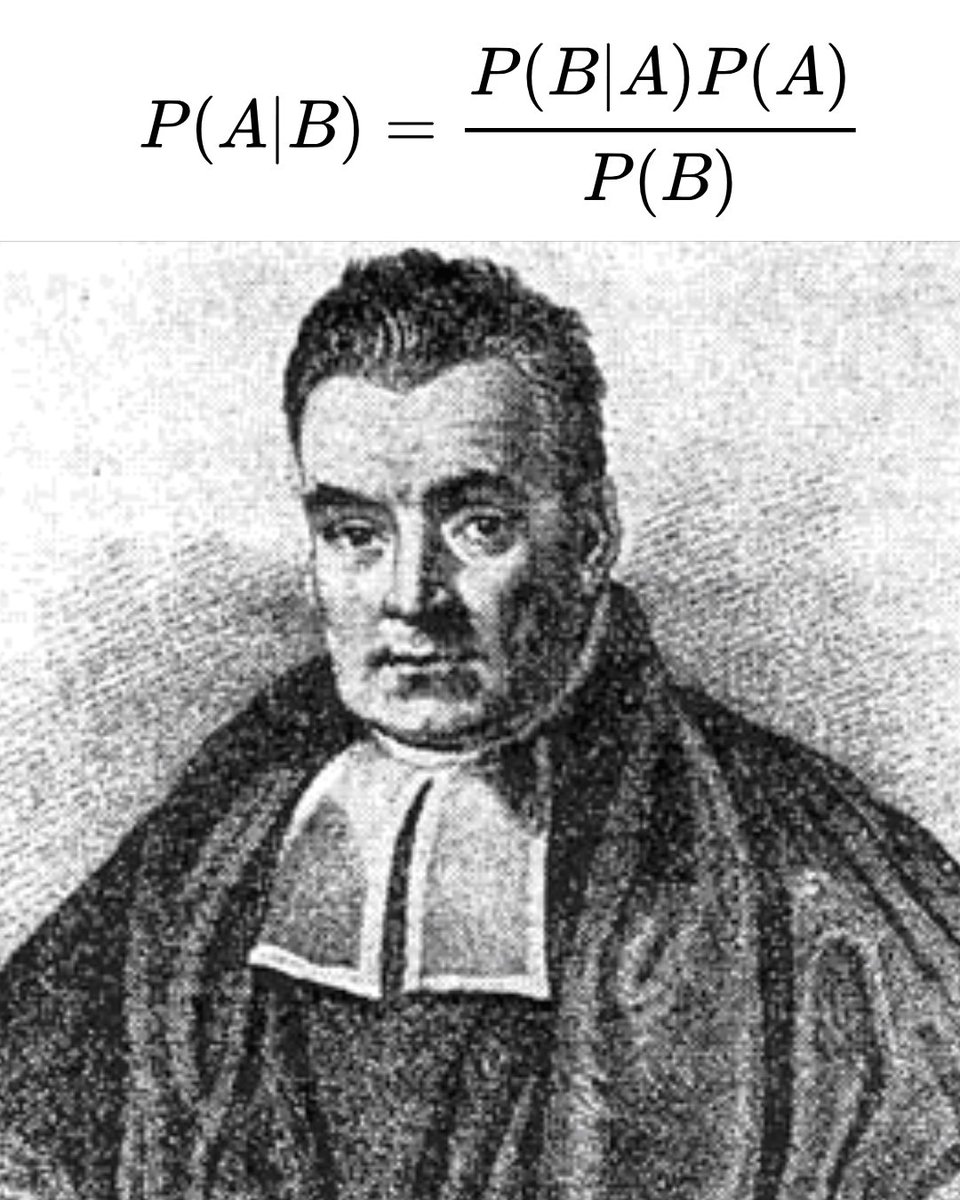
Bayes’ theorem is probably the single most important thing any rational person can learn.
So many of our debates and disagreements that we shout about are because we don’t understand Bayes’ theorem or how human rationality often works.
Bayes’ theorem is named after the 18th-century Thomas Bayes, and essentially it’s a formula that asks: when you are presented with all of the evidence for something, how much should you believe it?
Bayes’ theorem teaches us that our beliefs are not fixed; they are probabilities. Our beliefs change as we weigh new evidence against our assumptions, or our priors. In other words, we all carry certain ideas about how the world works, and new evidence can challenge them.
For example, somebody might believe that smoking is safe, that stress causes mouth ulcers, or that human activity is unrelated to climate change. These are their priors, their starting points. They can be formed by our culture, our biases, or even incomplete information.
Now imagine a new study comes along that challenges one of your priors. A single study might not carry enough weight to overturn your existing beliefs. But as studies accumulate, eventually the scales may tip. At some point, your prior will become less and less plausible.
Bayes’ theorem argues that being rational is not about black and white. It’s not even about true or false. It’s about what is most reasonable based on the best available evidence. But for this to work, we need to be presented with as much high-quality data as possible. Without evidence—without belief-forming data—we are left only with our priors and biases. And those aren’t all that rational.