The era of Robot Money has begun
peaq’s next chapter starts now — enabling robots and machines to do business, on every chain
Read the Purple Paper: https://t.co/cnD2K5j64Z
Imagine you had a humanoid robot. You could teach it to do anything. When it recharged, it could upload its learnings (on an anonymized basis) to all the other robots. It could be the most powerful data network effect in history.
peaq has secured $20 million in the largest @CoinList launch in 2+ years 🎆
Over 14,500 community members contributed over $36 million to oversubscribe peaq’s token launch on @CoinList, making it both the largest raise and the launch with the highest amount of contributed funds on CoinList in over two years 🚀
The peaqonauts showed up in a big way 🧑🚀
The funds will primarily go to ensuring the DePINs building on peaq go on to become category leaders, as well as to accelerate peaqosystem growth, and boost various ecosystem and community initiatives 🦾
The peaqosystem grew 20%+ last month, as peaq continued to cement its position as the home of #DePIN. The funds will help to double down on this growth, while making it easier and faster to build, launch, and scale on peaq ⚡️
Read all about it: https://t.co/aoviWMbN4z
1/ The Polkadot Q4-2023 Update is Here 🔥
Polkadot saw sustained organic growth last quarter, with a big spike in transactional data in late December - while fees remained stable as the network demonstrated its ability to support enhanced activity⚡
1/ 🚨 The wait is over!
Today, @circle has enabled #USDC, the second largest stablecoin by market cap, on Polkadot!
Now, every parachain in Polkadot’s ecosystem can access USDC natively without the need of a bridge.
Learn more in the 🧵 below 👇
On to 2.0
As of today, Parity’s Polkadot node v1.0.0 is released. We are symbolically entering a new era of development for the network. How 2.0 is built is just as important as what 2.0 consists of. This is a vast human effort which needs processes that scale with an ever-increasing technological surface area.
The 1.0 era of core development was defined by delivering the 2016 whitepaper’s initial vision, mostly by the efforts of engineers from a single organization.
The 2.0 era will be defined by a decentralized collective of developers designing and building in the open. This marks a transition from a few agents building software to many agents - sometimes competing, sometimes collaborating, but all working to move things forward.
From now on, Parity will not maintain codebases for Polkadot or Kusama runtimes - neither relay chains or system chains. The contents of those codebases have been moved to a Fellowship repository.
And as always, OpenGov has the final say on which code upgrades are actually accepted by the networks.
https://t.co/ewgE1ZNG8K
Blockspace-centric architectures will outcompete blockchain-centric architectures. So what is blockspace, why should you care about it, and what are blockspace-centric architectures? 🧵 (1/n)
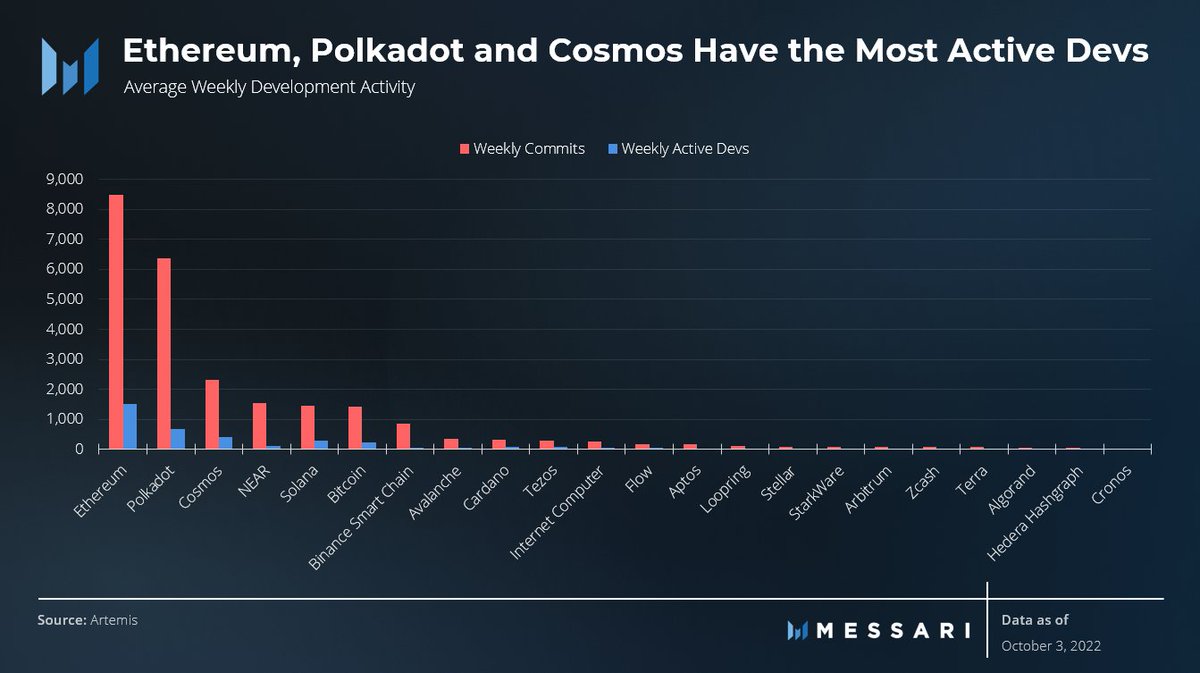
Polkadot still has the largest active developer ecosystem outside Ethereum, with almost 3x more weekly commits than the next largest ecosystem according to @MessariCrypto.
Shout out to the devs that actively contribute to making Polkadot's multichain vision for Web3 a reality.
Roadmap analysis: @cosmos vs @Polkadot - next 6 months.
1/6 Today🔍
Cosmos: built IBC to connect non-shared security chains.
Polkadot: built shared security and XCM to connect between shared security chains.
Both IBC and XCM currently only work between "same-format" chains.
'“Web3” as we think of it today was introduced in 2014 by @gavofyork, one of the cocreators of Ethereum (& founder of W3F, @Polkadot, @kusamanetwork & @ParityTech). Wood’s compact definition of Web3, as he put it in a recent Wired interview, is simple: “Less trust, more truth.”'
“Imagine if every time you did a Google search you had to pay Google a 10th of a cent for electricity. That just doesn’t make any sense…This is the key difference between the model of free execution with Polkadot vs. the smart contract model of transactive execution.”-@gavofyork