Dear IT professionals in their early 30s, take this advice to your heart, and thank me later. 👇👇
I used to think being a techie was all about coding and problem-solving.
Just do your job well, and everything else will fall into place.
I mean, who needs fancy presentations? Let your work speak for itself, right?
I was so Wrong!!!.
The corporate world is a different ball game. It's about selling yourself and your ideas as much as it is about the actual work.
I've learned the hard way that soft skills are just as crucial as technical skills.
Knowing how to communicate your ideas clearly and how to show your work's impact is what sets you apart. It's like being a superhero.
You need the technical skills to fly, but you also need the communication skills to land gracefully.
With AI on the horizon, these soft skills are becoming even more important. It's not just about coding anymore; it's about understanding people, building relationships, and knowing how to stand out.
Negotiation, conflict resolution, and teamwork are often overlooked in the tech world, but they're essential for career growth.
Being able to find common ground, resolve disputes, and collaborate effectively can be the difference between a good career and a great one.
Remember, technology is a tool, but it's people who drive success.
For almost 2-3 decades, this was the default escalator for tier 2 and tier 3 Karnataka talent.
Finish a degree -> join a testing or full stack course at places like JSpiders or QSpiders -> crack a small service firm, -> then get body shopped into a larger IT company.
It was a bit slow, but it worked. It created some sort of predictability.
AI is breaking this pipeline quietly and turning it irrelevant.
Testing scripts, CRUD based full stack work, basic automation, repetitive backend tasks. These were never high leverage skills, but they were employable skills. Now AI tools can do 60 to 80 percent of this work faster, cheaper, and without fatigue. Service firms will not say it openly, but their hiring behaviour already shows it. Fewer freshers. Fewer benches. More expectation from day one.
What worries me more is not AI itself. It is the time lag in understanding.
In Bengaluru tech circles, people are already talking about copilots, agents, prompt driven workflows, and outcome based roles. In tier 2 and tier 3 towns, the conversation is still about which course has better placement, which institute promises 100 percent jobs, which syllabus matches interview questions.
That mismatch is definitely going to hurt!
I see resumes flooding WhatsApp groups with the same keywords. Manual testing. Selenium. Java full stack. React basics. It seems like we are still seeing a system that is training people for yesterday’s jobs. And these youngsters are not lazy or incapable. They are rational actors operating on outdated information.
The tragedy is that AI actually lowers entry barriers if taught right. A sharp youngster from Davanagere or Kalburagi with good thinking skills can now do things that earlier needed years of experience. But nobody is teaching them how to think with AI, how to use it as leverage, how to move from using AI for writing covering letter to problem solving.
If this gap is not addressed soon, we will see a painful phase. More trained people. Fewer real entry level roles. More blaming of the system, or the market, or fate.
The conversation has to shift from learning tools to learning judgment.
If not, AI will not just disrupt jobs. It will break a long standing social contract that tier 2 and tier 3 Karnataka (applies to tier2/3 India too) trusted for upward mobility.
📊 What 1g/month for 15 years really is
It’s a wealth preservation strategy, not a wealth creation strategy.
You’re basically saying:
“I want stable value, not explosive growth.”
Good for security.
Not enough alone to become rich.
🧠 Real formula for getting rich (boring but true)
Increase income (skills > degrees)
Invest monthly
Own growth assets (businesses/stocks)
Hold some safety (gold/cash)
Do this for 10–20 years
Gold = seatbelt
Equity = engine
You need both. But the engine makes you move.
To all worried about not buying gold and silver when it was cheap .
Except a very few percentage of wealthy people - every single one of our parents and grand parents have missed the same bus many decades or years back .
Reason - they did not have that extra cash to buy and were running to meet their monthly expenses .
So - just stop worrying and create a way to make that extra cash .
That extra cash can ONLY , ONLY be created by some type of manufacturing / creation / or small business .
Find what suites you - start as soon as possible with courage .
When you have 10 crore rupees in your bank account - gold and silver price will be least of your worries .
Be practical - stop running behind the herd and find ways to create wealth !
And - live your life . Max 80 years is our life time , don’t spend years whining about gold and silver prices .
If u have missed it - it’s alright . If u have a nice family , great kids or a peaceful life - u r blessed !
In 10,000 years, your country won’t exist. The borders will be dissolved, and your language will be extinct or unrecognizable.
Your digital footprint will be gone, and data will rot faster than stone. Most of what defined us today, money, politics, status and online lives, will vanish without context.
What survives will be fragments: misread, mythologized, guessed at, and wrong.
The uncomfortable truth is this: human certainty is an illusion built on missing data. We don’t know where we truly came from. We don’t know how many civilizations rose, advanced, and quietly reset before us.
As history shows us, it isn’t a straight line of progress, it’s a series of collapses, with survivors writing the story. And we don’t know if we’re evolving… or just approaching another reset.
Every college student dreams of working in IT companies, but only a few actually understand how these companies make money.
Big IT companies like TCS, Infosys, Wipro, and Cognizant don’t make money by building flashy apps or selling products like Google or Apple. They mainly make money by selling skilled people + tech services to other companies.
Here’s the simplified breakdown:
These companies work with banks, hospitals, retail chains, airlines, governments, and big enterprises that don’t want to build tech in-house. So they outsource their work.
1. IT Services (Main Money Maker)
Clients pay them to build, run, and maintain software systems
Examples:
• Bank apps & payment systems
• Company websites & internal tools
• ERP, SAP, cloud migration
They charge per employee per month or per project
2. Outsourcing & Managed Services
Instead of hiring 1000 engineers, companies hire TCS/Infosys to do it cheaper
These IT giants manage:
• Servers
• Databases
• Security
• Daily operations
Clients pay yearly contracts (very stable revenue)
3. Consulting & Digital Transformation
They advise companies on:
• Moving to cloud (AWS, Azure)
• Using AI & data analytics
• Automating business processes
This pays higher margins than normal coding
4. Offshore Advantage (Secret Sauce)
They hire engineers in India at lower cost
Charge clients in US/Europe at higher rates
Difference = profit
5. Long-Term Clients = Predictable Money
Once a company signs, they stay 5–10 years
That’s why these firms have stable revenue, less risk
In short:
They sell time + talent + trust at scale
Not products. Not ads.
Just millions of engineering hours, every year.
That’s how Indian IT giants quietly print billions 🚀
you will age gracefully if you release urgency from your body, talk to a higher power, stretch every day, keep your circle small, nourish yourself with hydrating food, release anything that weighs on your heart, have a carefree heart and a clear conscience, keep your whimsy alive
Tithis affect the nervous system more than the mind. That’s why some days feel off without a reason.
Tithi means Vedic lunar day.
•On Ashtami, the body tires faster.
•On Ekadashi, appetite drops naturally.
•On Chaturdashi, thoughts scatter or intensify.
•On Amavasya, things feel empty or unfinished.
If it didn’t work like this, the Vedic calendar wouldn’t have survived thousands of years without rewriting.
Don’t believe it. Watch it quietly for one lunar cycle.
Luxuries that don't look like luxuries, but are:
1. Working from home
2. Having your mom and dad alive
3. No addiction
4. Peace with your partner
5. Roof over your head
6. Breathing through your nose
7. Food on the table
If somebody wants to strengthen the Sun in your chart, these basic things:
1: Chant Aditya Hrdayam daily. Ideally at sunrise but anytime in day before 10 am is still ok.
2: Worship Shiva in any Shivalaya. It has the added power of making the Moon of your chart shant if you do just Jal abhishek.
3: Offer Arghya to Sun in morning at sunrise.
This is really basic, no cost inexpensive remedy.
4: Chanting Gayatri will always strengthen Sun but not many people can bear internal Surya.
5: Doing homa, any homa will create an Adrshya Surya near the person doing it.
🛕 5 Common Puja Room Mistakes
(that can Backfire as Per Vaastu Principles)
Almost EVERYONE does the 4th Mistake!
1. Using mandir as storage
Bills, keys, medicines, matchbox = blocked energy
→ Fix → Keep only puja items here
2. Broken idols or cracked photos
Creates mental stress & delays
→ Fix → Replace damaged sacred items
3. Mandir near toilet / under stairs
Disturbs peace & focus
→ Fix → Use a wooden mandir + keep it covered
4. Old/burnt diya & old flowers (Most Common)
Stagnant energy at home
→ Fix → Clean daily, remove flowers on time
5. Praying in wrong direction
Reduces calmness
→ Fix → Face East or North
✨ Vastu = small habits, big shift
#vastu #vaastu #puja #mandir #temple #sanatan #dharma
Be extremely careful what you say consciously or unconsciously, what you feel and what you do. Every word has a verbal and a nervous reaction, which sets a wave going.
@DealsDhamaka What about the maintenance cost for iPhone screen and body damages? Its darn expensive. Using Samsung S23 since 2 years, after 8 years of using iPhone. Compact design and Smooth UI/UX, good SW updates, no hardware or software issues so far. Dropped multiple times, ZERO damages.
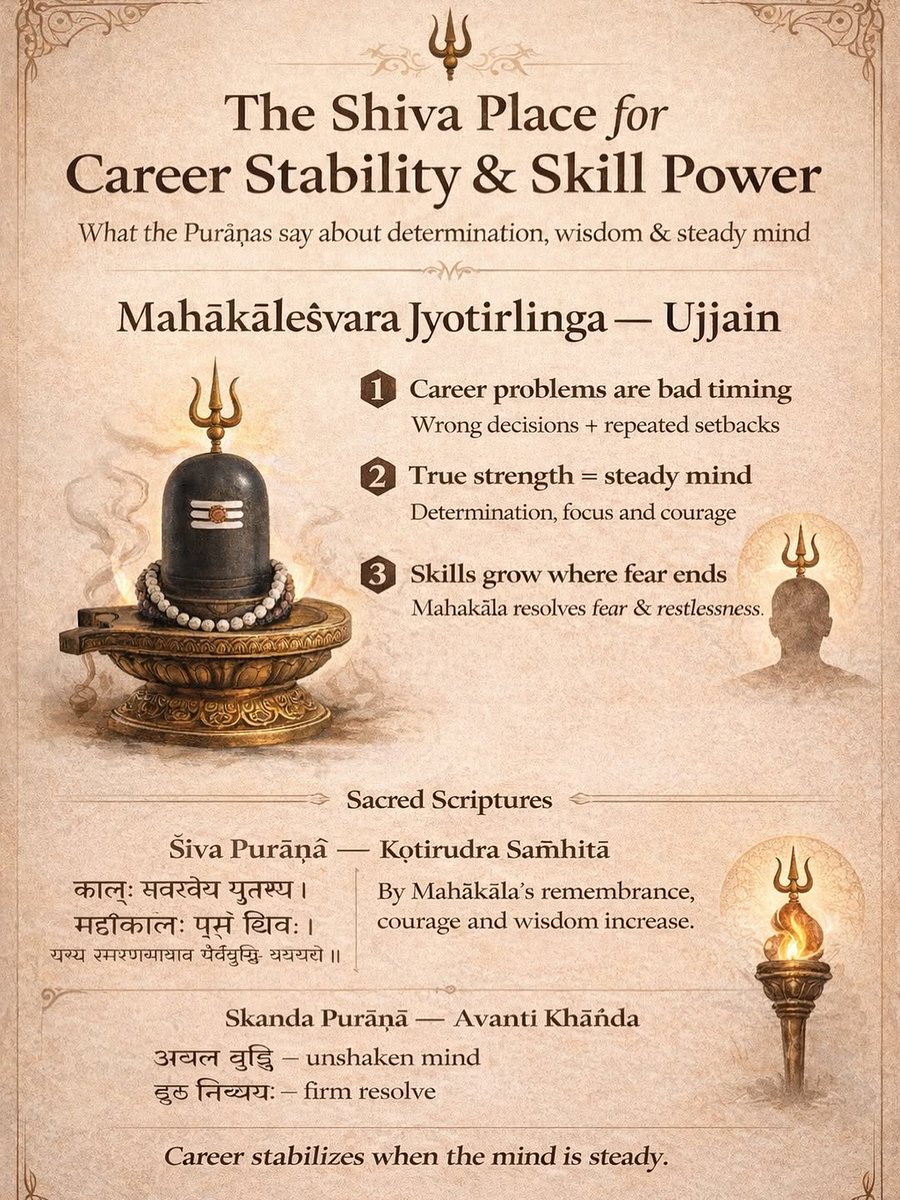
The Shiva Place for Career Stability & Skill 🕉️
Power
The Puranas never describe career problems as a lack of luck.
They describe them as a disturbance of time-sense and mind-steadiness.
When decisions are rushed, fear-driven, or repeatedly reactive, effort scatters and skills fail to compound.
That is why Mahākāleśvara Jyotirlinga (Ujjain) is not associated with wealth alone -
it is associated with clarity of timing, courage, and an unshaken mind.
In the Śiva Purāna (Kotirudra Samhitā), Mahākāla is remembered as the form of Shiva who:
dissolves inner fear
steadies intelligence
restores confidence in right action
The Skanda Purāna (Avanti Khanda) repeatedly connects Mahākāla with:
acala buddhi
an unmoving intellect
drdha niścaya
- firm resolve
Because when the mind stops trembling, skills begin to grow naturally.
Shiva here is not changing external circumstances.
He is reordering the inner clock - so actions align with time instead of fighting it.
That is why careers stabilize not by force, but when fear ends and steadiness begins.
Career stabilizes when the mind is steady.
This is the Mahākāla principle.
5. Buy a car only if you can comfortably pay for it in cash or with short-term financing, avoid long loans that tie up your income for years.
6. Don’t feel pressured to attend every wedding, birthday, or social event, politely decline invitations when your budget or energy doesn’t allow it.
7. Stop comparing your life timeline to others on social media, many people only show highlights, not their struggles or debts.
8. Invest and save at your own pace, don’t rush into “get rich quick” schemes or copy risky moves just because friends are bragging about gains.
9. Choose vacations and holidays that fit your actual budget, a simple, peaceful getaway is better than an expensive trip that leaves you stressed and in debt.
10. Prioritize your health and peace of mind over impressing others, eating home-cooked meals, exercising regularly, and getting enough sleep are free and priceless.