Lecturer @hslu, Computer Science and Information Technology // Former @CSS_ETHZurich/@ETH, @ECFR, @Pacificforum // cyber warfighting, IW, CEMA, space 🃔
My latest for @lawfare on the "Cyber Corps: Ukraine's least understood cyber actor."
"By the summer of 2024, the Ukrainian military intelligence service (GUR) was one of the closest-watched actors in the Russia-Ukraine war. News outlets reported extensively about the service’s maritime drone campaign against Russia’s Black Sea fleet and drone strikes against Moscow’s strategic early-warning radar network. At the same time, the GUR had begun to self-attribute its offensive cyber operations, an unusual departure from the traditional secrecy of other intelligence services. Yet, on July 1, 2024, another development connected to the GUR passed almost unnoticed. A small band of hacktivists calling themselves the Cyber Corps (Кіберкорпус) quietly appeared on Telegram, claiming the group “was created by officers of the GUR of the Ministry of Defense.”
Whether the Cyber Corps is genuinely affiliated with the Ukrainian military intelligence service cannot be answered definitively. But a series of indicators and circumstantial evidence suggest some form of organizational relationship. To date, the GUR has neither endorsed the Cyber Corps’ claim that GUR officers created it, nor repudiated the corps’ claims taking credit for cyber operations the GUR officially conducted. Curiously, the Cyber Corps’ distributed denial-of-service (DDoS) activities also increasingly overlapped with, and ultimately led to the absorption of, parts of the IT Army of Ukraine."
Link: https://t.co/3F4gI2flK5
Yesterday (Nov. 26), the Foreign Relations Counsellors (RELEX) meeting took place. As expected, cyber restrictive measures (i.e. sanctions) were on the agenda.
if there were no disagreements in the RELEX meeting, the next step in the EU Council's bureaucratic pipeline is for cyber sanction to appear as non-discussion item for approval on the agenda of the next COREPER II meeting (Committee of Permanent Representatives). COREPER essentially votes on whether to propose the item to the Council for adoption. The next COREPER II meeting is on December 2.
Note 1: If the cyber sanctions appear as a discussion item (item II), then we know that some member states need more convincing - i.e. the French have not yet succeeded.
Note 2: If it is on the agenda as non-discussion item and all representatives agree, the sanctions will be forwarded as an A item to the Council without further discussions. If one or more representatives still have reservations, it will be forwarded as a B item to the ministers for further political discussion. And if one or more representatives disagree, then the item goes back to RELEX to figure out what to do.
If it is approved as an A item by COREPER II, the EU Council has to formally adopt the sanctions. This can happen at any time either in written form or in-person at any other Council meeting. Normally, nothing should go wrong here as all the preparatory meetings ironed out any disagreements.
If the French succeeded in convincing all the other member states, then the sanctions should be publicly announced between December 3-11. If the French want to make a diplomatic spectacle out of it, then they might wait until December 14, when the next Foreign Affairs meeting is taking place (i.e. when all the 27 foreign ministers meet in-person in Brussels).
p.s. Next week Monday or Tuesday the updated COREPER II agenda should be published online, so we can check whether cyber sanctions appear as non-discussion or discussion item. If they are not on the list, then know that there were disagreements within RELEX.
Also note, since EU cyber sanctions are a non-legislative item, the Council does not publish the COREPER II voting record on cyber sanctions. So, sadly, we will not know whether all 27 members voted positively on the sanctions item or whether some members abstained.
I hope this helps a bit to understand the EU's bureaucratic machinery.
It looks as if the French government has succeeded in convincing the other EU member states to support the implementation of cyber sanctions against the IRGC for the refrigerator attacks.
On November 18, four documents were disseminated in the EU Council titled "Cyber restrictive measures 20261118 - Evidence" (Screenshot 1).
(Note: On November 16, Barrot announced that he would present evidence to his EU counterparts)
On November 19, the EU Council's Horizontal Working Party on Cyber Issues approved new cyber sanction listings (Screenshot 2).
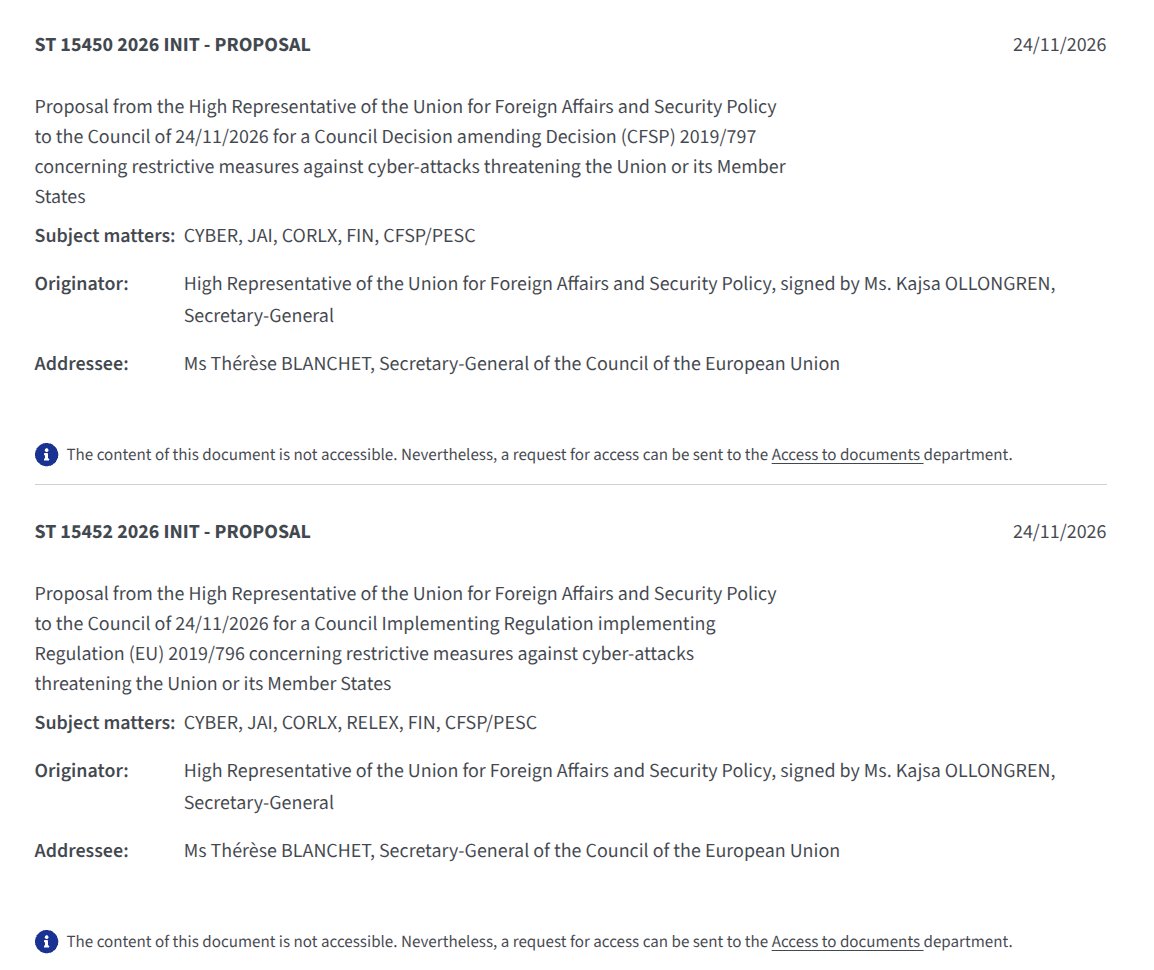
And on November 24, the High Representative put forward a proposal to amend the EU's cyber sanctions list (Screenshot 3).
I expect new EU cyber sanctions to be announced pretty soon.
p.s. I have put in a FOI request for the four evidence documents. But I doubt the EU Council will release them. Nonetheless worth a try :)
This is the most informed overview so far of Russian military's digital transformation, told by the man in charge of it, Deputy Defense Minister Dmitry Shcherbinin (a civilian with defense industry, tech, policy background brought to the MoD by Belousov)
https://t.co/fLUpWYCzxR
NEW from me: Confirming WSJ that U.S. officials have identified as many as 50 commercial vessels hit by cyberattacks, investigating ties to Iran. Am told they got in via Fortinet system vulnerabilities, and were able to hop from IT to OT systems.
https://t.co/sv3ZMWhOCB
It's quite interesting to see how all major media outlets are jumping on the Rosstat data leak to report on Russian military casualty figures, but don't cover the groups themselves, the ecosystem behind it, nor the role of "hacktivism" in war.
Director of National Intelligence Jay Clayton says NSA outage caused by the agency applying software patches for vulnerabilities discovered last month that affected a large swath of the internet: https://t.co/gGQDUZRptB
And so it begins...
Just remember: There is no evidentiary attribution standard Paris has to clear. I highly doubt that no matter how weak or strong France's evidence might be, none of the 26 member states will deny Paris its push for Iran sanctions.
https://t.co/EUO19jE9P2
I don't know ... the only thing that convinces me in France's attribution assessment is the infrastructure overlap to the Shahid Kaveh recon campaign in April.
The rest is weak sauce. FOFA is widely available. CyberbanNews article after the fact doesn't mean much. And Farsi language traces is suggestive, but insufficient.
It's also just bad practice by the French to not even state whether this attribution assessment is high, medium, or low confidence level.
The publication of the attribution assessment by the French judiciary/police, foreign ministry, and ANSSI shows a whole of government approach. But what strikes me as odd is Paris' quick unilaterism. One would assume that given how widespread this campaign likely was, that the French government would coordinate a unified response with all the other affected EU countries. Instead, Paris storms ahead with its public attribution, summons the Iranian ambassador, and then wants to push for another round of EU sanctions (???)
We'll see whether other EU governments will release their own attribution assessments before the EU's Foreign Affairs Council meeting on November 16. My best guess is that France will share some of its classified intelligence insights with the affected member states beforehand. If not, then this could become a rather awkward meeting for France.
p.s. Foreign policy-wise it would make a lot of sense for the US administration to push out their attribution assessment - if it was Iran. This might entice its European allies to join the next stage in the war against Iran.
p.s.2 I just can't shake the feeling that Paris is getting played.
Source: https://t.co/yplWhol938
Also, Jenna McLaughlin's Nov. 3 article is quite informative: https://t.co/HTqwELCmNy
New: U.S. spy agencies have a "low confidence" judgment Iran is responsible for the cyberattacks on France's refrigeration systems, three sources tell me. Unlike France the U.S. does not pin blame on a specific group. U.S. sees Iran as leading suspect on attacks across Europe too
“I’ve never been approached by a service member asking to develop a drone with AI built in. The job is to identify and solve practical problems”, a Brave1 representative told NBC News.
Brave1 supports Ukrainian developers building AI-driven solutions, including Clarity AI and Dwarf Engineering. The task is not to replace humans, but to make their work simpler and less dangerous.
@NBCNews takes a closer look at how this shift is unfolding in Ukraine. Article in the first reply👇
In cases you are interested in parts of my longer answers (This was before the French attribution statement came out):
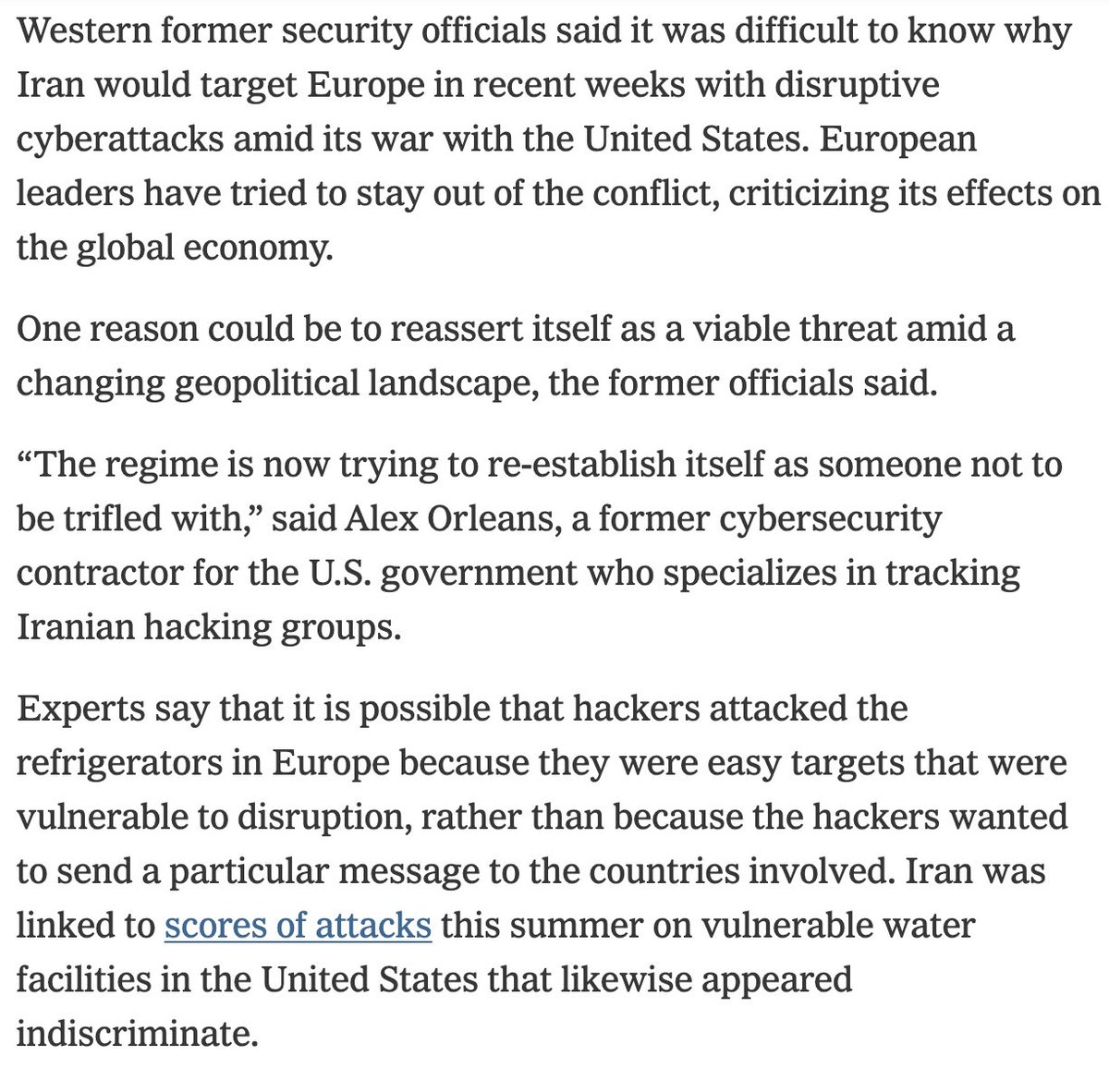
Several threat actors have previously demonstrated an interest in sabotaging refrigeration systems. But none have mounted a cross-border campaign that systematically used defrost functions, manipulated temperature settings, suppressed alarms, and locked operators out of refrigeration controllers (https://t.co/votVSfZvcw). The current campaign in Europe is considerably more elaborate and carefully planned than anything we have seen prior, and is primarily targeting Danfoss and Copeland/Dixell refrigeration controllers (https://t.co/Q7Drdxfe37).
(Note: It is still unclear whether the attacks in Europe and those against US military commissaries (https://t.co/0N19APZwWA) are connected, were carried out by the same threat actor, and whether the full range of techniques observed in Europe was also used in the US).
(Anonymous) For example, shortly after the Russian invasion in February 2022, a threat actor suspected to be affiliated with Anonymous accessed a Danfoss controller at Russia's Selyatino Agricultural Hub. He changed the temperature settings from −24°C to +30°C which threatened to spoil around 40.000 tons of frozen meat and fish products (https://t.co/pg8RB46ABP); Danfloss itself noted in its October 2025 Tech Insider Newsletter that “sixteen [Russian] supermarkets using AK SM 800 were targeted by cyberattacks at the start of the war. The hacker group Anonymous publicly encouraged disrupting Russian infrastructure” (https://t.co/KyQ6UfR9fn, p. 9).
(Iran) The same Danfloss newsletter also notes that in 2022, “forty stores were hacked [in Israel]. All affected stores lacked proper firewall or VPN protection, and all used AK SM 800. Only the SM800 was affected” (https://t.co/KyQ6UfR9fn, p. 9). Noam Rotem and Ido Kenan published a piece back in August 2023 that looked into the hacking and shutdown of industrial refrigerator systems at a Shufersal supermarket in Tel Aviv (https://t.co/vBnmq82Vb0). The investigation did not identify the manufacturer of the compromised refrigeration controls, so a connection to Danfoss or Copeland remains unconfirmed. In May 2026, Profero investigated an attack on an Israeli food-production facility and attributed it with high confidence to the IRGC-linked Cyber Isnaad Front. The attack involved wiper malware and compressor damage, with no identified Danfoss or Copeland equipment (https://t.co/9ibf7kRlCF). NPR talked to Profero’s CEO Omri Segev Moyal last week and he of course was confident that the recent refrigerator attacks in the US and Europe were conducted by the Cyber Isnaad Front as well (https://t.co/MX2tEz2NIP).
(Russia) In November 2024, the pro-Russian hacktivist group CyberArmyofRussia_Reborn (CARR)/Z-Pentest, compromised a meat-processing facility in Los Angeles and shut off its refrigeration, spoiling more than 2.000 pounds of meat and triggering an ammonia leak to force an evacuation (https://t.co/9rJwSEbI4V). Notably, the DoJ’s indictment does not identify the manufacturer of the refrigeration controls nor whether the attackers activated defrost mode.
So, from a technical perspective, the recent self-attribution by NoName and Z-Pentest is unconvincing. The current attacks demonstrate a level of operational planning and familiarity with industrial refrigeration systems that we have not previously seen from these groups. Rather than simply shutting down equipment or changing temperature settings, the attackers systematically exploited defrost functions, suppressed alarms and locked operators out of controllers, potentially preventing intervention while refrigerated goods deteriorated. The Copeland incident also involved hundreds of parameter changes across dozens of devices within minutes, suggesting a level of automation. This requires a different set of skills, including knowledge of refrigeration processes, controller-specific commands, and automated attack tooling.
////////////
Supermarket refrigeration systems are/were very attractive because they are/were relatively easy to discover and access. Many controllers had/have publicly exposed management interfaces, often protected only by weak or default passwords (https://t.co/votVSfZvcw). So, there is no need to even exploit any software vulnerabilities. Refrigeration systems also offer measurable physical effects, immediate visibility, and considerable media attention. One possibility could be that we are dealing with a non-political threat actor that is simply experimenting with automated attack protocols, potentially using AI tools to discover vulnerable systems, manipulate controllers and campaign across multiple countries. In this scenario, the attacks themselves are the experiment, while the public media coverage and government reactions provide the cherry on top.
Alternatively, the objective could be psychological to demonstrate how unprepared businesses are and to show how governments are unable to protect everyday services. Attacks against European supermarket chains and US military commissaries could also send a broader message about national preparedness for war. If a country cannot protect its refrigeration infrastructure, how prepared is it for armed conflict at home? Another possible motive could be retaliation, particularly by Russian or Iranian actors that might be seeking to make Western populations experience some of the economic hardship they are enduring.
////////////
Industrial refrigeration systems have been vulnerable for years - if not decades - largely because their security has never been a priority. Many controllers remain accessible via the open internet, weak and default passwords, and run outdated or unsupported software. Yet, attackers have rarely bothered to exploited these weaknesses systematically in a cross-border campaigning fashion. Refrigeration controllers offer limited opportunities for conventional ransomware. Similarly, isolated supermarket outages have little national-security significance. And spoiling food sends no obvious political message either. This may explain why we have not previously seen a comparable highly coordinated cross-border sabotage campaign to begin with.
////////////
Currently, we are being forced to learn from our adversaries who repeatedly exploit systems that we ourselves are reluctant to touch. They are gaining practical experience in conducting cyber operations against physical infrastructure, while we largely confine ourselves to studying the consequences and issuing defensive guidance. That is not a sustainable approach for a Europe that is sleepwalking into war. Europe needs to develop its own understanding of offensive cyber operations through systematic research, realistic experimentation and sustained cyber warfighting exercises, rather than waiting for adversaries to demonstrate what is possible.
Bianca Ferrari and Samuel Dempsey wrote a piece on "Who keeps cooking Europe’s frozen peas?" for the European Correspondent.
(with a few comments from my end)
https://t.co/qhsS2UHvTC