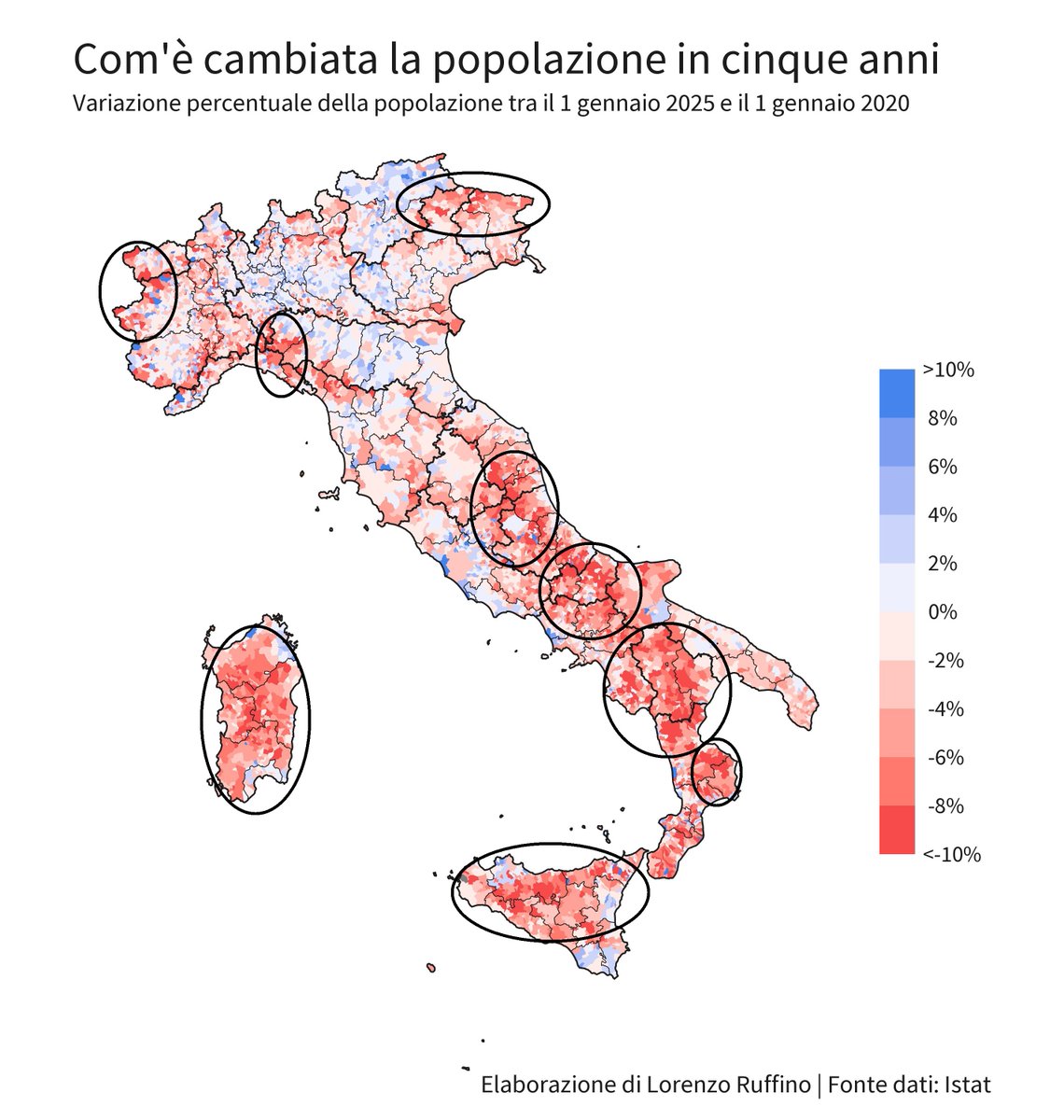
L'emigrazione dal Sud verso il Nord è purtroppo un fenomeno datato dovuto all'arretratezza delle Regioni del Sud in cui rispetto a quelle del Nord ci sono meno infrastrutture (autostrade e ferrovie), meno servizi (scuole, ospedali e impianti di smaltimento rifiuti) e pochissima industria. Un divario causato dai minori investimenti pubblici solo parzialmente ridotto durante il periodo del miracolo economico italiano e dell'IRI.
Ahead of the Islamabad Talks
A. Negotiations will be difficult. However, it’s important to recognize that this time the administration is bringing in Vice President Vance, who has a clear political interest in preventing a renewed escalation. Beyond domestic politics, Washington is acutely aware of the consequences of a breakdown: a major shock to global energy markets and highly problematic military options, ranging from strikes on civilian infrastructure to the risks of ground operations. In other words, both political incentives and strategic risks are pushing the U.S. toward avoiding collapse of the talks.
B. The gaps between the parties remain significant. Iran’s leadership is unlikely to concede on its missile program, and certainly not on its right to enrich uranium. In any scenario involving full sanctions relief, the issue of the 60% 440 kg enriched uranium stockpile will likely become a central sticking point.
C. The Strait of Hormuz issue is largely behind us. By effectively acknowledging Iran’s control over the strait, the U.S. has helped solidify this reality. Iran can already begin to reap the associated economic benefits. However, any expectation in Washington that Tehran will make concessions on force buildup or strategic capabilities is likely misplaced.
D. While the current ceasefire is temporary, the costs of the war and, critically, the growing recognition in Washington that regime change is not achievable and that enriched uranium cannot be eliminated through military means, may soften the U.S. negotiating position. Unlike previous rounds (e.g., Geneva), the administration’s ability to credibly threaten war has diminished. From Tehran’s perspective, they have already endured the worst.
E. Iran’s economic situation is dire, worse than before the war. Economic relief is therefore a critical priority for Tehran. That said, it is doubtful that Iran would trade core regime pillars for economic concessions
F. One of Iran’s most significant achievements, especially given that it stepped back from insisting on a permanent ceasefire (assuming there are no undisclosed understandings about extending the truce or U.S. recognition of its right to enrich), is the apparent U.S. willingness to engage in negotiations based on Iran’s 10-point framework.
G. This is notable because the gap between Iran’s 10 points and the administration’s 15-point framework remains substantial. The central question is whether Washington is prepared to move closer to Tehran’s positions, particularly on uranium enrichment and missile capabilities. These issues will be decisive not only for the negotiations, but for whether the conflict resumes.
H. Who Really Wants the Deal?
It is important to recognize that the push for negotiations originated in Washington. In practice, it was the Trump administration that shaped, if not dictated, the proposal conveyed via Pakistan for a two-week ceasefire. This matters because it suggests that the administration is entering the talks with a strong desire to reach an agreement quickly.
I. That does not mean Iran lacks interest, far from it, given its economic situation, but the sense of urgency appears to be more pronounced on the U.S. side
The bottom line is that current negotiations are not driven by optimism, but by a shared interest in avoiding further losses rather than securing victory.
#IranWar
allora il solco si è ampliato. Una marea di giovani continua a scappare dai territori del Sud + Isole, andando a rintuzzare momentaneamente la crisi demografica al Nord. Questo ovviamente crea squilibri sistemici, nel completo disinteresse della politica che ha cessato
2/4
This Saudi-centric analysis captures core dynamics of the Gulf order, but the crown jewel of UAE strategy is the Abraham Accords.
Unlike Kuwait or Doha, Abu Dhabi has sought to recalibrate the Gulf hierarchy through proximity to Israel (& its Zionist lobby), positioning itself as its principal Arab ally. This was designed as an effort to manufacture an new source of regional centrality, implicitly challenging Saudi Arabia’s monopoly over Arab-Muslim legitimacy.
Theres a very long list of US products that cannot be sold in the EU thanks to EU regulations. Since the favorite pastime of the Trump regime and every US oligarch is now to demonize EU regulations, I thought it would be very much worth going through some of those products.🧵
Dibattito che arriva anche al @Corriere: Regioni, perché hanno fallito e vanno abolite (o fortemente ridimensionate): 55 anni di democrazia degenerata | https://t.co/2sOrOk5Gdi https://t.co/0KEyU9QeDL
Spoiler: magari
Algeria just signed a $5.4 billion, 30-year oil & gas deal with Saudi Arabia’s Midad Energy.
This isn’t just another upstream contract — it’s a strategic signal about energy alliances in the Arab world.
👇🧵
L'Intelligenza Artificiale non può toglierti il lavoro, ma i sedicenti esperti che la spingono al tuo CEO senza sapere di cosa parlano si. Giga-thread di pensieri sparsi che puntano a descrivere i problemi di un mercato insostenibile che scaricherà il conto sui lavoratori.🧵
Right now, Turkey is the foreign state that dominates the international dimension of Libya’s crisis.
Ankara is not just the most consequential interferer, but also the most ambitious. It is attempting to pull off a complete 180-degree strategic reversal. The Turks have demanded that Prime Minister Dabaiba refrain from any military offensive in Tripoli. And they have been using the phrase “a new unified government,” a phrase that is (correctly) perceived by the Dabaiba family as an existential threat.
At the very same time, Turkey is sending military resources to the Haftar family, offering it training, and seeking to fully seduce it so as to achieve Turkey’s long-standing strategic goal: legislative ratification of the maritime border memorandum signed by Ankara and Tripoli 6 years ago.
I.e., the Dabaiba family is expected to fade gently into the good night.
But two op-eds published by the Dabaiba government this week in Europe reveal that the family has zero intention of going anywhere.
As Dabaiba informed US envoy Massad Boulos earlier this week, the incumbent Tripoli government rejects the notion of a new unified government ahead of elections.
In those op-eds, we are seeing for the first time the Dabaiba camp openly and bitterly criticize the Haftars.
Said differently, neither dynastic family is currently seeking an update of the economic arrangement they had forged in July 2022.
The reality is that the Haftar family would love to see Dabaiba shoot himself in the foot in Tripoli and ideally would love to see Turkey do the dirty work of easing him out of office.
Faced with this stark impasse, it is perhaps useful to not pre-suppose that Turkey succeeds at everything it touches. Sometimes, even Turkey’s foreign policy goes awry.
@med_eye io ricordo Avellino, Teramo, l'Aquila e forse qualcosa a Caserta: una cosa abbastanza carbonara, ma con finale in grande stile e quasi-rissa al Foro Italico a Roma. Spero che quest'anno non ci deludano - e non succederà.
Cultural reset: Gianluca Fru sale clandestinamente sul palco dell’ariston improvvisando una coreo su tu con con chi fai l’amore
#FestivaldiSanremo2025#sanremo2025
Per il nuovo capo del Pentagono l'Ucraina non entrerà nella Nato, non avrà un Articolo 5 e non tornerà ai confini del 2014. E' quello che la Russia chiedeva alla vigilia dell'invasione, che è stato discusso nei colloqui in Bielorussia e Turchia, e che da molti mesi tutti sanno.
stampa mainstream sta veicolando l'idea che sia in preparazione uno scontro intra-nato per la groenlandia, causato dalle paure dell'ue che trump voglia invadere l'isola.
la realtà è inversa: trump voleva maggiore impegno nato in groenlandia - e lo sta ottenendo.
“As Donald Trump prepares his triumphant return to the White House, American allies in Europe are waking up to a disagreeable reality. In Mr. Trump’s second term, the U.S. is going to be more powerful relative to its core allies than at any time in decades—and Mr. Trump’s second term is going to be even more disruptive and confrontational than his first.
Sadly, with the exception of the U.S., much of the West is sunk in decline. A generation of poor performance in the European Union and Japan means that America’s traditional partners bring less and less to the table each year. Japan seems to be undergoing an awakening. But many of our most important European allies are contending with three decades of economic, political and strategic failure.
Economically, our European partners and friends are failing the test of the digital age, generating neither the new technologies nor companies that the 21st-century demands. Their embrace of ruinous climate policies reduces their competitiveness. Their NIMBYism throttles growth, and their unsustainable welfare states further diminish their prospects.
Politically, our friends haven’t succeeded in making the EU great. Individual European states are too small to have much effect on global events, and when they try to act together, they punch below their weight. The EU bureaucracy moves too slowly and often with too many reservations and compromises to maintain Europe’s place among leading global actors. Meanwhile, partially as a result of a massive failure to manage migration policy and its consequences, the political establishment in country after country is losing ground to radical movements, sometimes on the left but more often on the right.
Strategically, the failure is even more dramatic. Europe is more vulnerable to Middle East disorder, Russian aggression and predatory Chinese economic policies than the U.S. is, but its responses to these and other challenges are as inept as they are insufficient. Even as waves of refugees from an exploding Middle East and North Africa triggered political and social crises across Europe, European diplomacy has remained essentially irrelevant in the region.
Europe has been passive in the face of Houthi interference with Red Sea commerce. Russia has kicked France out of Africa. Almost three years into Russia’s war in Ukraine, Europe still feeds Vladimir Putin’s war machine by buying Russian energy. Europe’s poorly conceived green policies have positioned China to destroy the automobile industry, a pillar of Europe’s economy and social stability.
As a result, Europe needs the U.S. more than ever but is less well situated to influence American policy—or to help the U.S. meet our many global challenges—than at any time in decades. This is why the leaders of once-great European powers tremble at every tweet from Mar-a-Lago and why Mr. Trump’s second term holds more challenges for Europe than his first.
For Europeans, the shift from Team Biden’s largely uncritical support will be painful. “Germany is my country’s closest and most important of allies,” President Biden told German Chancellor Olaf Scholz in October. For Team Biden, getting along with Germany was the foundation of smart foreign policy. That the Germans have been consistently and gravely wrong about Russia, China, Iran, climate, migration, the importance of strong defense and the condition of their own economy never seems to have registered with an American president whose worldview comes out of the 1970s and 1980s…”👇
As Russia shifts its gaze from Assad to Haftar, the Mediterranean once again becomes a theater of fragile power plays and unlearned lessons.
My latest @ACMideast@AtlanticCouncil examines the echoes of Syria’s collapse in Libya’s uncertain future:
https://t.co/91H7Ia40cp