Massive week ahead for creators and builders! 💸
If you're looking to stack some extra rewards, you're in the right place. I've rounded up some of the best active bounties, builder contests, and campaigns you can jump into right now 👇
→ Pharos Creators Earn: $7,800
Ends: July 27
https://t.co/SAuYQ7kH5f
→ Higgsfield Building Contest: $100,000
Ends: July 22
https://t.co/5CaZiYBqBO
→ Butta Redesign Art Contest: $4,500
Ends: August 17
https://t.co/UJXPdnZdpz
→ AI Video Contest: 2M Credits
Ends: August 25
https://t.co/Pm7gc3ZE8D
→ Art Contest: $1,000
Ends: August 3
https://t.co/m6RDvQxGHB
→ Instagram Reel Contest: $500
Ends: July 24
https://t.co/4wax3K84DY
→ $BARON Trading Contest: $500
Ends: July 27
https://t.co/LgKm1ad2kv
→ PantherTerminal Theme Contest: $150
Ends: July 24
https://t.co/4zbSw2Qeh4
→ Crynux Thread Contest: $100
Ends: July 25
https://t.co/ly7P67GiJy
→ Weekly Content Contest: $300
Runs weekly.
https://t.co/Ft7J59xdDN
📌 Bookmark this post so you don't miss a single deadline, and let's get building! 🤝
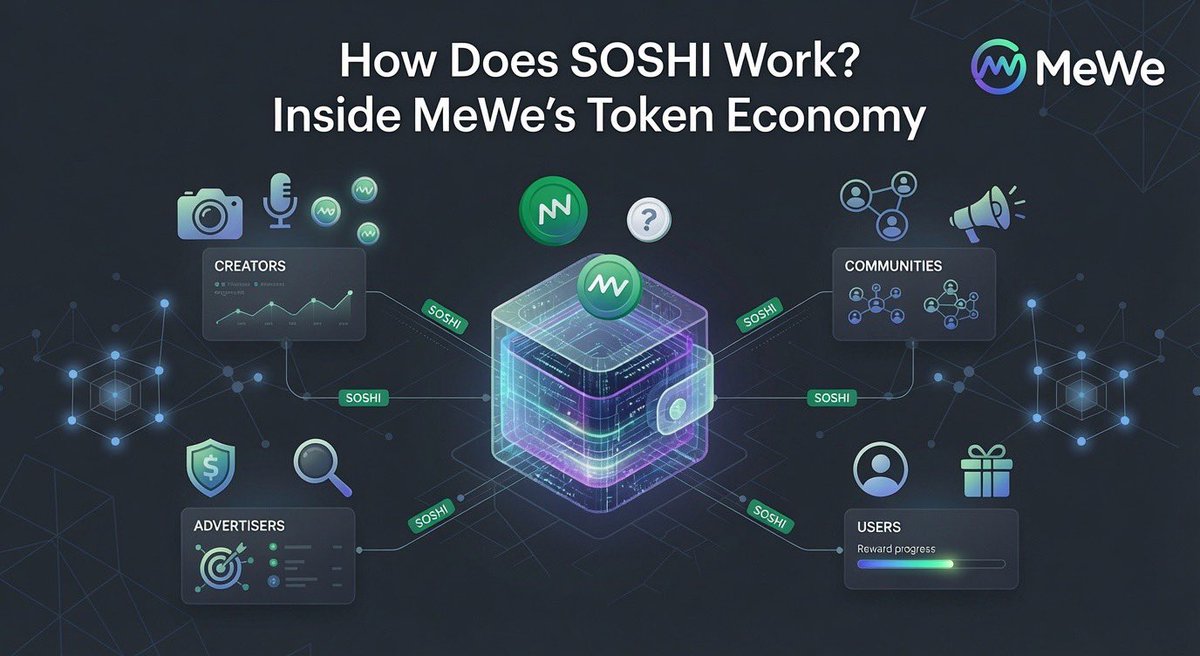
𝐇𝐨𝐰 𝐃𝐨𝐞𝐬 𝐒𝐎𝐒𝐇𝐈 𝐖𝐨𝐫𝐤? 𝐈𝐧𝐬𝐢𝐝𝐞 𝐦𝐞𝐰𝐞’𝐬 𝐓𝐨𝐤𝐞𝐧 𝐄𝐜𝐨𝐧𝐨𝐦𝐲
Most social platforms have never paid users directly for the value they create. SOHSHI is the exception worth understanding in detail, because it isn’t a theoretical whitepaper concept, it’s a live token economy already running inside mewe , the privacy first social platform with a reported base of over 21 million users
𝐒𝐎𝐒𝐇𝐈 𝐜𝐚𝐧 𝐛𝐞 𝐞𝐚𝐫𝐧𝐞𝐝 𝐭𝐡𝐫𝐨𝐮𝐠𝐡 𝐟𝐨𝐮𝐫 𝐝𝐢𝐬𝐭𝐢𝐧𝐜𝐭 𝐦𝐞𝐜𝐡𝐚𝐧𝐢𝐬𝐦𝐬 𝐫𝐢𝐠𝐡𝐭 𝐧𝐨𝐰 :
1. direct tipping from other users
2. opt-in ad rewards
3. a structured referral program
4. rewards for community leadership roles like group moderation.
It runs on Soshi, a decentralized social protocol built on Avalanche, and it's accessed through an embedded wallet inside the @mewe app itself which meaning a new user doesn't need prior crypto experience to start earning it.
That's the short answer. The longer answer, and the part most coverage of "social media that pays you" gets vague about, is exactly how each of these mechanisms actually functions, what's live today versus what's still rolling out, and how it genuinely compares to the other platforms making similar promises.
(Source : https://t.co/gF5t9vKYRm)
𝐖𝐡𝐚𝐭 𝐀𝐜𝐭𝐮𝐚𝐥𝐥𝐲 𝐇𝐚𝐩𝐩𝐞𝐧𝐬 𝐈𝐧𝐬𝐢𝐝𝐞 𝐀𝐈𝐎𝐍
Most people hear "AI agent running your marketing" and picture something unsupervised, publishing whatever it wants while you sleep.
That's not how @oortech built AION, and understanding the actual mechanics behind it changes what the tool means entirely.
AION is a multi agent system designed to automate the operational layer of a Web3 project, social media, community management, internal collaboration, and paid media, without removing the human from the decision that actually matters. Every agent inside it runs its own continuous loop, but that loop always ends at the same place.
A human click. Nothing goes public without an operator approving, rejecting, or rewriting it first.
Here's the actual cycle every module follows, and it's worth understanding because it's the same five steps regardless of which channel the agent is working in.
𝐌𝐨𝐧𝐢𝐭𝐨𝐫 ➜ The agent watches continuously, not on a schedule, not when someone remembers to check, but constantly, across whatever it's assigned to track.
𝐉𝐮𝐝𝐠𝐞 ➜ It doesn't treat every signal as equally important. It evaluates relevance first, filtering out noise before anything moves forward.
𝐃𝐫𝐚𝐟𝐭 ➜ Once something is judged worth acting on, the agent writes the actual response, reply, or piece of content, ready for review, not ready to publish.
𝐃𝐢𝐬𝐭𝐫𝐢𝐛𝐮𝐭𝐞 ➜ The draft routes to the operator's group, a single click away from either going live or getting sent back.
𝐑𝐞𝐩𝐨𝐫𝐭 ➜ The cycle closes with a record of what happened, so the team isn't guessing at what the agent did or why.
𝑴𝒐𝒏𝒊𝒕𝒐𝒓, 𝒋𝒖𝒅𝒈𝒆, 𝒅𝒓𝒂𝒇𝒕, 𝒅𝒊𝒔𝒕𝒓𝒊𝒃𝒖𝒕𝒆, 𝒓𝒆𝒑𝒐𝒓𝒕. 𝑻𝒉𝒂𝒕'𝒔 𝒕𝒉𝒆 𝒆𝒏𝒕𝒊𝒓𝒆 𝒂𝒓𝒄𝒉𝒊𝒕𝒆𝒄𝒕𝒖𝒓𝒆. 𝑬𝒗𝒆𝒓𝒚 𝒎𝒐𝒅𝒖𝒍𝒆 𝒋𝒖𝒔𝒕 𝒄𝒉𝒂𝒏𝒈𝒆𝒔 𝒘𝒉𝒂𝒕 𝒊𝒕'𝒔 𝒎𝒐𝒏𝒊𝒕𝒐𝒓𝒊𝒏𝒈 𝒂𝒏𝒅 𝒘𝒉𝒆𝒓𝒆 𝒊𝒕'𝒔 𝒅𝒊𝒔𝒕𝒓𝒊𝒃𝒖𝒕𝒊𝒏𝒈 𝒕𝒐.
——————————————————
Take the Social Media Manager as a concrete example. It continuously tracks roughly 88 curated accounts spanning blockchain, AI, DePIN, and media. It judges which of those signals are actually relevant to your project, drafts a reply worth sending, and routes that draft straight to your ops group.
A human makes the single decision that matters, whether it goes out or not. Everything before that decision, the watching, the filtering, the writing, already happened without anyone needing to sit and refresh a timeline all day.
Two design principles sit underneath all of this, and they explain why the system behaves the way it does.
☆ The first is human-in-the-loop by default, meaning the click isn't an optional safety feature bolted on afterward, it's the entire point of the architecture.
☆ The second is honesty over hallucination. If AION doesn't have the data it needs, or the data it has is stale, it says so instead of quietly filling the gap with something invented.
That second principle matters more than it might first seem, because the fastest way to lose a community's trust is a confidently wrong answer delivered with no hesitation.
The result is a system that isn't ten disconnected tools duct taped together, one for monitoring, another for drafting, a third for scheduling. It's one loop, repeated across every function a Web3 team actually needs, with the operator only ever dealing with a decision, never the logistics behind it.
That's the actual story here, Not a bot replacing judgment, but a system built specifically to remove everything except the judgment.
🦭#AION @oortech