I spent 20 minutes last night answering a StackOverflow question, providing a code snippet solving the problem & links to relevant documentation.
Checked this morning and the poster has deleted the question.
Please don't do that.
You’re bright. You’re talented. You’re ambitious. And you’re ready to co-create solutions for Africa. Joining Innovation House will accelerate you.
👇👇👇Click the link below 👇👇
https://t.co/TgvbQsai87
Machine Learning Techniques for Biomedical Image Segmentation: An Overview of Technical Aspects and Introduction to State-of-Art Applications
https://t.co/wenKBZKybX
by Hyunseok Seo et al.
#DeepLearning#RandomForests
AI curriculum 🤖
CS231n: CNNs for Visual Recognition, Stanford | Spring 2019
https://t.co/qdqkbvlXZQ
CS224n: NLP with Deep Learning, Stanford | Winter 2019
https://t.co/PeJdITqWLK
CS285: Deep Reinforcement Learning, UC Berkeley | Fall 2019
https://t.co/uIFLpG2RQV
I'm collecting interactive ML/DL/Math tools. :) Things like:
- GANs in the browser
- ConvNet Playground
- Activation Atlas
- Embedding Projector
- Initializing Neural Networks
and more. Please add to the list if you know more great resources. @__MLT__ https://t.co/l4C4wDTtTY
PyTorch 101
By Ayoosh Kathuria: https://t.co/MtPsfEpKxc
1. Understanding Graphs, Automatic Differentiation and Autograd
2. Building Your First Neural Network
3. Going Deep with PyTorch
4. Memory Management and Using Multiple GPUs
5. Understanding Hooks for debugging back pass
Machine learning portfolio tips
1. Good ideas come from ML sources that are a bit quirky.
- NeurIPS from 1987 - 1997
- Stanford’s CS224n & CS231n projects
- Twitter likes from ML outliers
- ML Reddit’s WAYR
- Kaggle Kernels
- Top 15-40% papers on Arxiv Sanity
Beginner's guide to learning #algorithm for competitive programming
- The basics, like 'Practice of Programming'
- Simple dynamic programming & greedy algorithms
- Basic graph concepts, breadth-first and depth-first search
- Basic data structures
- Dijkstra’s algorithm
1/2 ->
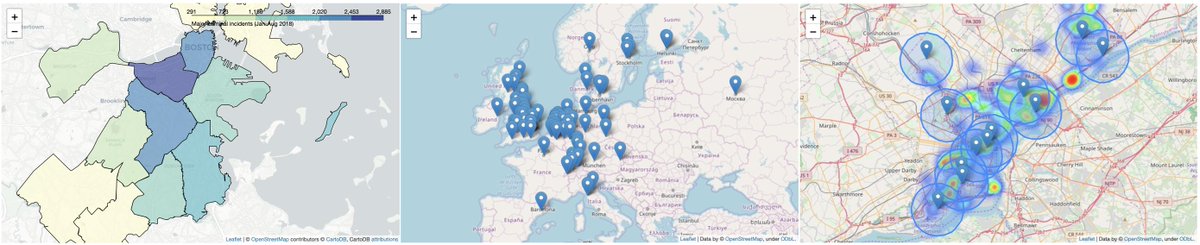
Announcing Kaggle's newest course -- Geospatial Analysis! We carefully designed the hands-on exercises to work with real data and offer solutions to real-world problems (from around the globe)! Of course, you'll also learn to create stunning maps :)
https://t.co/09HkFJohi3
This is the rejection letter for the work that just won the Nobel Prize. Don’t stop believing!
I should save all of mine and maybe one day some stranger will think it’s an amazing relic and tweet it...