Time to consider not just human visitors, but to treat agents as first-class citizens. Cloudflare’s network now supports real-time content conversion to Markdown at the source using content negotiation headers.
https://t.co/B7wYH4PtA8
Super excited about this launch -- every Claude Code user just got way more context, better instruction following, and the ability to plug in even more tools
The Naroditsky family shares the sad news of Daniel’s unexpected passing. Daniel was a talented chess player, educator, and beloved member of the chess community. We ask for privacy as the family grieves.
🇮🇳♟️India Exclusive Giveaway♟️🇮🇳
To celebrate GM Praggnanandhaa joining Team Liquid, we are giving away 2 SIGNED Pragg jerseys.
To enter:
👉Like + RT + Follow @teamliquid + Reply👈
⚠️MUST BE RESIDENT OF INDIA⚠️
@VKazulkin Having autonomous teams without Managers works for a mature organization and team but to lead the team we need a transition plan and how the manager does get measured in the Autonomous team ?!
I’m currently in @BryceCanyonNPS , and it seems like there are a couple of fires nearby. I had planned to drive to @ZionNPS east entrance tomorrow. Has anyone traveled there today or planned to do so tomorrow? Do you have any thoughts or experiences to share?
Timothy Davis, Lead Cyber Threat Intelligence Analyst at CIS, discusses the role of malware takedowns in a recent podcast episode. Listen here: https://t.co/zUq6Wo5rEc #cybersecurity#malware
In September, I got the chance to pair program for two hours with the legendary Steve Yegge (@Steve_Yegge), where he coached me on what he calls “CHOP, or chat-oriented programming,” and built something that I’ve wanted to build for nearly a year.
I learned how to use @SourcegraphCody to level up in ways that I couldn’t quite imagine before.
You may have seen the video excerpts I’ve made of videos and podcasts of talks I enjoyed — here’s the first one that I created of the famous Dr. Erik Meijer (@headinthebox), where he talks about how we might be the last generation of developers to write code by hand, and that we should have fun doing it.
I created the tool to make these video excerpts during that two-hour pair programming session with Steve!
We recorded the entire session — and here, I'm posting the “highlights reels,” where I show the prompts that I used (coached by Steve) to create the app, and the lessons learned along the way.
I can’t think of a better way to learn. Dr. Anders Ericsson, renowned for his research on expertise and deliberate practice, wrote the fantastic book “Peak,” where he identifies key elements to acquire new skills and achieve mastery, such as learning to play musical instruments, play sports, and practice medicine. Those elements are:
- Expert coaching: you learn best when guided by an expert (that’s Steve!)
- Fast feedback: you learn best when you get immediate, actionable feedback, so you can identify and correct errors quickly, and reinforce positive behaviors (check!)
- Intentional practice: you learn best when focusing on specific tasks (let’s CHOP more, as opposed to manually typing out code!)
- Challenging tasks: you learn best when you tackle tasks slightly beyond your current abilities (check!)
I can’t overstate how much I learned in two hours. In this thread, I post segments from that session, with some introductions, a statement of goals, and portions from the approximately 50 minutes required to build the code that uses ffmpeg to generate video excerpts, with transcribed captions.
(Building the app in 40 easy steps.)
It was fascinating to re-watch the recording — I’ve watched it in its entirety several times, which I found wildly entertaining. But I wanted to see if I could extract the lessons, so people wouldn’t need to watch the entire 90-minute video.
I inserted video captions that describe what is going on, with any prompts I’m giving to @SourcegraphCody / Claude / ChatGPT, so you can follow along, as well as other insights or lessons learned.
(In the lower-right corner of the video that shows the elapsed time — I was astonished to discover that, with Steve’s help, we had gotten the video extraction working in about 47 minutes. The remainder of the two hours was learning the tools, chit-chatting, joking around, etc.)
Among the lessons learned:
- in the beginning, my prompts were unambitious — Steve kept encouraged me to “type less, and lean on the LLM more.”
- despite Steve saying that the tools fully supporting CHOP still being a long way off, you’ll see that the interaction model becomes very evident by the end — give the LLM the relevant context, ask it to build or modify something for you, and ideally, it’ll appear in place, or it’ll be something you can copy/paste into your code base.
- a key skill is breaking tasks down to make steps more concrete for the LLM — or as Steve (and many Clojure programmers) likes to say, you reify your tasks (i.e., you make it more concrete or realized)
- having a good way to run your tests quickly becomes critical, because you often won't read the code that the LLM wrote — until the tests fail.
- when tests fail, a technique is just to ask the LLM to “try it again,” but lots of human judgment is required here. Sometimes this works, while other times, you’ll be iterating in circles, never getting closer to your goal
1/??
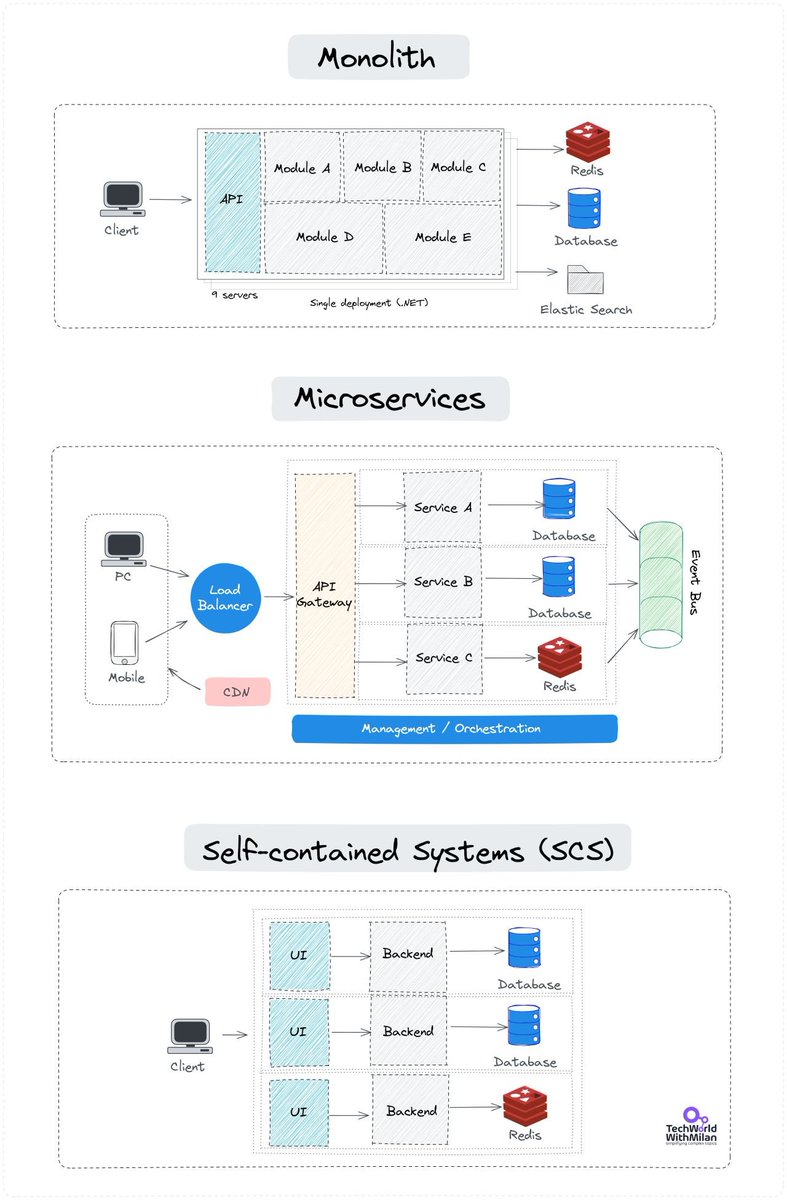
𝗛𝗼𝘄 𝘁𝗼 𝗱𝗼 𝗺𝗶𝗰𝗿𝗼𝘀𝗲𝗿𝘃𝗶𝗰𝗲𝘀 𝗮𝗿𝗰𝗵𝗶𝘁𝗲𝗰𝘁𝘂𝗿𝗲 𝗽𝗿𝗼𝗽𝗲𝗿𝗹𝘆?
𝗦𝗲𝗹𝗳-𝗰𝗼𝗻𝘁𝗮𝗶𝗻𝗲𝗱 𝗦𝘆𝘀𝘁𝗲𝗺𝘀 (𝗦𝗖𝗦) is a software architecture approach that prioritizes the decentralization of applications into independent systems, each with its domain logic, UI, and data storage. Unlike Microservices, smaller services focused solely on business logic, SCS are larger and encompass a broader scope within a specific domain.
SCS are systems that represent 𝗮𝘂𝘁𝗼𝗻𝗼𝗺𝗼𝘂𝘀 𝘄𝗲𝗯 𝗮𝗽𝗽𝗹𝗶𝗰𝗮𝘁𝗶𝗼𝗻𝘀, which include web UI, business logic and database, and it might have a service API. A single team usually owns them.
The main 𝗮𝗱𝘃𝗮𝗻𝘁𝗮𝗴𝗲𝘀 of such systems are:
𝟭. 𝗔𝘂𝘁𝗼𝗻𝗼𝗺𝘆 - Each SCS operates independently with its database, business logic, and user interface.
𝟮. 𝗗𝗼𝗺𝗮𝗶𝗻-𝗮𝗹𝗶𝗴𝗻𝗲𝗱 - SCS is structured around specific business domains, ensuring each unit represents a coherent and meaningful set of functionalities.
𝟯. 𝗗𝗲𝗰𝗲𝗻𝘁𝗿𝗮𝗹𝗶𝘇𝗲𝗱 𝗗𝗮𝘁𝗮 𝗠𝗮𝗻𝗮𝗴𝗲𝗺𝗲𝗻𝘁 - Individual databases per SCS ensure data consistency within its boundary, reducing cross-service dependencies.
𝟰. 𝗧𝗲𝗰𝗵𝗻𝗼𝗹𝗼𝗴𝘆 𝗗𝗶𝘃𝗲𝗿𝘀𝗶𝘁𝘆 - Allows for different technology stacks to be used across other SCS, suiting the specific needs of each domain.
𝟱. 𝗘𝘅𝗽𝗹𝗶𝗰𝗶𝘁𝗹𝘆 𝗣𝘂𝗯𝗹𝗶𝘀𝗵𝗲𝗱 𝗜𝗻𝘁𝗲𝗿𝗳𝗮𝗰𝗲 - Well-defined interfaces for interactions with other systems, maintaining a clear contract while preserving encapsulation.
𝟲. 𝗜𝗻𝗱𝗲𝗽𝗲𝗻𝗱𝗲𝗻𝘁 𝗗𝗲𝗽𝗹𝗼𝘆𝗮𝗯𝗶𝗹𝗶𝘁𝘆 - Each SCS can be deployed, scaled, and updated independently without affecting other systems.
Such systems go well along with 𝗗𝗼𝗺𝗮𝗶𝗻-𝗱𝗿𝗶𝘃𝗲𝗻 𝗗𝗲𝘀𝗶𝗴𝗻 (𝗗𝗗𝗗). The first step in creating such systems is domain analysis, which can be conducted by identifying bounded contexts that align with specific business domains. Each bounded context is then encapsulated within an SCS, which comprises its own data management, business logic, and user interface, ensuring each system is autonomous yet able to interact with others through well-defined APIs when necessary.
Why Self-contained Systems (SCS) has the 𝗲𝗱𝗴𝗲 𝗼𝘃𝗲𝗿 𝗺𝗶𝗰𝗿𝗼𝘀𝗲𝗿𝘃𝗶𝗰𝗲𝘀:
🔹 𝗕𝗿𝗼𝗮𝗱𝗲𝗿 𝘀𝗰𝗼𝗽𝗲: SCS has a broader scope encompassing the UI, business logic, and data storage within a bounded context
🔹 𝗥𝗲𝗱𝘂𝗰𝗲𝗱 𝗢𝗽𝗲𝗿𝗮𝘁𝗶𝗼𝗻𝗮𝗹 𝗖𝗼𝗺𝗽𝗹𝗲𝘅𝗶𝘁𝘆: Microservices can lead to a high level of operational complexity due to the management of many smaller, interdependent services, while SCS is more significant and more autonomous.
🔹 𝗗𝗮𝘁𝗮 𝗖𝗼𝗻𝘀𝗶𝘀𝘁𝗲𝗻𝗰𝘆: SCS manages their data, leading to better data consistency within each system, while Microservices often rely on a shared data store.
Check the full link in the comments.
#softwareengineering #microservices
Most people focus on optimizing the SELECT, but performance starts at CREATE.
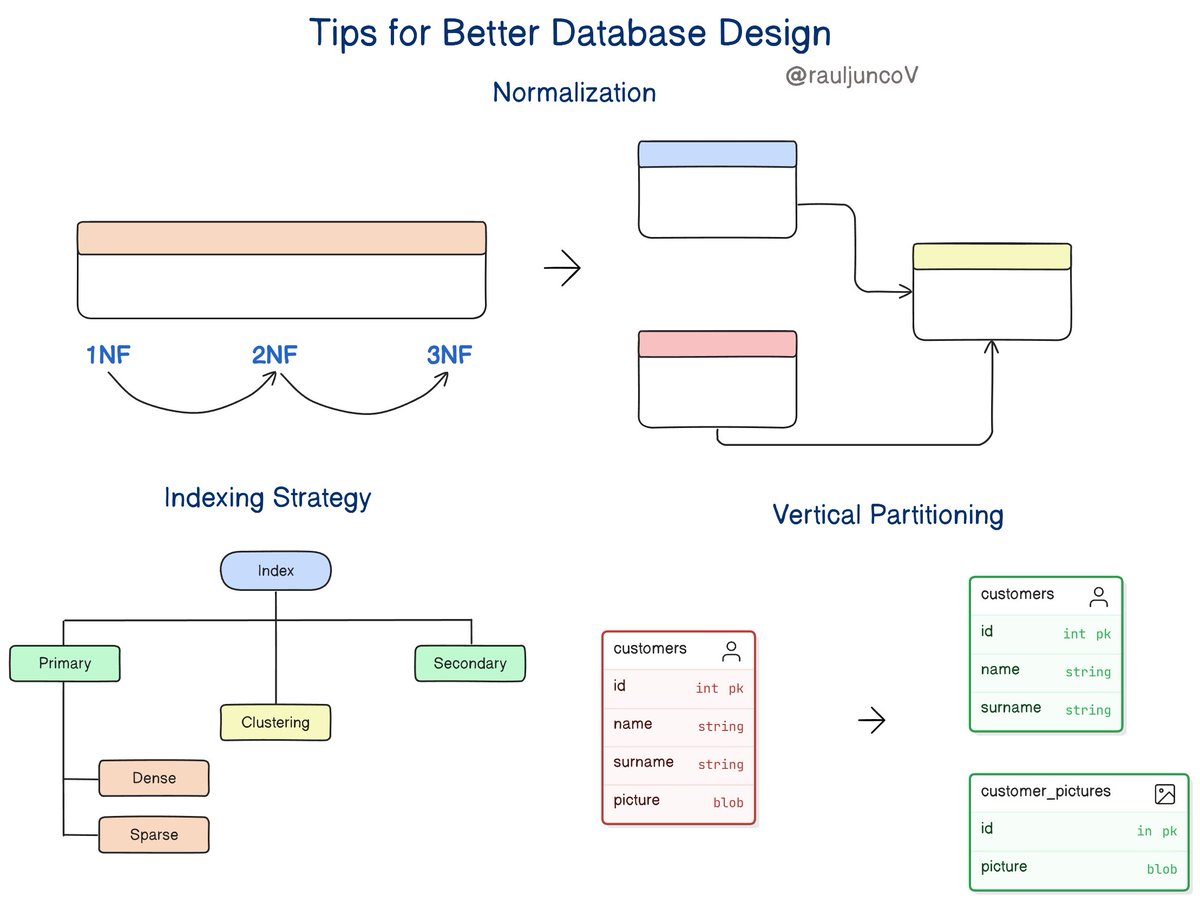
5 simple tips for designing a better database.
1. Normalize Your Data
• First Normal Form (1NF): Each column should contain atomic (indivisible) values, and each column should contain values of a single type.
• Second Normal Form (2NF): Every non-key column must depend on the entire primary key, not just part of it. This applies to tables with composite primary keys (a primary key made of multiple columns).
• Third Normal Form (3NF): Every non-key column must depend only on the primary key and nothing else (i.e., no transitive dependencies).
2. Use Appropriate Data Types
Choosing the right data types will impact performance and storage efficiency. Always:
• Use the smallest data type that can hold your data.
• Avoid using TEXT or BLOB unless absolutely necessary.
• Be mindful of precision requirements for numeric data types.
• Use DATE or TIMESTAMP for date/time data instead of strings.
Example: Instead of using VARCHAR(255) for storing a date, use DATE.
3. Indexing Strategy
Indexes will improve query performance but can also slow down INSERT, UPDATE, and DELETE operations if overused. Develop a balanced indexing strategy:
• Index columns are often used in WHERE, JOIN, and ORDER BY clauses.
• Avoid indexing columns that are often updated.
• Use composite indexes for queries involving many columns.
Example: Add an index if you do lookups often for the email column.
4. Use Constraints and Relationships
Enforce data integrity and relationships through constraints:
• Use primary keys to identify rows uniquely.
• Define foreign keys to enforce referential integrity between tables.
• Define unique constraints for columns that require unique values.
• Apply check constraints to enforce domain rules at the database level.
Example: Use NOT NULL constraints to ensure critical columns are always filled.
5. Partition Large Tables
• Horizontal Partitioning: Split a table into many tables containing the same columns but different rows.
• Vertical Partitioning: Split a table into many tables containing different columns.
Example: Separate infrequently accessed columns into a different table to reduce the size of the main table.
Performance starts with a good Design!
Here’s a list of my favorite blogs to stay updated on everything around building things with LLMs and the generative AI space in general:
(No specific order)