Three years since the first flight of Starship, the next generation is here. New ship. New booster. New engines. New pad and new test site. SpaceX engineers are working to solve one of the most difficult engineering challenges in history: developing a fully, rapidly reusable rocket
GPT-5.4 scored 75% on OSWorld's computer use benchmark today and everyone's celebrating "AI can use computers now." But look at what OSWorld actually tests, and what that number actually means.
OSWorld runs on desktop Linux. LibreOffice instead of Word. GIMP instead of Photoshop. Thunderbird instead of Outlook. And the human baseline? "Computer science major college students who possess basic software usage skills but have not been exposed to the samples or software before."
So the humans are failing because they've never used GIMP. The LLM is failing because it can't click the right spot in a dropdown. These are completely different failure modes producing the same number.
The tasks themselves are basic competency. Crop an image. Send an email. Format a cell. This is the knowledge work equivalent of literacy, the kind of thing where an experienced user scores 100%, every time, and failure would indicate something fundamentally wrong with the person, not that the task was hard. An experienced photo editor who can't crop an image has a problem. That's exactly what's happening with LLMs here. Something is fundamentally wrong with the computation, not the knowledge.
The LLM has read every GIMP tutorial ever written. It knows the keyboard shortcuts, the layer blending modes, the filter parameters. On the knowledge dimension it should be scoring close to 100%. Every single failure is a control failure, the screenshot-reason-click loop that is fundamentally a robotics problem, not an intelligence problem.
Which means 75% isn't "AI can use computers 75% as well as a person." It's "AI fails at physical interaction with interfaces 25% of the time despite knowing exactly what it wants to do." We'd be alarmed if after three years of development an LLM wrote incoherent paragraphs 25% of the time. But because computer use looks like it should be in the same category as text (it's on a screen, it's digital) people treat 75% as progress toward 100% instead of as evidence that the remaining 25% is a fundamentally different kind of problem.
The SWE-bench comparison makes this even clearer. SWE-bench verified tests the opposite kind of task: producing a working PR against an existing codebase. That's a genuinely specialized skill. If you used the same CS students from OSWorld, they'd score close to zero. It's something only experienced developers can do. Early models (GPT-4o, the original Claude Sonnet 3.5) scored around 33%, which doesn't sound impressive until you account for how specialized the skill is. The starting point was already remarkable. Current models scoring 50%+ is extraordinary.
OSWorld inverts everything. The tasks aren't specialized, they're universal. The starting point (Claude Sonnet 3.5 at ~15%) might feel like a reasonable floor until you realize the human benchmark for any experienced user of the relevant software should be 100%. And consider how much knowledge the LLM already has of these applications. 15% was already a sign that something was categorically wrong with the approach. Three years later, 75% on tasks that should be trivially easy given the model's knowledge isn't progress toward solving the problem. It's evidence the problem is structural.
Both benchmarks implicitly load on our intuition from school tests, where 75% feels like a solid B and 33% feels like failing. This makes SWE-bench look less impressive than it should and OSWorld more impressive than it should. Adjust for the actual difficulty and specialization of the tasks, and the picture inverts: SWE-bench is a genuine triumph of symbolic intelligence operating in its native medium. OSWorld is a discrete architecture failing at continuous sensorimotor control, a robotics problem disguised as a software problem. https://t.co/3PEpClOslF
The benchmark is flattering the model by comparing it to the wrong human and the wrong kind of task.
Ahhhh, Codex 5.3 (xhigh) with a vague prompt just solved a bug that I and others have been struggling to fix for over 6 months. Other reasoning levels with Codex failed, Opus 4.6 failed. Cost $4.14 and 45 minutes. Full trace plus includes original issue: https://t.co/DbBACN2HLj
I know this prompt is relatively bad. Honestly, our stable release is in a week, and I was throwing some Hail Marys at the frontier models to see if I could get a clean, understandable fix for some of these bugs. By using `gh`, it grabs much better context from the issue, so its not terrible.
The best thing that Codex did was eventually start reading GTK4 source code. That's where I ended up (see my GH issue), and I knew the answer was somewhere in there, but I didn't have the time or motivation to do it myself. The other models never went there, and lower reasoning efforts with 5.3 didn't go there either. Only xhigh went there. I think that was a critical difference.
The final fix was decent. It was small, all in a single file, and very understandable. It had one bug I identified (you can see in the trace), and then I manually cleaned up some style. But, it did a great job.
Definitely an "it's so over" moment. But at the same time, it feels amazing because now our next stable release will have this fix and I was able to spend the time working on other fixes as it went.
NVIDIA just dropped PersonaPlex-7B 🤯
A full-duplex voice model that listens and talks at the same time.
No pauses. No turn-taking. Real conversation.
100% open source. Free.
Voice AI just leveled up.
https://t.co/YfzFQfBzMS
NEO just proved every major AI lab built their vision models wrong 💀
OpenAI, Google, Anthropic...
they all use the same approach: train a vision encoder, bolt it onto an LLM, pray the alignment works.
NEO said "what if we just... didn't do that?"
and built a native vision-language model from first principles instead.
here's why this is actually insane:
traditional VLMs are Frankenstein architectures. you take a pretrained vision encoder (CLIP, whatever). add a projection layer. attach it to a frozen language model. hope they learn to talk to each other.
it works. but it's fundamentally fragmented.
vision and language compete for model capacity. alignment is expensive. training happens in stages. you're forcing two systems designed for different things to cooperate.
NEO throws this out completely.
it processes images and text through the same autoregressive architecture — a unified vision-language primitive that learns both modalities natively from scratch.
no separate vision encoder. no projection gymnastics. no alignment tax.
the technical breakthroughs that make this possible:
• Native Multi-Modal Attention with mixed masking - text tokens use causal attention (normal LLM behavior), image tokens use full bidirectional attention (exhaustive visual interactions). each modality processes information its natural way, in the same model, at the same time.
• Native-RoPE assigns distinct base frequencies to temporal, height, and width dimensions — solving the critical mismatch between text sequences (temporal) and visual data (spatial). no more forcing spatial information through temporal-only positional embeddings.
• Adaptive architecture that uses pre-Buffer layers during pre-training, then merges everything into a monolithic backbone during fine-tuning — automatically allocating capacity for encoding, alignment, and reasoning.
the efficiency? 390 million image-text examples. not billions. 390 million.
and it rivals GPT-4V and LLaVA.
every major lab uses modular architectures because that's what worked first. NEO suggests we've been doing it the expensive, complicated way this whole time.
We were able to reproduce the strong findings of the HRM paper on ARC-AGI-1.
Further, we ran a series of ablation experiments to get to the bottom of what's behind it.
Key findings:
1. The HRM model architecture itself (the centerpiece of the paper) is not an important factor.
2. The outer refinement loop (barely mentioned in the paper) is the main driver of performance.
3. Cross-task transfer learning is not very helpful. What matters is training on the tasks you will test on.
4. You can use much fewer data augmentations, especially at inference time.
Finding 2 & 3 mean that this approach is a case of *zero-pretraining test-time training*, similar to the recently published "ARC-AGI without pretraining" paper by Liao et al.
Yann LeCun on architectures that could lead to AGI
---
"Abandon generative models
in favor joint-embedding architectures
Abandon probabilistic model
in favor of energy-based models
Abandon contrastive methods
in favor of regularized methods
Abandon Reinforcement Learning
in favor of model-predictive control
Use RL only when planning doesn’t yield the predicted outcome, to adjust the world model or the critic.
IF YOU ARE INTERESTED IN HUMAN-LEVEL AI, DON’T WORK ON LLMS"
---
From "IP Paris" YT channel (link in comment)
What a crazy week in AI 🤯
- Mistral AI Agents
- Claude Voice mode
- Google SignGemma
- Factory AI SWE Agents
- Perplexity launches Labs
- Flux.1 Image Editing Kontext
- SpAItial AI Foundation Models
- Opera’s first AI Agentic Browser
Here’s EVERYTHING you need to know:
Two major wins for @Solana are minimal transaction fee and its fast execution time.
Lets learn how it compares with Ethereum's transaction mechanism and why Solana needs a lot of rework before it is ready for scale.
A thread 🧵...
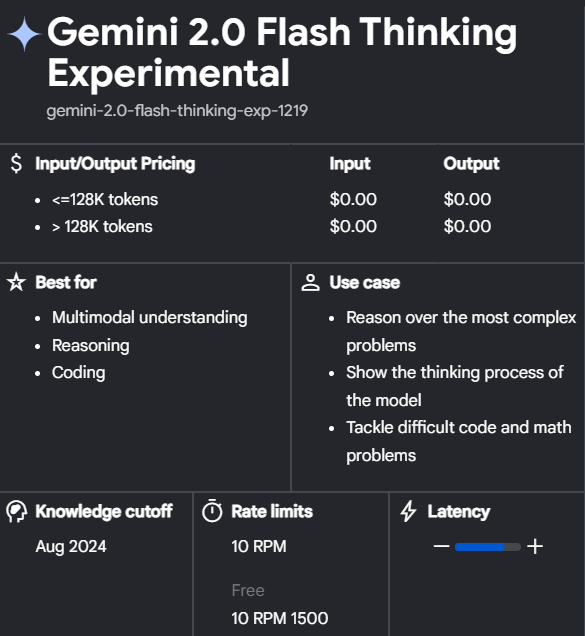
Google just cooked OpenAI in the AI reasoning game.
Gemini 2.0 Flash Thinking is out, and it's already beating OpenAI's o1 in the Arena Leaderboard.
It's faster and shockingly transparent on its "thinking"🤯
8 wild examples (and how to try):
I'll get straight to the point.
We trained 2 new models. Like BERT, but modern. ModernBERT.
Not some hypey GenAI thing, but a proper workhorse model, for retrieval, classification, etc. Real practical stuff.
It's much faster, more accurate, longer context, and more useful. 🧵
Don't let anyone peer pressure you into buying a house with the midwit argument "renting is throwing away money" which in 99% of cases is BS
Generally renting SAVES you money over buying if you will own the house for less than 15 years
New York Times made a famous buy vs. rent calculator that got updated recently
https://t.co/Vw1WoxiOz2
The same applies to most markets worldwide
The only valid argument for buying a house for most people is if you can use leverage (a mortgage) to buy it, but you will pay about the same of amount of the house price in interest payments to a bank for 30 years
Big golden handcuffs that'll keep you tied down forever while you fund rich bankers
I recorded a complete 5-hour course where I'm building an iOS app using Cursor
95% was coded by Claude AI. The rest (the animations, the workflow and UI fixes) is where AI falls short and what I spend a lot of time teaching.
Code and projects provided. You can watch the entire course: https://t.co/LXll23bWJc
A short proof that LLMs (even o1) still can't reason:
Consider the problem of inverting a perfect binary tree. That's an old, entry-level interview question that humans and LLMs can solve easily. Now, let's add just 3 key nuances to make it new and unique:
1. It must invert *keys* ("bit-reversal permutation")
2. It must be a dependency-free, pure recursive function
3. It must have type `Bit -> Tree -> Tree`
These small changes are enough to move this problem out of the "memorized solution zone". It isn't on the internet. And, guess what? This is enough to make it completely intractable to modern AIs. All of them fail miserably at it, no matter how you prompt it.
This is very relevant, because the problem is still easy to a human researcher, and being capable of solving it is clear pre-requisite to contribute to CS research. Yet, all modern AIs fail miserably. As much as I love LLMs, truth is: they do NOT reason, and they will never do CS.
Some prompts for you to try:
https://t.co/Dc0pTHi5zo
I'm willing to give $10k to anyone who shows any AI capable of implementing this function correctly. It just won't work, no matter how long it thinks. (The solution is 7 lines of code!)