@realvijayk@kapsacoin IonQ mcap 20BN
QTC mcap 4M
The CEO of $QTC is also Quantum Machine Build Lead at @QueraComputing who recently raised over $230M from Nvidia and Google.
The Devs at QTC were recently recognised for their work by @IonQ_Inc
QTC is the decentralised Quantum Computer.
@realvijayk@kapsacoin $QTC is a blue chip larping as a micro cap (4m mcap) while the founders are from MIT and Dr. Mikhail Shalaginov (@MYShalaginov), ranked as one of the world’s top 2% most-cited researchers in 2025 in the latest @Stanford / @ElsevierConnect ranking.
https://t.co/eGkVwfEZVG
There is another Proof-of-Useful-Work gem besides $PRL sitting on Safetrade, quietly waiting to be discovered … 👀
One is valued at ~$220M.
The other sits around ~$3M.
Built around research originating from academia as well and a team with backgrounds from MIT, Harvard and quantum computing research. Advisors were heavily involved in $KAS.
Both projects are attempting to make computation itself the scarce resource:
$PRL → useful AI computation
$QTC → useful quantum simulation
Different markets, similar idea.
Bet AI + Quantum = win
https://t.co/txfCW3Lk7i
@qubitcoinx Quantum makes AI look incredibly basic.
Infact there is no path to achieving singularity without Quantum Computing.
At some point all these AI Data Centers are going to pivot to Quantum Computing.
$QTC will lead the charge.
@IonQ_Inc Mcap $20BN
$QTC Mcap $2.8M
qPoW is actually insane tech.
SHA3 hashing + parametrized quantum circuits + quantum sampling + classical verification all combined into one architecture.
(@MYShalaginov and @MikeDubrovsky are cooking hard here. Remember that Dubrovsky is the advisor of @kaspa aswell. Kaspa hit 5 billion dollars.)
And this wasn’t just theory the prototype was benchmarked on real IBM quantum hardware.
@qubitcoinx is building way deeper tech than most people realize.
Mikhail and Yudong recently had a great discussion with Fred Chong, one of the world’s leading voices in quantum computer architecture.
Quantum computing is still largely a field shaped by physicists, which makes Fred’s perspective especially valuable, coming from computer architecture and supercomputing.
They drilled into the challenges of building the full stack required for fault-tolerant quantum computing: compilers, error correction, verification, scheduling, and hardware/software co-design, and debated where NISQ-era approaches may still provide value, particularly for optimization problems with limited datasets such as biomarker discovery and cancer treatment prediction.
For the Qubitcoin community, this direction is highly aligned with what we have been building:
In addition to our VQA-based component already being part of qPoW, for the last few months, we have been heavily focused on integrating tasks directly relevant to fault-tolerant quantum algorithms and the future quantum software stack.
The long-term goal is not just to make a quantum-aware blockchain, but to help create computational infrastructure naturally connected to the emerging fault-tolerant quantum ecosystem.
This week we sat down with Professor Fred Chong (University of Chicago) to talk about the future of quantum computing and why one of its first real applications may be cancer treatment prediction.
Chong explains how quantum algorithms like QAOA could help identify hidden cancer biomarkers by analyzing complex biological datasets that overwhelm conventional approaches.
We also get into fault-tolerant quantum computing, quantum compilers, neutral atoms, superconducting qubits, and how useful quantum systems may emerge long before fully error-corrected machines arrive.
Full episode is here on X and at the links below (see comment).
Timestamps:
00:00 - Intro
01:34 - From Jurassic Park to Quantum Computing
10:13 - Modernizing NISQ Research
13:45 - Designing Around Quantum Hardware
20:30 - Variational Quantum Algorithms
23:07 - Quantum Computers for Cancer Research
30:35 - How Q4Bio Began
37:20 - Will We Need QEC in the Future?
40:25 - What Quantum Computers Can Learn from Classical Architecture
43:08 - Would Fred Return to Classical Computing?
46:11 - Quantum Software and Quantum Compilers
55:19 - Starting https://t.co/WSyvIzK6Zz
1:01:43 - Classical Analogs to Quantum Hardware
1:12:21 - Advice for Young Scientists
1:17:43 - Is AI Impacting Quantum Research?
1:22:38 - Importance of Formal Verification
1:30:40 - QLDPC Codes
1:35:48 - Fred’s Beginnings in Computer Science
1:42:48 - Chicago vs Silicon Valley
1:46:27 - Do We Need More Quantum Software Companies?
1:53:17 - Future of Quantum Computing and Cryptography
@LaPetiteADA@LaPetiteADA
Me - you are 💯 % right - one need a brain to understand
Brain 🧠 - whaaat do you mention me ?
Me - just a real brain - one like you my brain
Brain 🧠 - man you chatched the curve at last
Bitcoin mines SHA-256 hashes. Useful for security, but useless scientifically.
Qubitcoin mines quantum simulations on GPUs.
QuEra has just confirmed that this computation has real value for research.
https://t.co/VAfxd5Wlv2
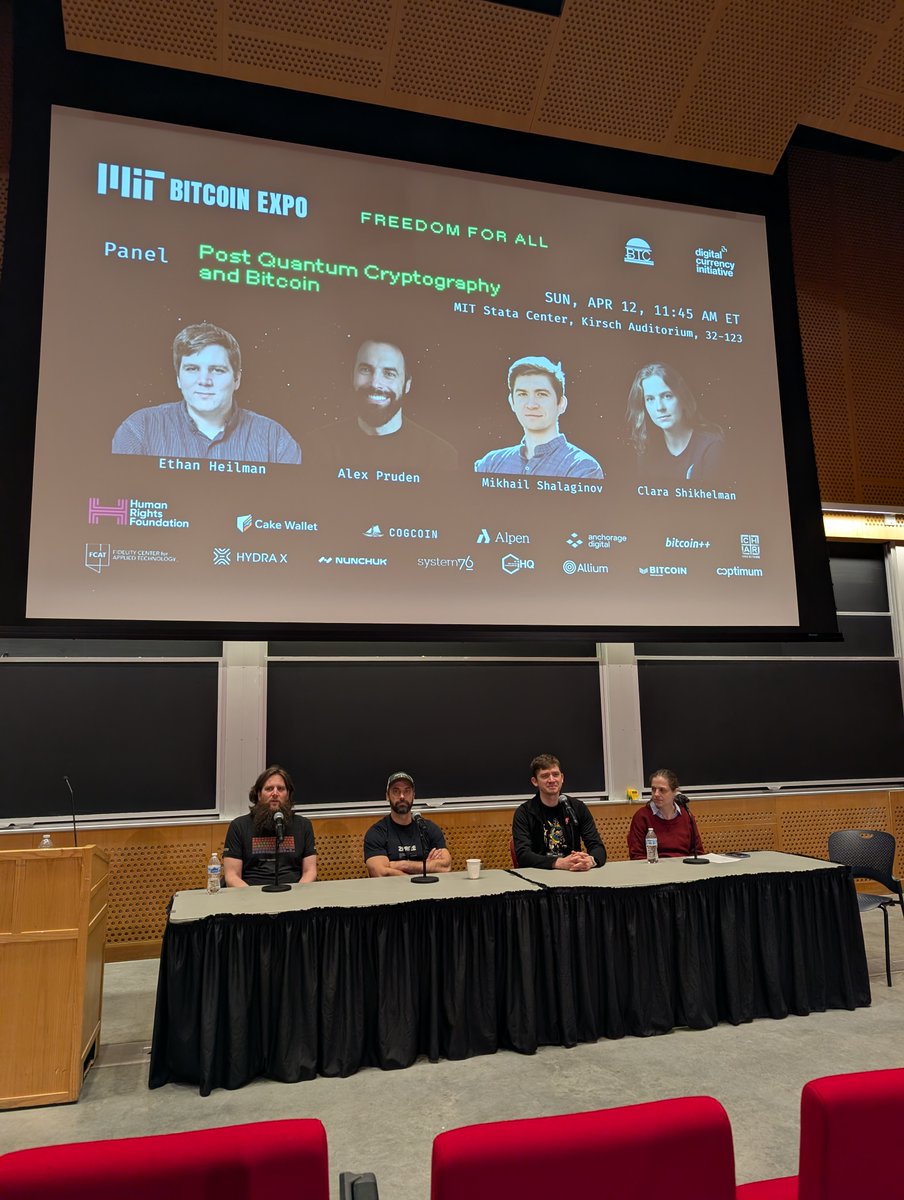
Important point from @MYShalaginov
The challenge is not merely replacing signatures.
It is preserving decentralization, throughput, fee dynamics, and social consensus under quantum pressure.
That is a much deeper problem than most people realize.
$QTC is one of the few projects thinking in that direction from first principles. ⚛️
It was great to take part in the @MITBitcoinClub Expo, joining a panel on post-quantum cryptography and interacting with Bitcoin Core developers and leading cryptographers.
As quantum machines mature, running Shor's Algorithm or its variants at scale is becoming increasingly plausible, directly challenging Elliptic Curve Cryptography, which underpins Bitcoin and Ethereum.
Bitcoin’s security relies on private keys. However, once a transaction is made, the public key is revealed. With a sufficiently powerful quantum computer, that public key could be used to recover the private key and take control of the funds. This fundamentally changes the security assumptions of the entire ecosystem.
The solutions are not straightforward. Post-quantum schemes exist (e.g., Falcon and Dilithium), but signatures are often 10–100x larger. Since signatures dominate transaction size, this would mean fewer transactions per block, higher fees, slower propagation, and increased centralization pressure. A naive transition risks disrupting Bitcoin’s economic balance.
Upgrading Bitcoin is also inherently difficult. The system resists change by design, and history (e.g., the 2017 split into Bitcoin Cash) shows how contentious even relatively simpler upgrades can be. A post-quantum transition would require global coordination and a large-scale migration of funds.
There is also a deeper question: a significant fraction of coins that are likely lost becomes vulnerable in a quantum scenario. Should they be left as a bounty, or somehow reclaimed? There is no clear consensus.
Quantum computing is advancing rapidly and poses a systemic risk to digital assets. The window to prepare is limited, and the challenges are both technical and social.
Can Bitcoin be upgraded, or will its core assumptions be tested beyond repair?
P.S.: I believe @qubitcoinx (originally inspired by Bitcoin) will become both quantum-secure and quantum-friendly.