I was at #AdobeMAX this week to present #projectSurfaceSwap! Our surface selection and replacement techs!
Check it out here: https://t.co/l76025JQrb
What a blast the Sneaks were!
Adobe Research is heading to #SIGGRAPH2025, the premiere conference for computer graphics and interactive techniques!
From generative image editing to 3D reconstruction, we’re sharing 25 papers this year – this teaser is just a glimpse. 🔗 https://t.co/FOvDUgbet6
Come find us at @siggraph and explore the future of creativity!
Editing appearance, geometry, lighting with precision is easy with a 3D scene representation. But it's so much more difficult with just an image or photograph.
Enter IntrinsicEdit: Precise generative image manipulation in intrinsic space (@siggraph 2025)!
https://t.co/ebO7f6iEgG
Without no task-specific training, we show state-of-the-art results on material editing, object removal & insertion, relighting.
Our method can preserve identity of unedited image aspects, and thanks to editing in intrinsic-image space, it provides unprecedented control.
Cool! Try the rgbx wrapper in ComfyUI made by @toyxyz3. If you're interested about the technical details, check out our paper at https://t.co/t74kPN3FyK.
🎓 We introduce SAMa! A material selection and segmentation model on 3D models in any format (3DGS, NeRF, Mesh).
Given a user click, we propose to select all regions on an objects with the same material. We can also do segmentation in under a minute: https://t.co/cl3KvzBLcw
We’re thrilled to release the implementation and model weights for our SIGGRAPH 2024 paper, "RGB↔X: Image Decomposition and Synthesis Using Material- and Lighting-aware Diffusion Models"!
📂 GitHub Repository: https://t.co/xcpDTskBTn
RGB↔X is a unified diffusion-based framework that enables realistic image analysis (intrinsic channel estimation, referred to as RGB→X) and synthesis (realistic rendering from intrinsic channels, referred to as X→RGB).
This framework explores the connections between diffusion models, realistic rendering, and intrinsic decomposition. We believe this can benefit a wide range of downstream tasks, including material editing, relighting, and realistic rendering from simple or under-specified scene definitions.
TL;DR for graphics people: You can now use diffusion models to eliminate or simulate global illumination in image-space on G-buffers.
🌐 Project Page: https://t.co/j8frbAAn2r
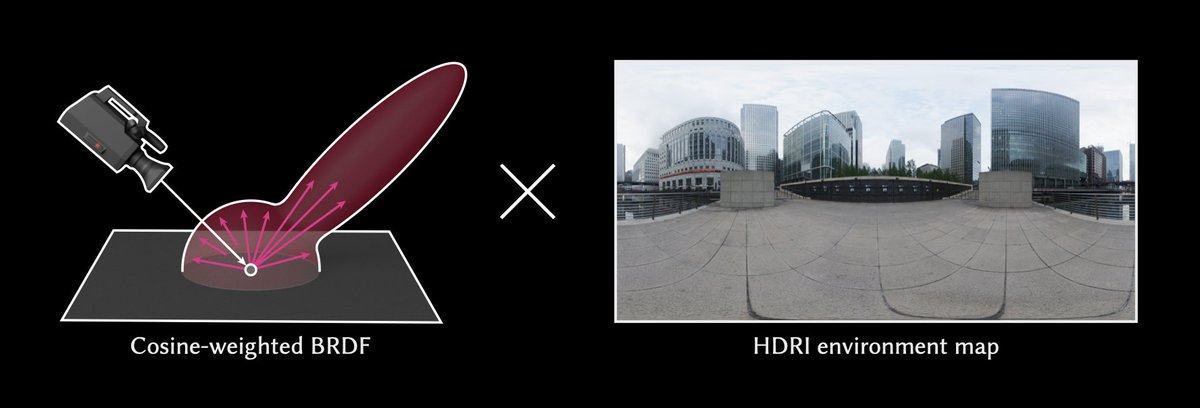
We present a learning-based rendering method that uses normalizing flows to efficiently importance sample product distributions comprising distant emitters (i.e., HDRI lighting). This is joint work with my amazing collaborators @MilosHasan, @fujun_luan, @krishnamullia, and @iliyang at Adobe Research. 1/5
What a pleasant big surprise. Free to share a $1M secret to get a best paper award: to get Iliyan presenting the paper. @EGSympRendering@iliyang. Congrats to @tzumaoli, Trevor and Ravi.
No more huge output PDFs in Overleaf. Put this file in your project root and it will compress non-JPEG images. Default quality settings are high, works even for noisy images.
https://t.co/Mj5PlWGqAR
Our work on #NBVH (Neural ray queries with Bounding Volume Hierarchies) will be presented this summer at #SIGGRAPH2024!
What's that? See🧵below ⤵️
📃Source Code: https://t.co/ZR6Ji7Hlz1
🌐Project Page/Paper: https://t.co/ooiiL2PHX0
(ft. @PhilippeWeier@iliyang@boubek et al.)
Ever wanted to load a large asset in your GPU path tracer, only to find it doesn't fit in memory? Then check out our #SIGGRAPH2024 paper “N-BVH: Neural ray queries with bounding volume hierarchies” (with Alexander Rath, @exppad, @iliyang, Philipp Slusallek and @boubek)
📸You took a room photo or generated one with your favourite Diffusion model? Want to turn it into 3D but find finding and placing the assets is boring?
📚Checkout PSDR-Room for turning a single photo to scene using differentiable rendering & retrieval! https://t.co/CW8505vTSv