Sharing my journey from RN-bedridden with chronic pain/illness-thriving w disability to help others live better quality lives. US Pain Foundation Volunteer
I’ve been a US Pain Foundation peer support volunteer for a year now, and it’s the best thing I’ve done in a long time. All our groups offer a feeling of support and community from fellow chronic pain warriors. My group, the New York Group, meets every 4th Friday of the month at 2:00 Eastern. Check us out, all are welcome!
Nearly 80% say pain makes it hard to connect with loved ones.
Chronic pain doesn’t just hurt—it isolates.
Let’s unmask the emotional toll.
Because pain is more than a chart. It’s a life.
Find peer support: https://t.co/DMhVQethWK
#ThisIsPain#UnmaskingPain#LifeWithPain
Thanks for reading.
This was part 48 of my 50-part series on the best bio hacks based on the recent research to optimize your health.
If you enjoyed this post, follow @karlmehta for part 49.
Repost the first tweet to help more people see it:
A pain researcher held his wife’s hand during childbirth and watched her pain drop. He spent the next five years figuring out why.
Pavel Goldstein, a researcher at University of Colorado Boulder, ran the study with 22 romantic couples. Both partners wore EEG caps (sensors that read brain waves in real time) while the woman received controlled heat pain on her arm. They tested four setups: sitting together without touching, holding hands without pain, sitting together during pain with no touch, and holding hands during pain.
The brain maps in this image tell the whole story. Each orange line is a verified connection between the two brains firing in sync. No touch, no pain: 12 connections. Holding hands, no pain: 10. Pain but no touch: just 5. Pain actually shreds the natural brain sync between partners. But holding hands during pain: 22 connections, over 4x the no-touch pain condition. The coupling explodes the moment touch and pain combine.
The sync happened on a specific brain wave frequency tied to focused attention and, specifically, to processing someone else’s pain. When both brains locked into this rhythm, two things happened at once: the woman reported less pain, and the man’s empathy accuracy (how well he could estimate her pain level) went up. Higher sync, less pain, better empathy reading. All three moved together.
The why behind it is worth following. When your partner’s brain syncs with yours during pain, it may signal that you’re understood. A 2023 Brain Sciences study found that gentle, caring touch activates a deep brain region that acts as the body’s built-in pain suppression switch, and that region connects directly to neurons that release oxytocin, the bonding hormone. Feeling understood may trigger reward circuits that actively dampen pain.
And it only works with someone you love. A 2024 study from the Chinese Academy of Sciences found the brain sync boost during touch showed up between romantic partners but not between strangers. Same physical contact, different relationship, no coupling spike.
The study is small: 22 couples, all heterosexual, only women received pain, and the team is clear this is correlation, not proven causation. But Goldstein has since confirmed the empathy-touch-pain link across heart rate, breathing, and brain waves in three separate published papers.
The whole line of research started because his wife told him to “shut up and just hold my hand” during labor. Three papers and 250+ citations later, he can show you the wiring diagram of why it worked.
Being diagnosed with multiple sclerosis at 24, Grace thought she was going to become bedridden from the disease.
At 44, she became our first patient with MS to receive CAR T‑cell therapy being studied to slow disease progression. #MSAwarenessMonth
More: https://t.co/KZlu41EW8k
CMS is inviting organizations to apply for the MAHA ELEVATE Model!
The @CMSinnovates' MAHA ELEVATE model is the first Innovation Center model to focus on holistic, patient-centered functional or lifestyle medicine approaches that include nutritional, physical activity interventions, psychological and/or self-care strategies to address the whole person rather than individual disease. It’s what the MAHA Movement is all about!
We’ll award ~$100 million total to fund up to 30 proposals with evidence-based functional and lifestyle medicine interventions so more people with Original Medicare can join these programs. Learn more: https://t.co/JlKAIRReFo
There is a version of this story that is easy to romanticize. A famous man stays loyal to his wife. People applaud. The end.
But the real version is much harder, much quieter, and far more honest than that.
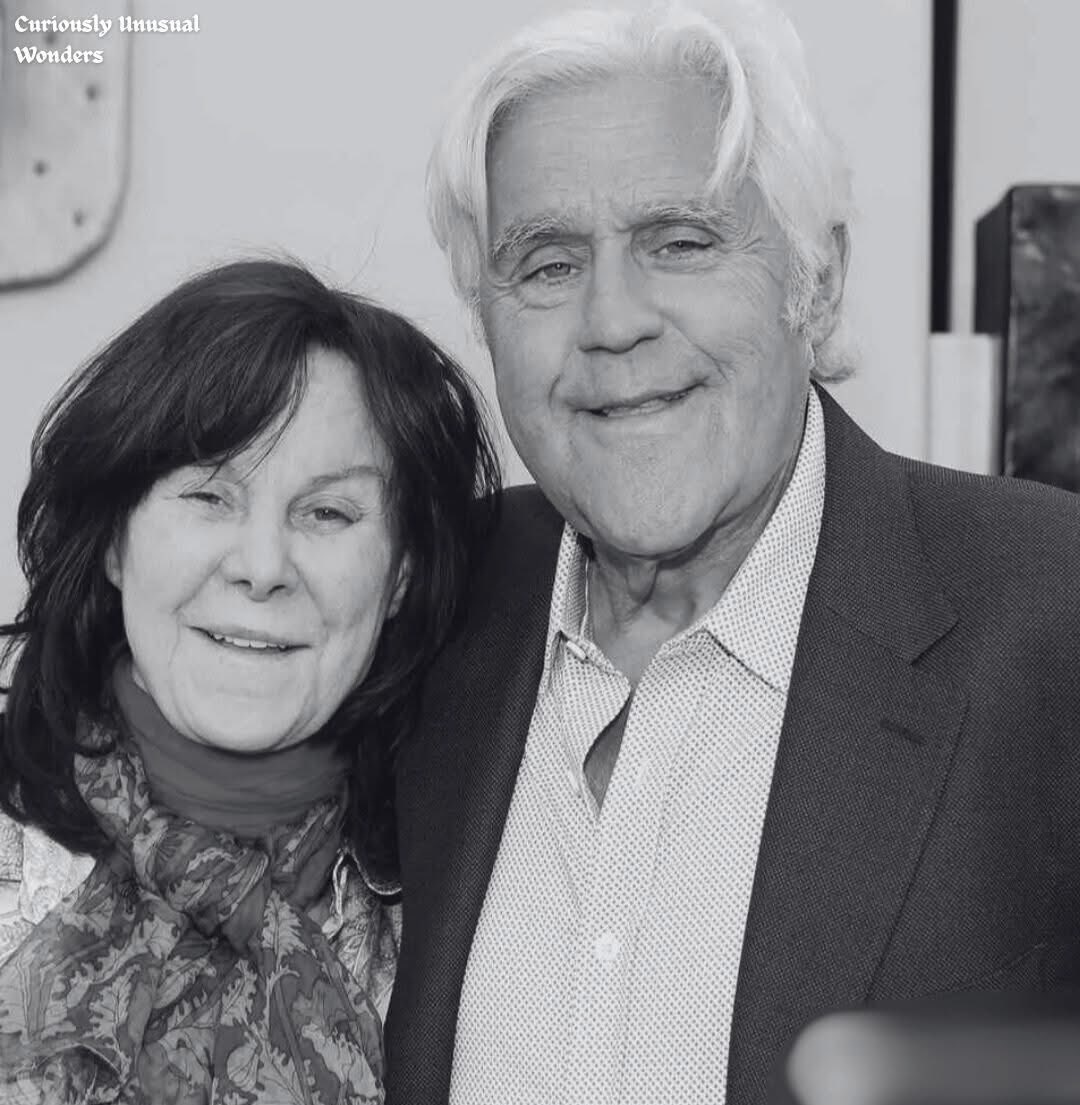
Jay Leno, 75, spent more than two decades as one of the most recognized faces on American television, hosting The Tonight Show night after night for millions of viewers. His wife, Mavis, stood beside him throughout all of it — not as a background figure, but as a woman of genuine accomplishment in her own right. She was nominated for the Nobel Peace Prize in 2002 for her advocacy work supporting women living under Taliban rule in Afghanistan. She was fiercely independent, deeply curious, and someone who loved to travel and explore the world.
Then, in 2024, Jay filed for conservatorship over her estate. The reason was that Mavis had been diagnosed with advanced dementia and was progressively losing capacity and orientation.
Their life changed completely.
The restaurants they once visited together are now off the menu. The travel Mavis always loved is no longer possible. The conversations they used to have in the evenings have narrowed and shifted in ways that are hard to fully explain to someone who has not lived it. Dementia does not just take memory. It slowly changes the shape of every moment two people share.
Jay has spoken publicly about the hardest part of the journey, and it is not what most people would expect. For years, every single morning, Mavis would wake up believing she had just received news that her mother had died. She experienced that grief fresh, as if hearing it for the first time, every day. Her mother went through that process of dying over and over again, for about three years. Each time, Mavis cried. Each time, Jay held her through it. He described it as truly tricky, and genuinely hard.
But he did not leave.
He rearranged his life around her needs. He only takes work that allows him to be home the same day or at most one night away. He comes home every evening and cooks her dinner. They watch television together, animal shows and travel documentaries on YouTube since real travel is no longer an option. When he carries her to the bathroom, he has a name for it. He calls it Jay and Mavis at the prom, the two of them dancing back and forth down the hallway, and she thinks it is funny. She still laughs. He still makes her laugh on purpose, every single day.
She still knows who he is. She looks at him and smiles. She tells him she loves him.
When someone asked Jay if he was going to get a girlfriend now, he was genuinely surprised by the question. He told them he already had one. He was married. Forty-five years. That was not something he considered walking away from.
What he said next is the part that has stayed with people.
He said that when you get married, you take vows. You say for better or worse. And most people, he noted, never really expect to be called upon to actually act on those words. They say them and hope the worse never arrives.
For Jay, it arrived.
And he is passing the test.
He has said he hopes his situation draws attention not just to his own story, but to the 50 or 60 million people in America who are quietly doing the same thing for a parent, a spouse, a sibling, and doing it completely without recognition. Nobody sees them. Nobody is interviewing them. They are just showing up every single day for someone who needs them, because that is what love actually looks like when it is no longer a feeling but a choice you make again every morning.
Jay Leno still makes his wife laugh. She still has the fire, he says. She still growls at the television when something offends her. She still smiles when he walks into the room.
For better or worse is not a promise you make on a beautiful day in a beautiful place with everyone watching.
It is what you do on a Tuesday evening when you carry the person you love to the bathroom and call it the prom, just to make her smile.
That is the whole story.
@TheKentAcorn When birds sense a threat, like a predator nearby, they will freeze like this for several minutes hoping to not be noticed. I first saw birds do this at my feeder last year and learned about it. I was afraid they were sick too but it’s a survival mechanism.
At a quiet wildlife sanctuary in Missouri, something happened that left grown men wiping their eyes and caretakers standing still in disbelief.
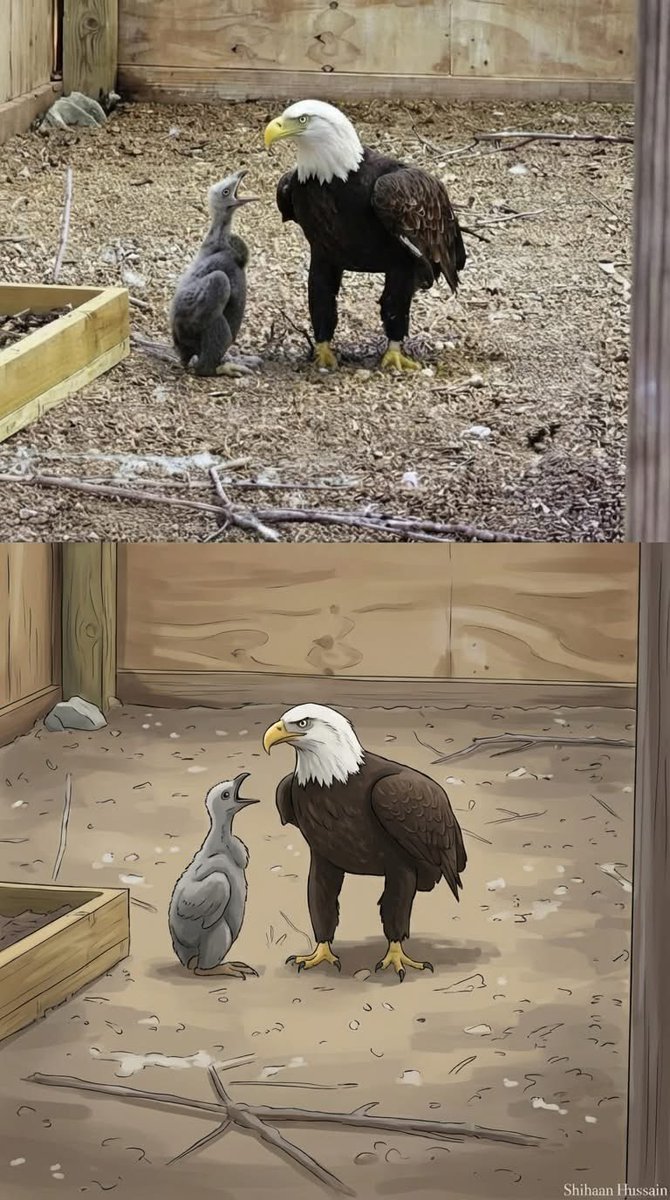
Murphy was a bald eagle who could no longer fly. An old injury had taken the sky from him, and he lived out his days on the ground while other eagles soared overhead. For years, visitors passed by his enclosure, admiring his sharp eyes and powerful wings that would never again lift him into the air.
Then one spring morning in 2023, the keepers noticed something strange.
Murphy began gathering twigs.
Not randomly. Carefully. One by one, he arranged them just like a wild eagle would high in the treetops. He shaped a nest on the ground with the same care any proud parent would show. Soon, he settled into it, lowering his body gently, as if guarding something precious.
But there was no egg.
What he was protecting was a rock.
A simple, cold stone.
And yet Murphy treated it like his own flesh and blood.
He sat over it for hours, barely moving. He flared his wings when other eagles came too close. He stared down anything that dared approach his nest. To him, that rock was life. To him, it mattered.
The staff watched in silence. It was tender and it was painful all at once. A bird who could not fly still carried the fire of a father, even when nature had given him nothing to raise.
Then, by chance, an orphaned eaglet arrived at the sanctuary.
Too young to survive alone. Hungry. Weak. A tiny bundle of feathers that needed a miracle.
And someone remembered Murphy.
If he could love a rock with that kind of fierce devotion, what might he do for a living, breathing chick.
With steady hands and held breath, the caretakers made a quiet decision. They removed the rock from Murphy’s nest and gently placed the eaglet in its place.
What happened next is the kind of thing that stays with you for life.
Murphy looked down. He leaned closer. He studied the small, trembling body beneath him.
Then he spread his wings.
He pulled the eaglet close and covered it as if he had been waiting his whole life for that moment. No hesitation. No confusion. Just acceptance.
From that day on, Murphy fed the chick, guarded it, and warmed it through cold nights. A bird who would never touch the clouds again was giving another eagle the chance to one day rule them.
Visitors began stopping longer at his enclosure. Some cried. Some stood quietly with hands over their mouths. Here was a creature broken by fate, still choosing love without question.
Murphy taught something we all forget in hard times.
That being strong does not always mean flying high.
Sometimes it means staying grounded and still opening your heart.
He never knew that rock was not an egg.
And he never cared that the chick was not his by blood.
All he knew was that something needed him.
And he was ready.
Even a grounded eagle can rise, not with wings, but with love.
@jamesomearasr@QueenofCr8tvty I have a handicap placard which I use on bad days. When I pull into a designated spot near the store entrance, I tell my passengers “It’s one of the perks”. I love your cane story, gotta look on the bright side!
👇🏻 is the quiet truth no one wants to say out loud.
Modern medicine didn’t collapse because doctors stopped caring, it collapsed because systems taught them that helping people is a secondary concern to not getting sued.
When every decision is filtered through liability, documentation, billing codes, and institutional fear, patients stop being humans and start being risk profiles.
That moral injury, making choices you know aren’t right just to protect yourself, burns people out faster than long hours ever could. And patients feel it.
You’re not imagining it. You’re not “difficult.” You’re navigating a system that quietly trained itself to see survival, not care, as the priority.