Absolutely incredible.
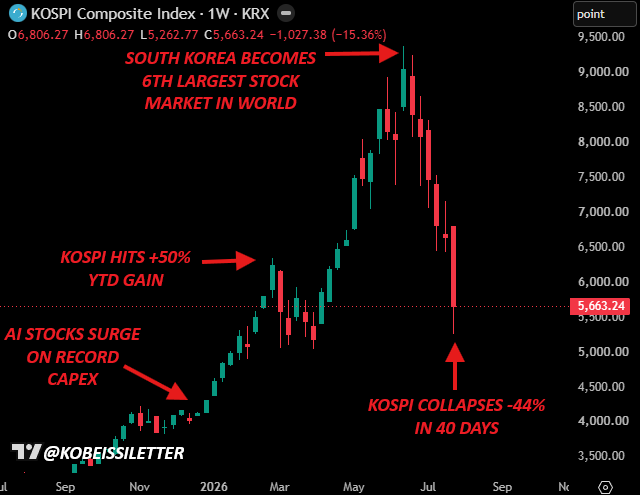
In an unprecedented move, South Korea's stock market just collapsed -44% in 40 days, erasing -$2 trillion in market cap.
Now, South Korea's finance ministry has announced plans to "stabilize" the market.
What is happening? Let us explain.
(a thread)
We didn’t have “HR” when building Palantir, for similar reasons - I avoided Ryan’s mistake.
And when we needed some PeopleOps, we hired technical leaders.
Going into the vast majority of companies and firing most of their HR and Marketing departments would tend to create value!
You might have heard the rumours, it's time to reveal what we are working on.
🗺️ An open world Middle-earth RPG.
⚔️ A new Kingdom Come adventure.
We’re excited to tell you more when the time is right.
#WarhorseStudios#Annoucement#lotr#KingdomComeDeliverance
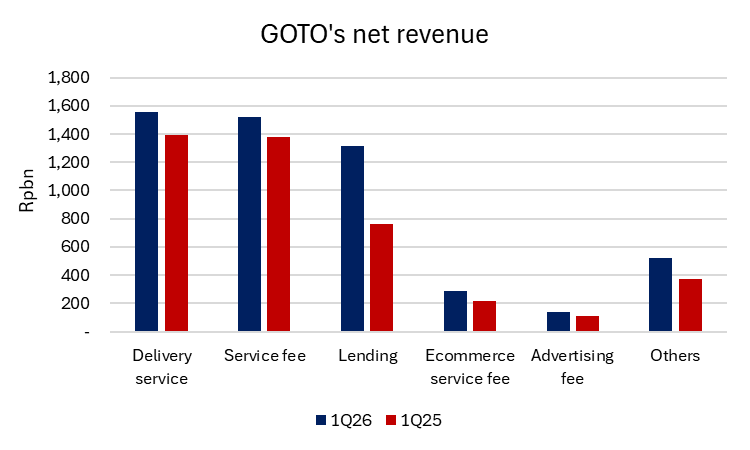
$GOTO reported lending revenue growth of 72% YoY in 1Q26. On the surface, that looks like strong execution. In reality, it is a macro signal. Credit is expanding because incomes are not.
When household cash flows are healthy, borrowing tends to fund consumption upgrades or investment. What we are seeing instead is credit filling a gap. The middle and lower-income segments are increasingly relying on fintech lending to smooth day-to-day expenses.
That is not growth. That is stress. This ties back to a broader shift in Indonesia’s consumption base. The middle class is no longer expanding at the same pace. Real income growth is lagging cost pressures. As a result, consumption is being sustained by leverage rather than income.
For platforms like GoTo, this creates near-term upside. Lending is high margin, scalable, and drives revenue growth. But it also introduces second-order risks: 1) credit quality deterioration as borrowers become more stretched, 2) higher provisioning over time, and 3) regulatory scrutiny if consumer stress becomes more visible
The key point is sustainability. Revenue growth driven by credit expansion is only durable if underlying income growth follows. If it does not, you eventually see rising defaults and a normalization of growth.
So the 72% number should not be read as pure strength. It is a reflection of a weakening micro backdrop where households are borrowing to maintain consumption, not to expand it.
Introducing Claude Managed Agents: everything you need to build and deploy agents at scale.
It pairs an agent harness tuned for performance with production infrastructure, so you can go from prototype to launch in days.
Now in public beta on the Claude Platform.
Enterprise gap is the BIGGEST blocker for x402
There are 2 types of agentic payments
(i) Machine-to-Vendor (M2V)
(ii) Machine-to-Machine (M2M)
x402 is designed for M2M. It's designed to be open, permissionless, self-propagating (good virus). This can be a double-edged sword.
For M2M, most tools (MCP/Skills) rn are free. So if an agent were to pay x402 to other agents, their services need to be "highly differentiated" (proprietary dataset, actionable signals).
If the free tool is better or at the same level as paid, who would pay for it (right?)
Real $$$ is in M2V — the vast majority of value transacted in the global economy is between businesses, ~70-80% in B2B
If x402 were to meaningfully grow, enterprises/top vendors need to be onboarded. M2V needs to be a priority.
Happy 402 day: Venice now supports x402 – the internet-native payment standard for agentic commerce
Shoutout to @coinbase, @linux, and other participants
AI agents can now access Venice inference autonomously. An agent sends a request, pays instantly with their DIEM balance or USDC on Base, and gets the response in a single round trip
Today is 4.02 day.
Less than a year ago (May 6, 2025), we published the x402 whitepaper.
Since then, the protocol has:
• Processed 166M+ transactions
• Unlocked new monetization models for API, data, and other providers on the web.
• Enabled autonomous flows that were difficult to support with traditional account infrastructure
Today, we’re taking the next step.
x402 is moving to @linuxfoundation, and we are launching x402 Foundation - with broad, cross-industry collaboration & input to steward an open, neutral standard for payments over HTTP.
A big thank you to our amazing founding partners in this effort: @Adyen, @Awscloud , @AmericanExpress, @Ampersend_ai, @Circle, @Cloudflare, @Coinbase, @Fiserv, @Google, @KakaoPayCorp, @Mastercard, @merit_systems, @Microsoft, @Polygon, @PPRO_Payments, @Shopify, @SierraPlatform, @Solana , @Stripe, @Thirdweb, and @Visa.
Enrollment for the foundation is open if you - or your company - is interested in participating, please reach out!