RNAbpFlow: Base Pair-Augmented SE(3)-Flow Matching for Conditional RNA 3D Structure Generation
1. The paper introduces RNAbpFlow, a novel generative model for RNA 3D structure prediction using SE(3)-equivariant flow matching. Unlike traditional methods, it generates all-atom RNA structures without relying on evolutionary sequences or structural templates.
2. RNAbpFlow conditions RNA 3D structure generation on both nucleotide sequence and base pairing information. This enables the model to capture canonical and non-canonical base interactions, significantly improving RNA topology sampling.
3. The model employs a nucleobase center representation, optimizing all rotatable bond angles of nucleobases to directly generate all-atom RNA structures in an end-to-end manner, eliminating the need for post hoc geometry refinement.
4. Experimental results show that incorporating base pair information leads to substantial improvements in RNA 3D structure accuracy. RNAbpFlow outperforms traditional and deep learning-based methods across multiple benchmark datasets.
5. RNAbpFlow is benchmarked against RNAJP, a molecular dynamics-based RNA 3D sampling method, demonstrating superior global and local structural accuracy while capturing non-canonical interactions more effectively.
6. On CASP15 RNA structure prediction benchmarks, RNAbpFlow achieves competitive results even with noisy base pair predictions, showcasing its robustness and adaptability to real-world data.
7. The model is trained on a large RNA structural dataset and optimized for speed and accuracy. It uses SE(3)-flow matching to efficiently generate RNA structural ensembles with improved fidelity to experimental structures.
8. Ablation studies reveal that incorporating base pair conditioning and base-pair-centric loss functions significantly enhances performance, underscoring the importance of RNA 2D information in guiding 3D structure generation.
9. RNAbpFlow provides a fully automated framework for RNA 3D structure generation, paving the way for applications in RNA drug discovery, riboswitch design, and RNA structural dynamics analysis.
@imDBhattacharya
💻Code: https://t.co/Pt7bAHN9jB
📜Paper: https://t.co/5LpfMRXPkc
#RNA3D #GenerativeModeling #StructuralBiology #MachineLearning #Bioinformatics
EquiRank: Improved protein-protein interface quality estimation using protein language-model-informed equivariant graph neural networks
1. EquiRank integrates protein language model (ESM-2) embeddings with symmetry-aware equivariant graph neural networks (EGNNs) to enhance protein-protein interface quality estimation, outperforming state-of-the-art methods.
2. The framework achieves a Spearman correlation improvement of 9% over AlphaFold-Multimer on benchmark datasets, demonstrating superior model ranking and distinguishability for high-quality protein complex models.
3. Leveraging EGNNs, EquiRank ensures rotation and translation equivariance, crucial for handling 3D protein structures, while efficiently combining multimeric geometries and sequence-based features.
4. Comprehensive benchmarking reveals EquiRank’s generalizability across diverse datasets, including imbalanced datasets where existing methods struggle, highlighting its robustness and adaptability.
5. Ablation studies underline the critical contributions of protein language model embeddings and EGNN architecture, with sequence-based features improving ranking performance by up to 28%.
6. EquiRank delivers consistent success in ranking and distinguishing high-quality models with top-10 hit rates of 98% on balanced datasets and superior performance on challenging imbalanced datasets.
7. This innovation paves the way for precise protein-protein docking, structural model evaluation, and insights into molecular interactions, setting a new benchmark for protein complex quality estimation.
@imDBhattacharya
💻Code: https://t.co/XZE6Ax5XFc
📜Paper: https://t.co/Tr5SVf2eHD
#ProteinInteractions #GraphNeuralNetworks #MachineLearning #Bioinformatics #EquiRank
Postdoctoral Fellowships in Pandemic Prediction and Prevention (PPP) at Virginia Tech
The PPP Destination Area (DA) project is a major initiative supported by the Office of the Provost. We seek highly qualified and motivated post-doctoral candidates in a wide number of areas:
Checkout our new @PNASNews paper,
"The transformative power of transformers in protein structure prediction" https://t.co/EoJVrEtRnD
A big shoutout to the amazing @VT_CS grad students @bernie_bouss and @RahmatullahRoc1 👏
PIQLE: protein-protein interface quality estimation by deep graph learning of multimeric interaction geometries by Md Hossain Shuvo, @CaptainRafi97, @RahmatullahRoc1, @imDBhattacharya in
@BioinfoAdv https://t.co/FpTapawPee
PIQLE: protein-protein interface quality estimation by deep graph learning of multimeric interaction geometries https://t.co/TUDtjB34uL #biorxiv_bioinfo
Exciting #postdoc opportunity @VT_CS@VTEngineering working w/ @imDBhattacharya develop deep learning & data-driven methods & algorithms for computational modeling of molecular structures. Salary: $54,840 - $65,000; excellent employee benefits! https://t.co/KfO0xQLojL
We're kicking off our "10 Things to Know" faculty series. First up is @imDBhattacharya, who joined the department this spring. Fun fact: he is a huge fan of classical guitar!🎸
https://t.co/ehfX4bPs9p
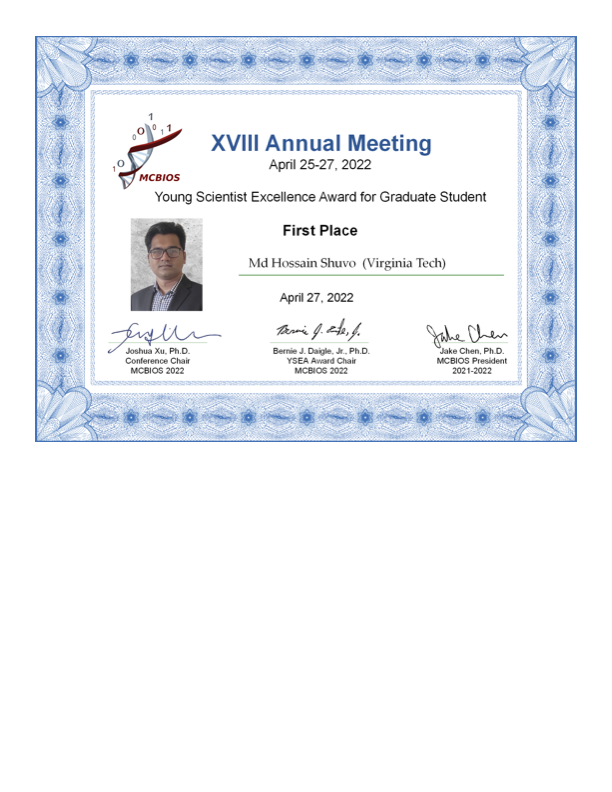
Doctoral student Md Hossain Shuvo @mzs0149 won the 1st Place in the Young Scientist Excellence Award for Graduate Student at the MCBIOS 2022 conference. Congratulations to Hossain for making @VT_CS proud, not to mention the $500 cash prize😀
An undergraduate student in my class gave me an N95 respirator today and said “I see you wear these in the class everyday and this is a gift for you.”
…You made my day! Thank you!


![imDBhattacharya's tweet photo. 5. We enjoyed a group hike to the beautiful Cascade Falls [Photos by @CaptainRafi97]. https://t.co/CAJIU4HQ8v](https://pbs.twimg.com/media/FbQT8QDX0AIiels.jpg)
![imDBhattacharya's tweet photo. 5. We enjoyed a group hike to the beautiful Cascade Falls [Photos by @CaptainRafi97]. https://t.co/CAJIU4HQ8v](https://pbs.twimg.com/media/FbQT6kWX0AE3mzW.jpg)








![imDBhattacharya's tweet photo. 5. We enjoyed a group hike to the beautiful Cascade Falls [Photos by @CaptainRafi97]. https://t.co/CAJIU4HQ8v](https://pbs.twimg.com/media/FbQT-s2XkAEv8Ws.jpg)