This new SKILL.md standard might quietly become the “npm for AI agents.”
AI just got a universal skill system — and almost nobody is talking about it.
SKILL.md = a simple markdown file that turns AI into on-demand specialists.
Not prompts.
Not configs.
Actual reusable capabilities.
Here’s why this is a big deal 👇
1. Skills load only when needed
No more stuffing giant context.
Agents read name + description → load full skill → execute.
→ Faster
→ Cheaper
→ More reliable
2. One skill works across tools
Claude
Cursor
Copilot
OpenAI Codex
Gemini CLI
VS Code
Write once. Use everywhere.
That’s massive.
3. Progressive disclosure = smarter agents
Level 1: reads name + description
Level 2: loads skill body
Level 3: loads files on demand
AI now behaves like modular software, not a chatbox.
4. This unlocks "Skill marketplaces"
Imagine installing:
• review-pr → code review specialist
• growth-tweet → viral content writer
• bug-hunter → security scanner
• research-deep → analyst agent
AI becomes downloadable expertise.
5. Skills > prompts
Prompts = temporary
Skills = reusable infrastructure
This shifts AI from:
"ask better questions" → "build better abilities"
And that changes everything.
Soon workflows will look like:
Agent + Skills = Autonomous system
Not just chat.
Not just automation.
Composable AI intelligence.
The people building skills now
will control the AI ecosystem later.
This is early.
But not for long.
Bookmark this.
In 6 months, everyone will be talking about SKILL.md.
karpathy is showing one of the simplest AI architectures that actually works..
dump research into a folder, let the model organise it into a wiki, ask questions, then file the answers back in.
the real insight is the loop...every query makes the wiki better. it compounds.. now thats a second brain building itself.
i think this is so good for agents if applied right
instead of pulling from shared memory every session, they build a living knowledge base that stays.
your coordinator is not just coordinating tasks anymore.. it is maintaining institutional knowledge so every execution adds something back to the base.
the bigger implication is crazy tho.
agents that own their own knowledge layer do not need infinite context windows, they need good file organisation and the ability to read their own indexes.
way cheaper, way more scalable, and way more inspectable than stuffing everything into one giant prompt.
Python is that one friend who's good at everything 🐍
One language. Infinite uses.
Whether you're building AI agents, training models, scraping the web, or shipping APIs , Python has a library for that.
Which combo do YOU use the most? 👇
#Python#Pandas#NumPy#Matplotlib #Seaborn #Scikitlearn #TensorFlow #PyTorch #LangChain #LangGraph #LlamaIndex #CrewAI #HuggingFace #ChromaDB #FastAPI #Django #SQLAlchemy
Imagine building a system that scales effortlessly, never crashes, and handles millions of users seamlessly. Sounds impossible? It’s not - it’s system design.
Every high-performing system follows a set of essential principles that make it secure, scalable, and resilient. Let’s explore them:
1. Observability & Monitoring – Like having a control room for your system, with logging, tracing, and real-time monitoring using tools like Prometheus and OpenTelemetry.
2. Security & Compliance – Protecting data with encryption, API authentication, and zero-trust architecture to keep systems secure.
3. Distributed Systems – The backbone of large-scale applications. Caching, message queues, and leader election mechanisms keep everything running smoothly.
4. High Availability & Fault Tolerance – Backup strategies that ensure systems stay up even when failures happen, using failovers, redundancy, and disaster recovery.
5. Microservices & Architecture – From REST vs. gRPC to service discovery and circuit breakers, these patterns help prevent cascading failures and improve flexibility.
6. Database Design – Choosing between SQL and NoSQL, data partitioning, replication, and consistency trade-offs to optimize performance.
7. Scalability & Performance – Load balancing, caching, and auto-scaling ensure that systems can grow without breaking.
Building a robust system isn’t just about writing code—it’s about designing for scale, security, and reliability. Master these concepts, and you’ll be ready to build systems that can handle anything.
[Explore More In The Post]
Day 83/365 of GPU Programming
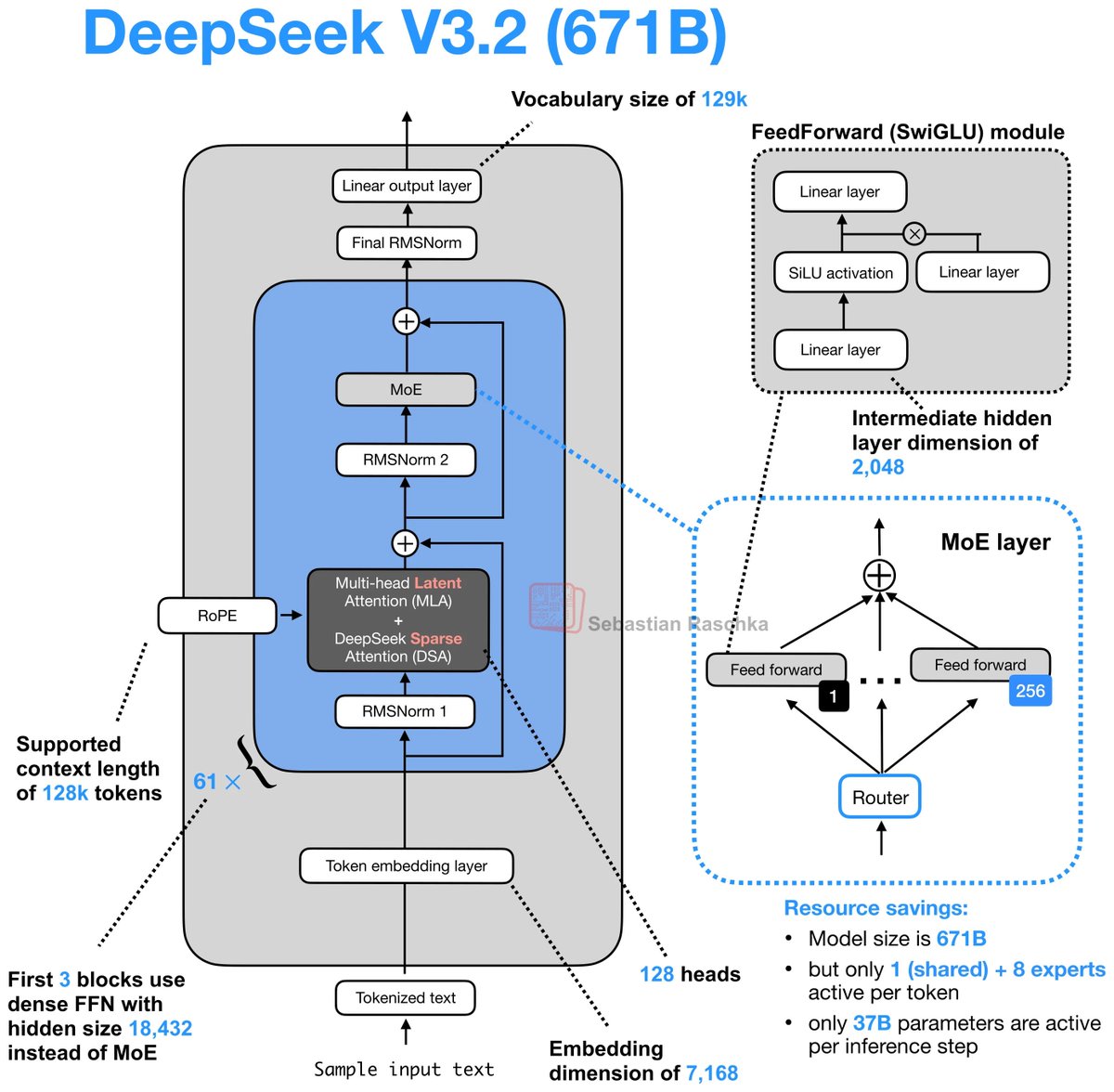
Looking at DeepSeek's Multi-Head Latent Attention today. The last part of the AMD challenge series is to optimize an MLA decode kernel for MI355X where the absorbed Q and compressed KV cache are given and your task is to do the attention computation.
A resource that really helped internalize what MLA does was @rasbt's incredible visual guide to attention variants in LLMs (luckily he posted that last week!), which covers everything from MHA to GQA to MLA to SWA, et cetera. If there's one place to get a visual intuition for recent attention mechanisms, it's this blog post.
@jbhuang0604's video on MQA, GQA,MLA and DSA was the best conceptual intro I found on the topic and progressively builds up the ideas from first principles.
The Welch Labs analysis of MLA is a great watch as well. Beautiful visualization of the changes DeepSeek made for MLA.
Tried out a few kernels once I had a basic understanding of MLA and I think I'm slowly getting more comfortable with at least analyzing kernels.
Nobody gives a clear answer on how to become an AI Engineer.
So here's mine. Practical. No fluff.
The skills, why they matter, and how to build them 👇
Skill 1: LLM Fundamentals
Tokens, context windows, sampling, why models hallucinate.
Resource: Read the model cards. Actually read them.
Skill 2: Prompt Engineering
System prompts, few-shot examples, chain-of-thought.
Practice: Take a broken prompt and fix it 5 different ways.
Skill 3: RAG Architecture
Vector DBs, embeddings, hybrid search, chunking strategy.
Practice: Build a doc Q&A app. Without LangChain first.
Skill 4: Evals
Define what "good output" looks like. Then measure it.
This separates engineers from prompt monkeys.
Skill 5: Agentic Systems
Tool use, memory patterns, MCP basics, multi-step flows.
Practice: Build an agent that can fail gracefully.
Skill 6: Prod Observability
Cost per call, latency, trace logging, hallucination detection.
You're not an Engineer until you've debugged a prod failure.
The ceiling in this field belongs to people who understand why, not just how.
Bookmark this. Build in this order.
🚨 BREAKING: Passive studying is dead!
Claude can train your brain harder than most professors ever will.
Here are 10 Claude prompts to learn anything 10× faster
Become a Claude Certified Architect
Here is the complete resource list in one place:
Link to join: https://t.co/OXQyTmfCmb
Training courses: https://t.co/UaJzLeXKrP (13 free courses)
Cookbook: https://t.co/SLnSUT7xT1
Exam Guide: https://t.co/A2pbDcyGwa
Practice questions: https://t.co/90eXwUxiXQ (free)
MCP documentation: https://t.co/SbwZI0fjVz (free)
API documentation: https://t.co/9rmnLWypxc (free)
Partner Network: https://t.co/diT5OE6ePJ (free to join)
Personal Playbook someone created after the exam: https://t.co/qhXan3XVri
🚨 BREAKING: Someone just open-sourced an entire AI-powered trading firm. Not one agent. A full team of analysts, researchers, traders, and risk managers.
It's called TradingAgents.
Bookmark it for later.
A multi-agent framework built on LangGraph that simulates how real trading firms actually operate. Every role. Every workflow. Every check and balance.
No Bloomberg Terminal. No $50K data feeds. No MBA required.
What's inside:
→ Fundamentals Analyst: evaluates company financials, identifies intrinsic value and red flags
→ Sentiment Analyst: scores social media and public sentiment
→ Technical Analyst: analyzes price patterns, indicators, and chart structures
→ Bull Researcher and Bear Researcher that literally debate each other on every position
→ Trader that synthesizes every argument and makes the final call on timing and size
→ Risk Management Team that evaluates volatility, liquidity, and can veto any trade
Their research paper shows the framework outperformed every traditional strategy they benchmarked.
Supports GPT, Claude, Gemini, Grok, OpenRouter, and even local models via Ollama. Pick whatever LLM you want.
Hedge funds charge 2% management + 20% performance fees for this exact workflow.
100% Open Source. Apache 2.0 License.
(Link in the comments)
🚨 BREAKING: Passive studying is dead!
Claude can train your brain harder than most professors ever will.
Here are 10 Claude prompts to learn anything 10× faster
🛡️ PentAGI – Automated AI-Powered Pentesting Tool that Integrates 20+ Security Tools
Source: https://t.co/50TAGdMf5t
PentAGI introduces an AI-driven approach to penetration testing, automating complex workflows with tools like Nmap and Metasploit while generating detailed reports
The tool stands out for its fully autonomous AI agents that dynamically plan and execute pentests, integrating over 20 professional security tools, including Nmap for network discovery, Metasploit for exploitation, and sqlmap for database attacks.
Users define a target, and PentAGI’s multi-agent system, comprising researcher, developer, and executor roles, orchestrates the process, leveraging long-term memory to recall past successes and adapt strategies.
#cybersecuritynews
🚨𝗕𝗥𝗘𝗔𝗞𝗜𝗡𝗚: Build your next app without spending a dollar on data.
Someone made a list of 320,000+ free public APIs, and developers are going crazy.
→ Weather, finance, news, sports, crypto
→ AI & machine learning APIs you can call right now
→ Government open data, maps, geolocation
→ Entertainment: movies, music, games, anime
→ Categorized, searchable, and verified as working
Free and 100% open source. Link Bellow:👇 just like + comment " send" + repost+ Follow me so that it can be auto DM.