Psiholog Paul Piff je v eksperimentu z monopolijem naključno izbranim igralcem dodelil dvakrat več denarja in boljše pogoje igre. Že po petnajstih minutah so svojo zmago pripisovali lastnim sposobnostim, na začetno prednost pa elegantno pozabili.
Zanimivo je, kako hitro človek iz ugodnega spleta življenjskih okoliščin sestavi pripoved o lastni izjemnosti. In kako zlahka začne usodo drugih presojati po merilih, po katerih njemu samemu nikoli ni bilo treba živeti.
Največja nevarnost privilegija ni privilegij sam, temveč trenutek, ko ga človek zamenja za lastno veličino.
https://t.co/xalsW7qWKP
Paul Tudor Jones: I Blew Up Twice, Then Skipped Harvard Business School to Keep Trading
You know, I had, I had two phenomenal learning periods where I lost everything. Like I had $10,000 and went down to zero, and then I made back like $20,000 and then went down to zero, and I remember...
Are you just using these low numbers so we can understand?
No, no, no, this is when you're 22 years of age and it's 1978 or '79, that's just a gargantuan amount of money. And I remember my father coming to me on the third time and said, you've got to get in something safe, like real estate!
Exactly.
I said no, I'm going to stick with this, and the rest is history. But I guess the point was, it was so funny, I guess by 1980, I was doing pretty well, and in 1980, I thought my father kept going, you've got to do something respectable, so I applied to Harvard Business School and got in. And I was thinking, okay, I'm going to go up there and what is this place going to teach me? I mean, I was already doing, I was probably making a couple of million bucks a year to trade my own account, which was a fortune back then. And the weekend before I was supposed to go, I was loading up the U-Haul to drive to Boston and just said, ah, this is crazy. They're not going to teach me anything about this, and this may disappear, and so I never went and continued trading.
Pravi bogataši nimajo plače. 🎩 Zato tudi kapice ne bodo dobili. Naj razložim po kmečko! Kdor ima na računu nekaj milijonov, ne živi od plače. Te povečini sploh nima ali pa je zaposlen pro forma, za nek minimalec. Živi od dobička, dividend in obresti.
Številka za zraven kave: na dividendo plačaš 25 % davka in 0 evrov prispevkov. Na plačo plačuješ prispevke od prvega do zadnjega evra. Brez zgornje meje.
Dokaz? Blaž Brodnjak. Človek, ki so ga nasprotniki kapice izbrali za njen obraz. Lani je prejel 1.797.887 € bruto. Od tega mu po oceni Financ ostane okoli 710.000 € neto. Dober milijon gre državi. Vsako leto. Ker ima plačo. Revni milijonar, torej.
Po kmečko. Na posestvu so trije. Grof, oskrbnik in hlapec.
Grof ne dela za plačo. Grof ima zemljo. Zemlja mu nosi rento, on pa hodi na lov.
Oskrbnik je tisti, ki zna. Ve, kdaj sejati, koga najeti in kako posestvo ne gre na boben. Plačan je dobro, ker je grof brez njega v enem letu berač. Hlapec orje.
Potem pride butalski župan in zavpije: “Obdavčimo bogataše!” In obdavči plače. Koga je zadel? Oskrbnika. Grof plače nima.
Brodnjak ni grof. Brodnjak je oskrbnik. Najbolje plačan v državi, ampak oskrbnik. Grofje so delničarji, ki jim je banka lani prinesla 503 milijone evrov čistega dobička. Njih v kampanji nihče ne išče.
Pa to ni nobena skrivnost. Predsednica republike je v kampanji 2022 sama povedala, da si je kot odvetnica dobiček izplačevala v dividendah. Povsem zakonito. Pri tem pa prejemala delavsko povprečno mezdo. In povsem logično. Tako dela vsak bogataš, ki zna računati.
Kapica pri 7.500 € bruto torej ni za grofe. Je za oskrbnike, kirurge, inženirje, manadžerje. Približno 13.700 ljudi, ki so naredili to napako, da služijo s plačo.
Samo ne recite temu darilo bogatašem. Bogatašev na tem seznamu ni. Bogataši nimajo plač.
Long story short. Pravi bogataši z denarjem delajo popolnoma drugače. Denar dela denar. Ne dela denarja plača. Tisti, ki hodi po mezdo je hlapec in ne gospod.
Zato za njih ta kapica ni. Bogati je ne bodo koristili. Ti so pred sistemom.
Koliko grofov poznate, ki hodijo v službo? Napišite samo številko.
Ljubljanska borza
Začel sem sestavljati podatke o podjetjih, ki kotirajo na Ljubljanski borzi, na enem mestu. Da ne bo treba za vsako številko brskati po desetih poročilih in petnajstih spletnih straneh.
Equinox sem zaradi konflikta interesov namenoma izpustil.
To ni investicijski nasvet. Je orodje za tiste, ki raje razmišljajo s svojo glavo.
Zadeva se bo sproti nadgrajevala. Ideje in pripombe dobrodošle!
https://t.co/QPQyW1AuRH
Zakaj so nekateri neznansko bogati, drugi pa kljub pridnosti in sposobnostim nikoli ne obogatijo? O bogastvu radi govorimo kot o nagradi za genialnost. O sreči precej manj. Pa vendar ima naključje pri naših življenjskih uspehih precej več besede, kot si želimo priznati. Tudi pri mojih. Moja najbolj brana kolumna za @finance_si
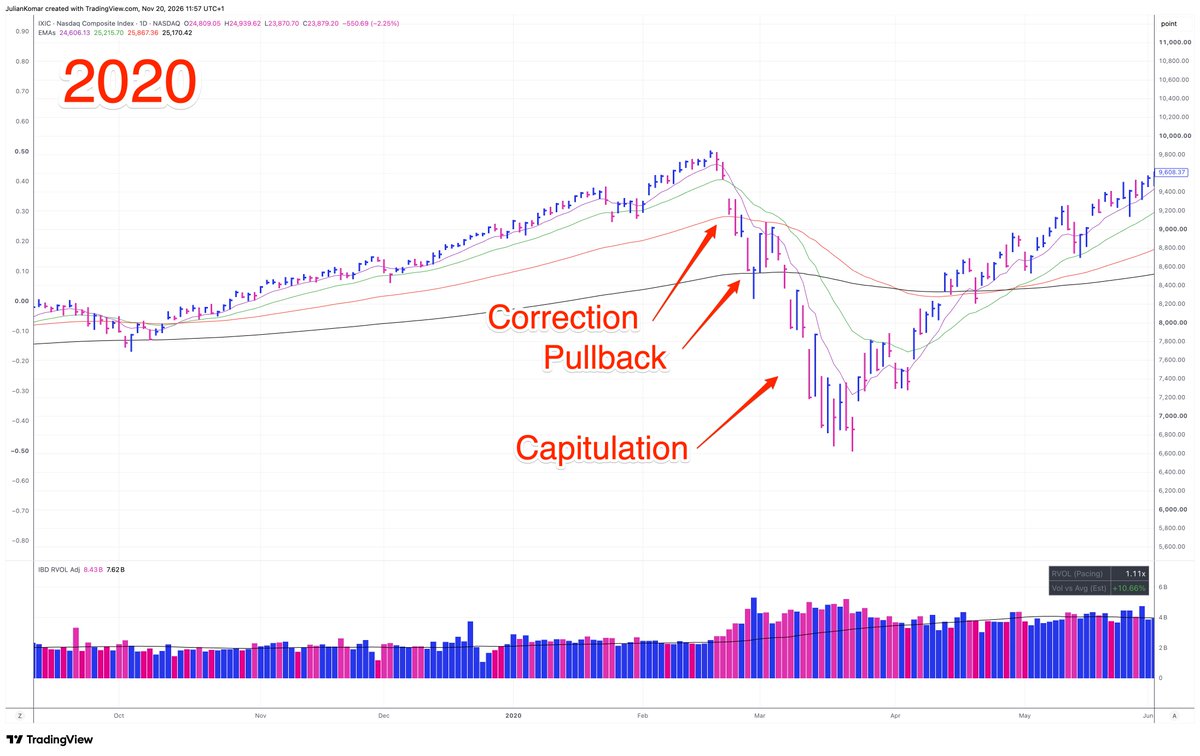
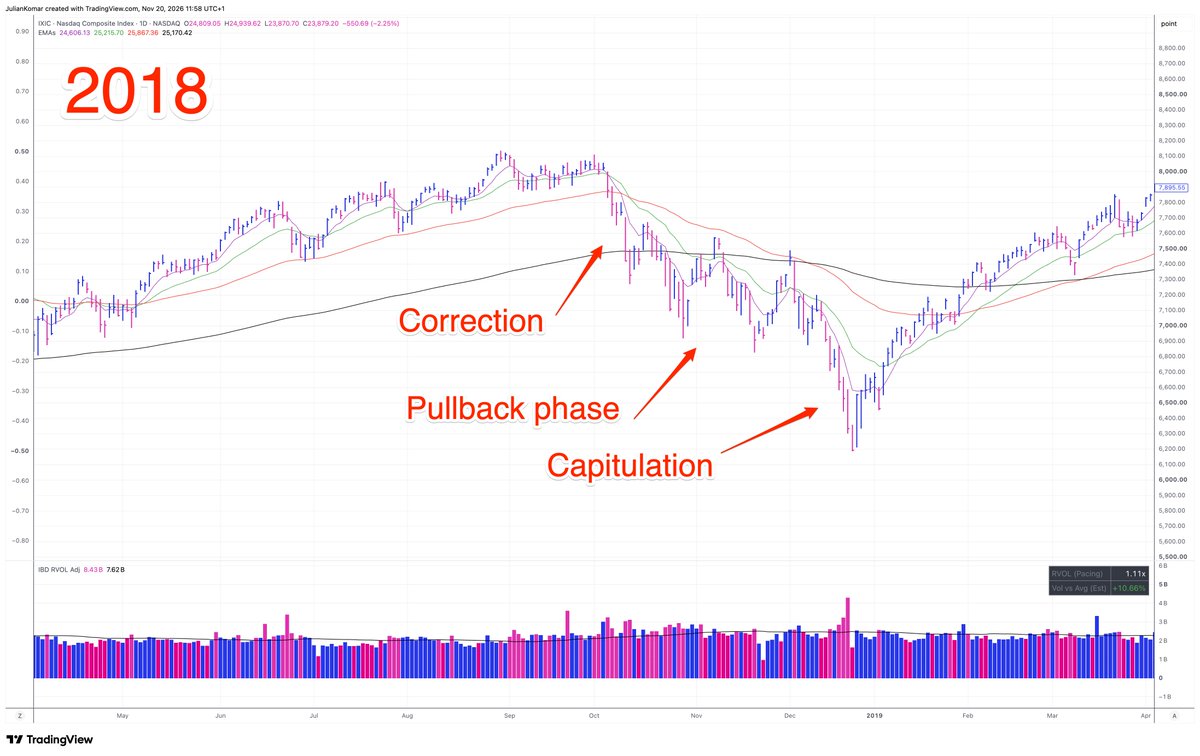
I've traded through 20+ years of market corrections.
And I've seen the same pattern play out again and again:
1. The market starts correcting.
2. The market stabilizes and moves sideways.
3. A BRUTAL FINAL SELLOFF shakes out the remaining buyers.
That third phase is particularly important.
Here's what I've learned:
1. THE INITIAL CORRECTION
The market starts declining.
Leading stocks begin to break down. Breakouts fail. More and more stocks lose their momentum.
But there's a problem:
There will ALWAYS be stocks moving higher, even during a correction.
And that's exactly why so many traders underestimate the risk.
They keep buying because individual setups still look attractive.
I've learned that a few strong stocks don't necessarily mean the overall market is healthy.
2. THE SIDEWAYS PHASE
After the initial decline, the market stabilizes.
The indexes bounce, move sideways, or attempt to recover.
Selling pressure appears to ease.
Traders become optimistic again.
Maybe the correction is already over?
But this is where things can become particularly dangerous.
The market can spend days or weeks moving sideways before the next wave of selling begins.
And traders who have been buying during this period may suddenly find themselves exposed to another sharp decline.
3. THE BRUTAL FINAL SELLOFF
This is the phase I pay particularly close attention to.
The market breaks lower again.
Selling accelerates.
Sometimes the major indexes decline 3–4% in a single session. Sometimes the weakness continues for two or three days.
Fear increases. Pessimism spreads. Even relatively strong stocks come under pressure.
This is what I call a possible capitulation move.
I've observed this type of behavior around many important market lows.
Look at the historical charts I've attached, including April 2025.
Notice how the initial correction and the sideways period were followed by an aggressive final decline.
And notice what happened afterward.
Of course, not every correction follows this pattern. And not every sharp sell-off marks a bottom.
But recognizing this sequence helps me prepare for what could come next.
4. HOW I TRADE A POSSIBLE CAPITULATION
When I see signs of a possible capitulation move, I don't automatically start buying stocks.
My first priority is to reassess my short positions and look to cover them.
Why?
Because after an aggressive decline, the risk of a powerful rebound increases significantly.
But covering shorts is NOT the same as getting bullish.
I can close my shorts and remain entirely in cash.
Then I wait for my market trend model to give me a new signal on the long side.
In the meantime, I'm preparing my watchlist.
I'm looking for growth and momentum stocks showing relative strength and developing constructive setups.
When market conditions improve, I want to be ready.
I don't want to start searching for stocks after the rally is already underway.
5. WHAT I'M WATCHING RIGHT NOW
We could experience a similar acceleration in selling in the coming days.
I don't know whether that will happen.
And I certainly don't know where the exact bottom will be.
But I know what kind of market behavior deserves my attention.
In my latest MARKET UPDATE Premium Weekend Report, I discussed this possibility and what I'm watching as the correction develops.
Throughout the week, I'll continue sharing my market assessments, observations, and the reasoning behind my trading decisions with members.
My goal isn't to predict the next bottom.
It's to help traders understand changing market conditions and make better decisions independently
If you think this move lower is bad, remember: in 2020, traders were effectively paying people $37 a barrel to take the expiring WTI futures contract off their hands. Cheers.
Be Ashton Kutcher:
- Works construction with his dad at 10
- Janitor, butcher and factory hand in high school
- Sweeps Cheerios dust at General Mills for $12 an hour
- Studies biochemical engineering at Iowa
- Wins a modeling contest. Drops out
- Gets cast as Kelso. Plays dumb for eight seasons
- Creates Punk'd
- Watches 50 Cent make $100M on Vitaminwater equity
- Realizes he's been taking endorsement checks
- "I've got to figure out how to get in the equity game"
- Hires someone from TechCrunch to introduce him around
- "I spent 90% of my time just listening"
- Puts $1M into Skype in 2009
- Microsoft buys it 18 months later. 4x
- First to 1 million Twitter followers. Beats CNN by 29 minutes
- Starts a fund in 2010. Puts in $1M of his own
- $500K into Uber
- $2.5M into Airbnb
- $3M into Spotify
- Loses money on an "Uber for planes"
- Watches Fab go from $1B on paper to a $15M sale
- Keeps investing
- Turns $30M into $250M in 6 years
- Marc Andreessen: "He started doing it when it really wasn't cool"
- Gets $100M from Liberty Media to start Sound Ventures
- Raises a $240M AI fund in about five weeks
- Already owns OpenAI
- Meets Dario Amodei at his partner's house in Beverly Hills
- Asks Sam Altman first if he minds
- Writes a $35M check at about a $5B valuation
- Gets asked on TV why he paid so much
- Says every company will be an AI company
- Keeps writing checks. $435M in total
- Steps back from the firm months before the IPO to start over at the early stage
- Anthropic goes public at $1.5T
- The stake: about $7B. Roughly 16x
- Most of it belongs to his investors but nearly $2B in carry goes to him and his firm
- His take: "Kind of cool when that works out"
"It's years of work, micro victories and failures stacked on top of one another."
@Astra__AI just passed 20M users.
When Duolingo had 20M users in February 2014, it had raised about $38M in VC to get there.
We got here in 3 years with $0 in VC.
AI changed how many students a small team can serve. We now run 3T+ tokens a month across 190+ countries. Reach got cheap. Making sure 20M students actually learn, and don't just collect answers, is the part that is still hard, and it is what we work on every day.
Next stop 50M.
Stanley Druckenmiller:
"So, I’ll never forget it. January of 2000 I go into Soros’s office and I say I’m selling all the tech stocks, selling everything. This is crazy…at 104 times earnings. This is nuts.
Just kind of as I explained earlier, we’re going to step aside, wait for the next fat pitch. I didn’t fire the two gunslingers. They didn’t have enough money to really hurt the fund, but they started making 3 percent a day and I’m out. It is driving me nuts.
I mean their little account is like up 50 percent on the year. I think Quantum was up seven. It’s just sitting there. So like around March I could feel it coming. I just, I had to play. I couldn’t help myself. And three times the same week I pick up a, don’t do it. Don’t do it.
Anyway, I pick up the phone finally. I think I missed the top by an hour. I bought $6 billion worth of tech stocks, and in six weeks I had left Soros and I had lost $3 billion in that one play.
You asked me what I learned. I didn’t learn anything. I already knew that I wasn’t supposed to do that. I was just an emotional basket case and couldn’t help myself. So, maybe I learned not to do it again, but I already knew that."
I love this story about what George Clooney learned from moving to Italy:
In the early-2000s he was a motorcycle trip to the Italian Alps and stopped by a small town on Lake Como to visit some friends. After he left his bike broke down so Clooney knocked on the door of the nearest house (which happened to be a beautiful estate on the water).
A member of the Heinz ketchup dynasty owned it. By the end of the day, Heinz asked the actor if he would like to buy the lakeside estate. Clooney balked which caused Heinz to lower the price.
Clooney said yes on a whim assuming he would sell the home within a year to turn a quick profit.
After moving in Clooney was sitting alone by the pool. In an interview with Esquire he described what happened next:
He looked out the window that first evening and saw a few construction workers walking home after work, orange vests, bellies sticking out, hard hats cocked on their heads. They pulled hunks off a loaf of bread and passed a bottle of wine as they walked, and they were singing.
Singing!
Clooney, who was making the leap from being pretty famous to being an international A-list actor–The Perfect Storm had been a hit, and Ocean’s Eleven was an even bigger one–thought to himself, Those guys are living their lives better than I am. Way better than I am.
He was always in such a hurry to be a success that he’d been eating dinner standing up for as long as he could remember. And then these guys–not much money, doing hard labor all day, and they’re celebrating another night walking home.
He thought, I’m never going to leave this house.
Clooney still has the house all these years later.
Some more thoughts about living a better life now:
https://t.co/nSEmgTywPH
Paul Tudor Jones: "You Retire, You Die," So I Keep Trading
And the other reason that I love trading. I'll never forget, my wife's Australian, and we first got married back in 1989. She said, well, I know you've got to live in New York, but I came from the beach. So when our last child graduates from college, you're taking me to the beach. So sure enough, my son turns 18, my fourth child, 2014. We're going. So we ended up down here in Palm Beach.
She gives me a GP, a general practitioner, so she makes me go in. I see the guy, and this guy's 83 years old, and I say to him, you're living here in the land of the walking dead. Everyone here is basically fossilized. What is the secret to longevity? And he goes, it's real simple: you retire, you die.
And that had a really profound impact on me. Because I realize as I get older, maybe when you get older you will too: boy, if you don't use it, you're going to lose it. And that's why I try to work out two hours a day. And another reason that I enjoy trading is I want to keep my mind sharp, because there are too many things that I want to do. My father lived to be 100. When I'm in my 90s, there are things I want to do. So I think trading is great therapy for me too.
The other reason that I really enjoy trading is I'd like to make an absolute pot of money so I can give it away. I've got so many causes that I want to give it to that I actually feel like this is the pursuit of nobility. I feel it's a privilege to wake up, and I just hope I freaking kill it so I can give it away.
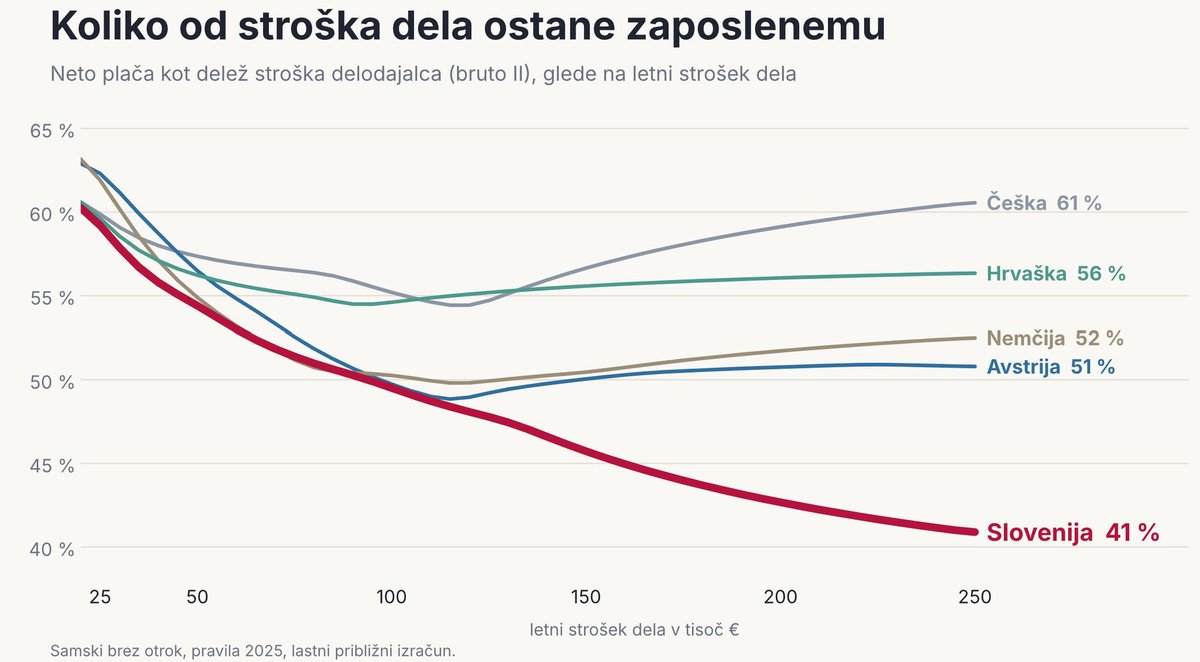
Od vsakih 100 EUR, ki jih zaslužite, država pobere 59 EUR.
Delo se ne splača več.
Zato ste nezadovoljni, ljudje.
Zato.
6.12.2026 na referendumu obkrožite ZA.
ZA nižje davke.
ZA razvoj gospodarstva.
ZA Slovenijo.
🇸🇮💜
To je le prvi paket sprememb. Ostale sledijo v kratkem...ker tako ne gre več naprej.
Delo se mora izplačati.
I’ve decided to leave NVIDIA. There are a few things I want to say.
As a robotics engineer at NVIDIA, I have seen Jensen as much more than the company’s CEO.
I admire his willingness to invest in a future that was not yet obvious. He committed to CUDA long before the deep learning boom and positioned NVIDIA for AI before it became everyone��s priority. Those decisions helped build the infrastructure that powers today’s AI.
I have seen that same vision in physical AI: investing in robotics, sharing open-source tools and projects, and building computing platforms that bring AI into the physical world. This is the work I do every day—and a future I believe in.
But what matters most to me is the culture he helped build.
Engineers are encouraged to explore, take risks, and learn from mistakes. Jensen reads employees’ Top 5 emails, follows their work, and engages directly. In a company this large, that connection matters. It makes an individual engineer feel that their ideas can still be heard.
That is why this has been so disappointing.
I do not have all the facts surrounding the allegations, and I cannot prejudge the investigation. My admiration for Jensen does not put him above scrutiny.
What I find difficult to accept is having to come to terms with his departure before receiving an explanation that helps me understand it. What this means for our direction, our culture, and the people doing the work remains unclear to me.
I have felt that engineers’ perspectives matter here. On this decision, I have not felt heard. That gap has been more painful than I expected.
I understand that some information cannot be shared immediately. But that does not erase the feeling of being left outside a decision that affects the company we help build every day.
A company’s greatness comes from its leadership, its governance, and the people who turn its ambitions into reality. Employees’ trust and sense of belonging are part of that, too.
Jensen’s vision and the engineering culture he shaped were important reasons I wanted to stay. His departure led me to decide that my own chapter here should also come to a close.
I leave with sadness and gratitude. The colleagues I have worked with, and the work we believed in together, will always matter to me.
These are my personal views.
Zlikana slovenščina je za salone. Pravo meso jezika diha v narečjih, v grlu, ki pozna mraz, strast in žganje. Vzemi našo mežiščino: beseda tam ni okrasek, ampak kos svinca izpod Pece. Odsekana, robata, z vonjem po smoli in šihtu. Brez blefa. Živa do kosti.
A serious post for those getting wrecked. Who cares how you got here, it’s history. You can learn from it and be better. We’ve all been there thinking we know better than the market, it’s wrong we’re right etc.. so now you know. Here is the key. You are in a special industry where next week all can change. It’s not like this in most careers. So be that change. Moreover don’t look backwards pissed off because you will miss the next great opportunity staring at you in the face. 🙏
Krka, celotna ekipa in predvsem Jože Colarič si zaslužijo pohvale in globoko spoštovanje vseh nas. 36 let konstantne rasti, izboljšanja poslovnih rezultatov, višjih dividend in skrb za lokalno skupnost in državno blagajno. Nihče v Sloveniji ni ustvaril toliko milijonarjev kot oni. Skromno, preudarno in vztrajno. Dragi Krkaši, ponosni smo nas vas!
https://t.co/m3X8LOMPgK