EGSR'26 Call for Papers is out!
Doing research on rendering? Physics-based, neural, stylized... Submit your work to EGSR!
Papers deadline: April 8th 2026
https://t.co/FBsuahA1eP
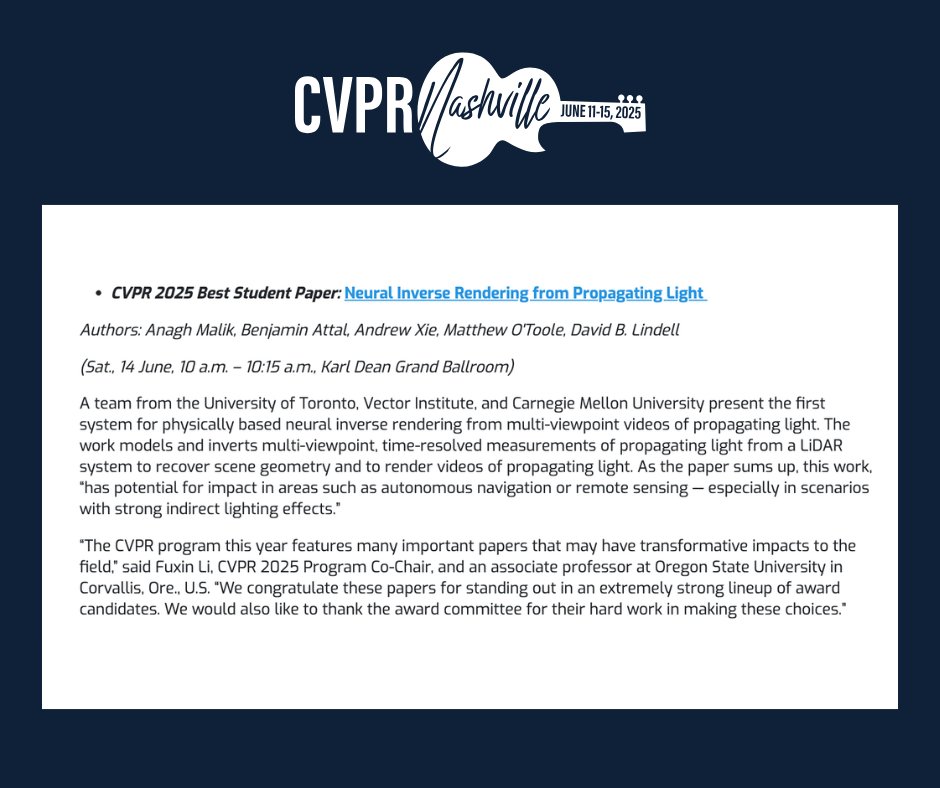
Congrats to RI Ph.D. Benjamin Attal, RI assistant professor Matthew O'Toole & co-authors from @UofT & @VectorInst for winning the CVPR 2025 Best Student Paper award! 🙌
Check out the winning work: "Neural Inverse Rendering from Propagating Light" 💡🏆
https://t.co/QCwrJYG1En
Honored that our work received the best student paper award at #CVPR2025! This was a really fun and exciting collaboration with @mpotoole led by amazing students @anagh_malik@imarhombus@AndrewEJXie!
Check out the work at https://t.co/lSPS4WJ2EH
Check out our work "Neural Inverse Rendering from Propagating Light", appearing at CVPR 2025 as an oral presentation. It was awesome collaborating @anagh_malik -- super bright, and a super hard worker who made everything easy :)
📢📢📢 Neural Inverse Rendering from Propagating Light 💡
Our CVPR Oral introduces the first method for multiview neural inverse rendering from videos of propagating light, unlocking applications such as relighting light propagation videos, geometry estimation, or light component separation!
\w @imarhombus (co-first), @AndrewEJXie, @mpotoole, and @DaveLindell
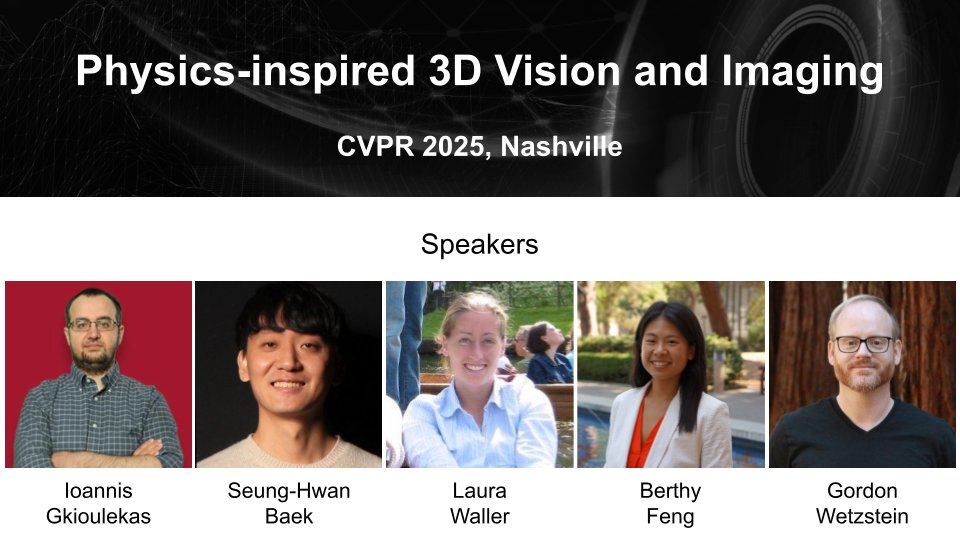
Excited to be part of the organizing team for the first workshop on Physics-inspired 3D Vision and Imaging! If you do research at the intersection of physical modeling & 3D/4D reconstruction please consider submitting your work :)
Website: https://t.co/DnbUu23kfl
We’ll be presenting NeRF-Casting at SIGGRAPH Asia next week! NeRF-Casting enables photorealistic rendering of scenes with highly reflective surfaces—something that was previously impossible with models like Zip-NeRF and 3DGS. (1/6)
Learn how to interpolate time-of-flight depth videos using Flowed Time of Flight Radiance Fields (F-TöRF) at this morning’s @eccvconf poster session.
Project:
https://t.co/j6klPyQ9y4
With Mikhail Okunev*, Marc Mapeke*, @imarhombus, @mpotoole, @jtompkin
(1/N) Flash Cache: Reducing Bias in Radiance Cache Based Inverse Rendering
Website: https://t.co/ytSXIoeyKo
tl;dr our #ECCV2024 (oral ✨) paper presents a new system for inverse rendering that is more physically accurate, and therefore less biased, than existing approaches.
(9/N) Our full system for inverse rendering combines the high-quality radiance cache, occlusion-aware importance sampling, and fast cache to produce low--cost and accurate rendering --- while still treating scene geometry as volumetric.