two weeks ago i wrote "ai was supposed to help juniors shine. why does it mostly make seniors stronger?"
it hit top 5 on hacker news with 450+ comments.
it’s about how ai shifts leverage toward experience instead of replacing it.
how i stopped getting 1-star reviews from freebie seekers:
1. detailed interactive onboarding that shows exact results.
2. hard paywall before any core action (no "upload then pay" traps).
3. a very cheap one-time pass if they reject the main sub. filters out the noise immediately and validates if the product actually solves their problem. willingness-to-pay test.
used to jump to a new codebase the second things got hard. it's the comfort zone. you don't learn anything new. forcing myself to stay with a flatlining project and figure out the business side was the only way to actually learn how to run a company.
just excluded 54 gb of build artifacts and cache files from my time machine backups:
- ~/.cache (3 gb)
- ~/.gradle/caches (6.2 gb)
- Docker.raw (16 gb)
- CoreSimulator (14 gb)
- DerivedData (9 gb)
- iOS DeviceSupport (5.6 gb)
all of this is temporary data that gets rebuilt automatically. saves a lot of storage and keeps backups fast.
note: if you store unbacked-up DBs inside local docker containers without volumes, keep docker.raw in your backups.
check yours:
du -shc ~/.cache ~/.gradle/caches ~/Library/Containers/com.docker.docker/Data/vms/0/data/Docker.raw ~/Library/Developer/CoreSimulator ~/Library/Developer/Xcode/DerivedData ~/"Library/Developer/Xcode/iOS DeviceSupport" 2>/dev/null
We just launched Xirp, a vendor-neutral agentic development environment. One place to manage agent sessions across @ClaudeDevs, @GeminiApp CLI, and @OpenAI Codex. 1,300+ @Spotify engineers already use it. Now it's available for you to try. Learn more at https://t.co/Hwo8Qqx4OI.
if you're picking ai video models for product or image-to-video workflows, a few price/performance takeaways:
1/ turn audio off in api params. cuts costs by up to 50% on models that charge extra for sound.
2/ text-to-video elo scores are useless here. subject consistency on image-to-video is what matters.
3/ keep clips at 4s max. motion degrades after 5s anyway and saves you a ton on api credits.
4/ budget $0.04-$0.05/s models deliver insane value. save $0.20/s tier for complex detail locking.
love finding out @replicate is completely down from my own internal anomaly detection and not a single word or email from them for over an hour. rely on critical infra, get zero status updates.
@kylegawley this.
people still sleep on selling the boring infrastructure.
i’m doing the same with my django + flutter + vue/nuxt stack. not sexy but it saves people months.
@jonathan_wilke for me the hard part is still the boring stuff. auth, payments, security, legal, conventions, emails, admin, multi tenancy…
ai helps a lot with the fun features but the production ready foundation still takes time. that’s why i started packaging my own stack.
@marclou congrats man. 25k with low churn is crazy.
i’m still at much smaller numbers with clothshift but seeing these long term consistent ones keeps me going.
how long did it take to get the first 5k?
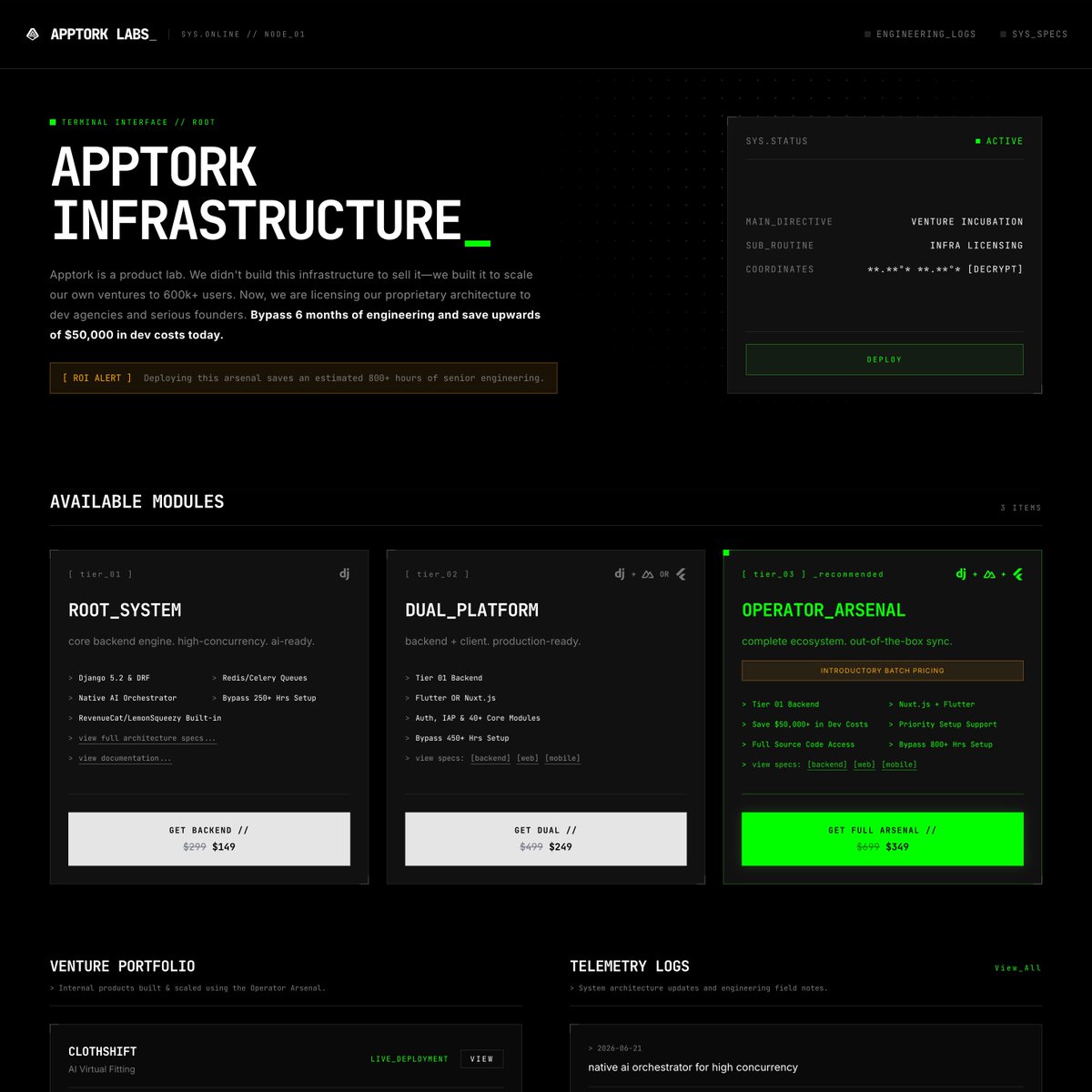
just pushed the new apptork labs site.
the boilerplates on here aren't random. apptork is my venture studio, and this is the exact django 5.2, flutter, and vue/nuxt stack i use to build my own apps.
it skips about 800 hours of dev work. link in profile.
also, no waiting around for manual github invites. you just enter your license key and a custom edge engine gives you repo access instantly. wrote a short note on how i built that on the site.
when designing software architecture, focus more on the organization's structure than the code. here are the pragmatic truths:
- architecture is actually dictated by team incentives and human dynamics.
- if you can't change the organization, adapt the architecture to fit it. adaptable systems survive, not idealistic ones.
-split your system in two: keep the core extremely strict and unbreakable but leave outer layers flexible and isoleted.
- crashes in the outer layer should never take down the core. this lets you maintain stability without killing your shipping speed.
@xburak trap. quantity is a bottleneck, not a strategy. the context switching alone kills roi here.
building a herd of donkeys is still building a herd you have to feed. this doesn't scale, just drains the dev behind
exponentially cut costs by packing multiple projects onto a single server. route via reverse proxy, map different ports, and squeeze every drop of idle compute. there is literally no limit to this.
So @loaibassam asked me my stack recently, I replied:
FREE:
Nginx web server on Ubuntu (free)
Auto upgrade with unattended-upgrade (free)
Scheduled workers with Cron (free)
Vanilla PHP for site backend (free)
Vanilla CSS (free)
Vanilla JS for code (free)
Game servers I do in vanilla Node JS (free)
SQLite for DB (free)
Python for tool scripts (free)
Cloudflare with Cloudflare tunnel for DNS/SSL (free)
Tailscale for security (free)
OpenFreeMap for maps (free)
CHEAP:
xAI for AI API (cheap)
Stripe for payments (cheap)
Cloudflare R2 for image storage (cheap)
Hetzner VPS ($4/mo)
Cloudflare domain reg (~$10/year)
So about ~$5/mo total costs with about ~5M unique visitors per month per site (these are site averages)
got randomly placed into a gemini a/b test recently. asked it to calculate body recomposition based on daily macros/flow, and it autonomously decided to build an interactive html visualizer instead of just dumping text. dragging sliders to see future projections instantly within the chat was next level