Most repos throw away their rejected ideas. DeepSeek Harness (https://t.co/lvYLAtEm56) does not: its .agents/notes folder holds 545 active decision records and 143 archived — where every declined proposal is kept permanently, with the exact reason it lost, and the archive is content-hashed so a "frozen" decision can't be silently edited later.
Checked it against 15 years of Architecture Decision Record practice (Nygard, MADR, adrkit, archgate) and every AI-agent memory pattern I could find (Cline's Memory Bank, Aider, spec-kit, Kiro, AgDR). Half of it is "ADRs done rigorously." The other half — permanent rejected-decision retention, hash-sealed archival integrity, and a calibrated (not quota-based) judgment call on what to archive — doesn't exist anywhere else I could verify. Genuine open gap in 2026, not a search-term problem.
Wrote up the full mechanism, the real example note, and the build-vs-adopt comparison (checked live against GitHub, not taken on faith) as a long-form article below. Porting this into every repo I run next.
Full article: https://t.co/fRY29V8qMU
Ran Qwen3.8 27B on an M4 Max two ways — 8-bit GGUF vs 4-bit MLX.
Expected the 4-bit build to be ~1.6x faster (18 GB vs 29 GB of
weights per token).
Got 3.6x.
41.6 tok/s vs 11.4. Half the memory. On Apple Silicon the
backend matters more than the bits.
Qwen3.8 27B advertises a 256K context window. I assumed it was theoretical — estimated 50-70 GB of KV cache.
Actual cost: 8.5 GB.
full_attention_interval=4 means only 16 of 65 layers keep a growing cache. And generation speed is flat across context.
Long context costs memory, not speed.
When prototypes take weeks to build, teams fall in love with bad ideas because of sunk cost fallacy. When a prototype takes fifteen minutes to generate with an AI agent, you feel zero attachment to discarding it. You can build five radically different concepts, test them with actual users the same afternoon, and throw four away without remorse.
Do not use a Computer Use agent to drag shapes around a Figma canvas; it is slow and imprecise. Use the official Figma MCP server to read node graphs, update variable tokens, and create components programmatically. Direct node tree manipulation is infinitely cleaner than simulated mouse clicks.
Pure vision models struggle with low-contrast buttons, but when you combine vision with the OS accessibility tree, the agent gets exact semantic bounding boxes and element IDs. Hybrid vision plus accessibility is 5x more reliable than vision alone.
Judging desktop automation isn't about speed; it's about deterministic recovery. When an agent drives Blender or AutoCAD via vision, your harness must verify state milestones after every action. If you can't verify intermediate state, you don't have an agent—you have an uncontrolled script.
Full-screen screenshots still cost ~800–1,600+ tokens on current vision models (GPT-5.6 Sol / Terra / Luna, Claude, etc.).
50 agent actions on a desktop task = 40–80k tokens burned on images alone. Crop to the active window or target region → routinely cuts token burn ~70%.
Still the biggest free optimisation for vision agents in 2026.
Everyone picks an AI design tool by the model behind it. That's the wrong axis.
Agents and renderers churn every few months. What outlasts them: a DESIGN.md contract any agent can read, and a local-first setup where you own the output.
Build around the durable layer, not the hype — that's the bet my book makes in Chapter 15.
Read it free: https://t.co/tcXnkj278h
The most dangerous thing in design work isn't AI. It's an undocumented agent workflow.
It looks fast for a week — then model defaults shift, versions update, and the person who knew the prompts moves on. Unrepeatable within a month.
A team design pipeline is just a documented decision: brand contract + skills + a review gate, written down once, run forever.
My new book: https://t.co/tcXnkj278h
Running one design agent gives you one answer. Running three in parallel gives you divergence.
The trick with multi-agent design teams: each agent anchors on what it just made — so sequential options all look alike. Parallel agents produce genuinely different directions you can actually compare.
Seven hero treatments in one round, not three loops. That's Chapter 12 of my new book:
https://t.co/tcXnkj1ziJ
The AI agent space looks like a charger war. Claude Code, Codex, Cursor, Gemini — different agents, different sockets.
MCP is the USB-C of AI. One socket, any charger.
That's why Open Design isn't locked to a single model: it speaks MCP, so the agent you use today can be swapped tomorrow without rebuilding your design pipeline.
Same brand spec, any agent. My book: https://t.co/tcXnkj278h
The AI agent space looks like a charger war. Claude Code, Codex, Cursor, Gemini - different agents, different sockets.
MCP is the USB-C of AI. One socket, any charger.
That's why Open Design isn't locked to a single model: it speaks MCP, so the agent you use today can be swapped tomorrow without rebuilding your design pipeline.
Same brand spec, any agent. My book: https://t.co/tcXnkj278h
The AI agent space looks like a charger war. Claude Code, Codex, Cursor, Gemini — different agents, different sockets.
MCP is the USB-C of AI. One socket, any charger.
That's why Open Design isn't locked to a single model: it speaks MCP, so the agent you use today can be swapped tomorrow without rebuilding your design pipeline.
Same brand spec, any agent. My book: https://t.co/tcXnkj278h
The most underrated detail in my new book: the preview window is a jail.
Open Design renders every AI-generated artifact inside a sandboxed iframe that can't read your cookies, your localStorage, or your ~/.ssh keys. Model output is untrusted code — it gets a room, not a key.
Local-first isn't just about privacy. It's about making "run AI output" safe by default.
Chapter 8: https://t.co/tcXnkj278h
Two things. First, the numbers age embarrassingly fast — the book pinned v0.9.0 with 150 brand systems and 261 plugins in June, and by the July release the product was at 0.16.1. A living book forces you to build a small publishing pipeline so a version bump doesn't break the whole package — that CI/CD turned out to be as valuable as the writing. Second, I keep finding that readers don't want the catalog, they want the architecture — where generation runs and who controls it. The living format is perfect for that, because the catalog churns but the architecture doesn't.
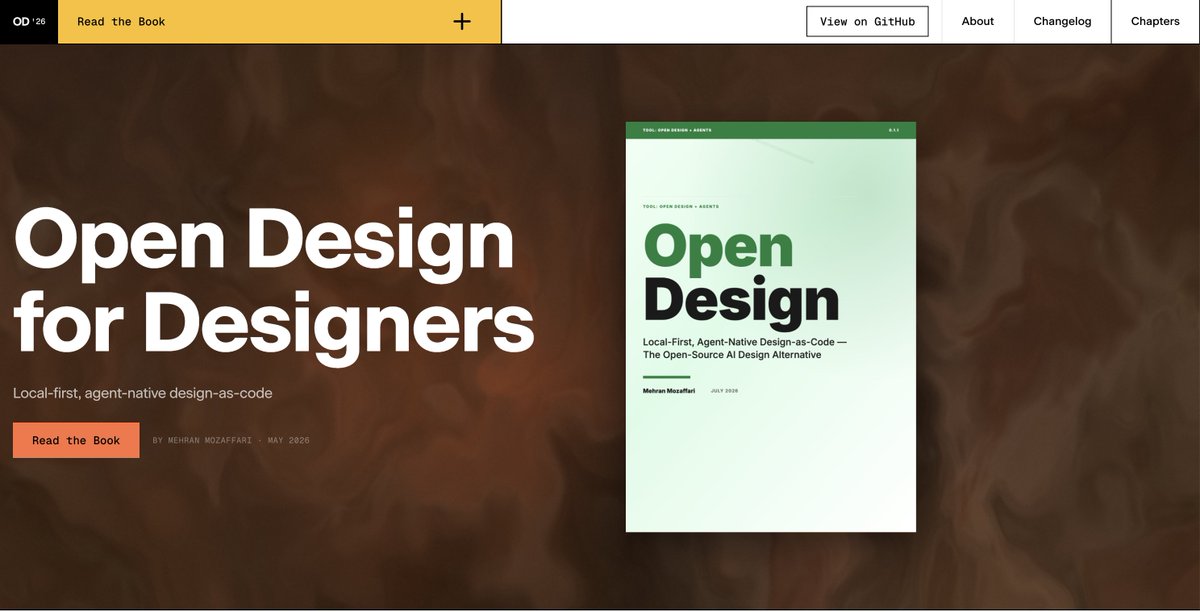
I’ve written a new book about Open Design — a local-first, agent-native design harness for turning briefs into real artifacts.
What I like most is that Open Design isn’t locked to one model. You can use different coding agents and model providers—Claude Code, Codex, Cursor, Gemini, OpenCode, Qwen, or a BYOK/OpenAI-compatible endpoint—while the harness supplies the design-specific layer: skills, design systems, templates, plugins, previews, and exports.
The same workflow can produce brand-aware prototypes, dashboards, decks, images, and motion artifacts as real files that move back into engineering.
The book is my contribution to the ecosystem: a living book that I regularly update and improve as Open Design evolves. Each release is versioned on GitHub, with its own publishing CI/CD to rebuild HTML, PDF, and EPUB, generate changelogs, and publish release artifacts.
Book repo: https://t.co/nY1KItG5O1
@OpenDesignHQ
The part of Open Design that changed how I think about design work: the brand system.
A DESIGN.md file becomes the contract between your brand and every AI agent you use — tokens agents can read, components agents can reuse, rules agents can follow.
Same brand spec, any model: Claude Code, Codex, Cursor, Gemini. Your design system stops living in someone's cloud and becomes a file your team owns.
That's Chapter 5 of my new book. Read it free: https://t.co/tcXnkj278h
Repo: https://t.co/nY1KItG5O1