IMPORTANT UPDATE
Technical maintenance has been successfully completed.
NullFee is now fully operational on both official domains:
• https://t.co/aSv1cHXQtN
• https://t.co/B7Rhw1Ah6g
Everything is working normally.
All balances, withdrawals, and user data remain fully secure.
Platform functionality is stable and all systems are operating without issues.
•••
IMPORTANT SECURITY WARNING:
All other sites are scams. We have only 2 official domains. To protect your assets, never enter your data anywhere else.
•••
Please continue using only our official domains listed above.
We also want to remind everyone NullFee DOES NOT request:
• Passwords.
• Phone numbers.
• Bank card information.
• Personal banking data.
• Software installations on your device.
•••
Thank you to everyone for your patience, support, and assistance during the maintenance period.
The platform is fully online and operating normally.
The platform is already live and the first competitive phase has officially begun.
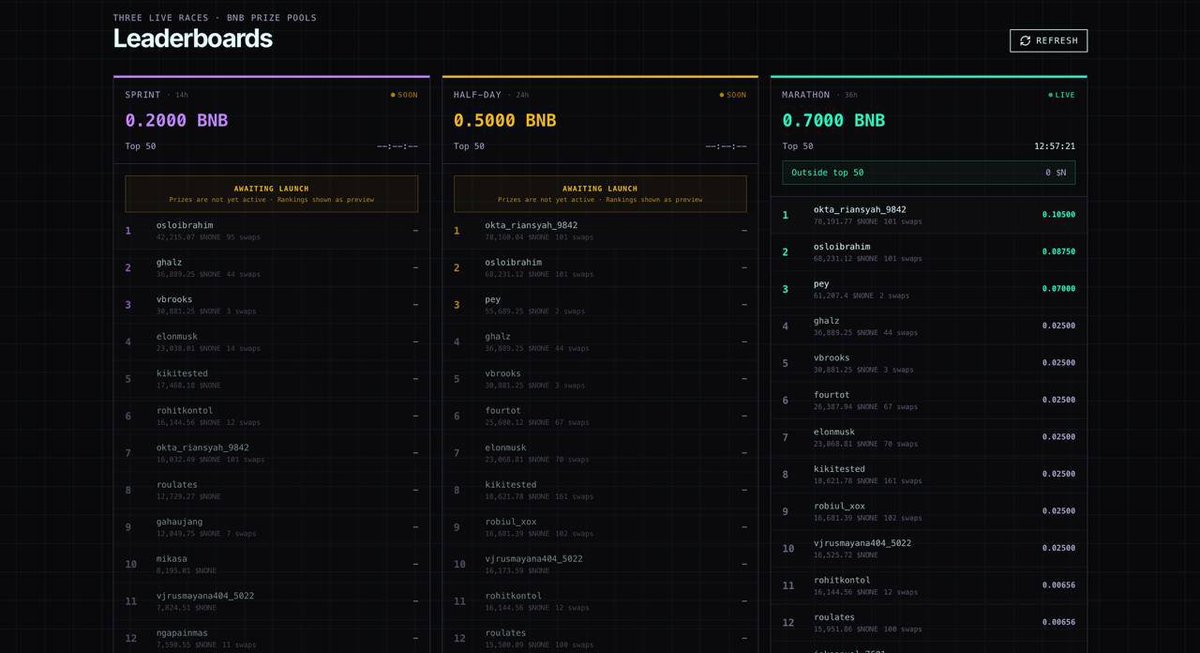
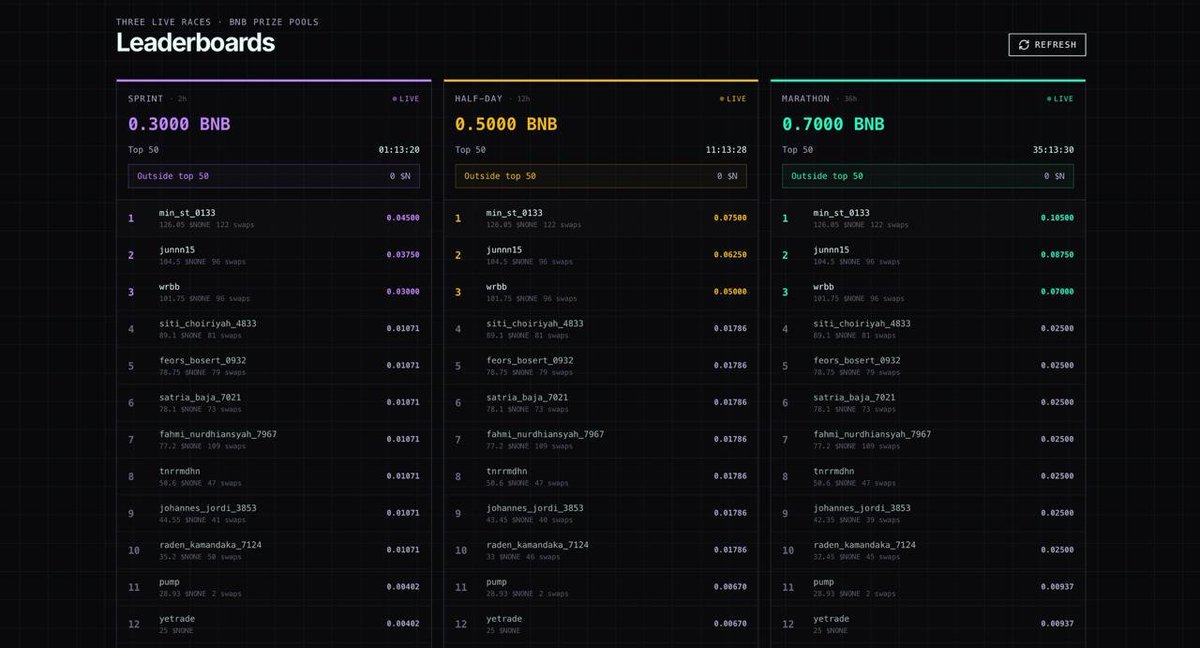
3 Leaderboards are now active with BNB reward pools.
The path to the top is simple:
The more $NONE you earn → the higher your ranking → the bigger your share of rewards.
But there is one thing every user should understand:
Swaps are not optional. Swaps are the core activity.
Every swap means you are already using the product.
NullFee is building a real zero-fee cross-chain DEX ecosystem — and active product usage matters.
Ways to earn $NONE:
• Complete swaps across chains.
• Invite referrals → earn 25 $NONE after your referral completes their first swap.
• Complete tasks.
• Open Mystery Boxes.
Referral system is already active:
Receive automatically:
• 15% from all swaps made by your referrals.
• 15% from all Mystery Box rewards earned by your referrals.
Trade. Use the product. Accumulate $NONE. Climb the leaderboards.
Stop paying. Start trading.
https://t.co/aSv1cHXQtN
NULLFEE IS LIVE!
Stop paying. Start trading.
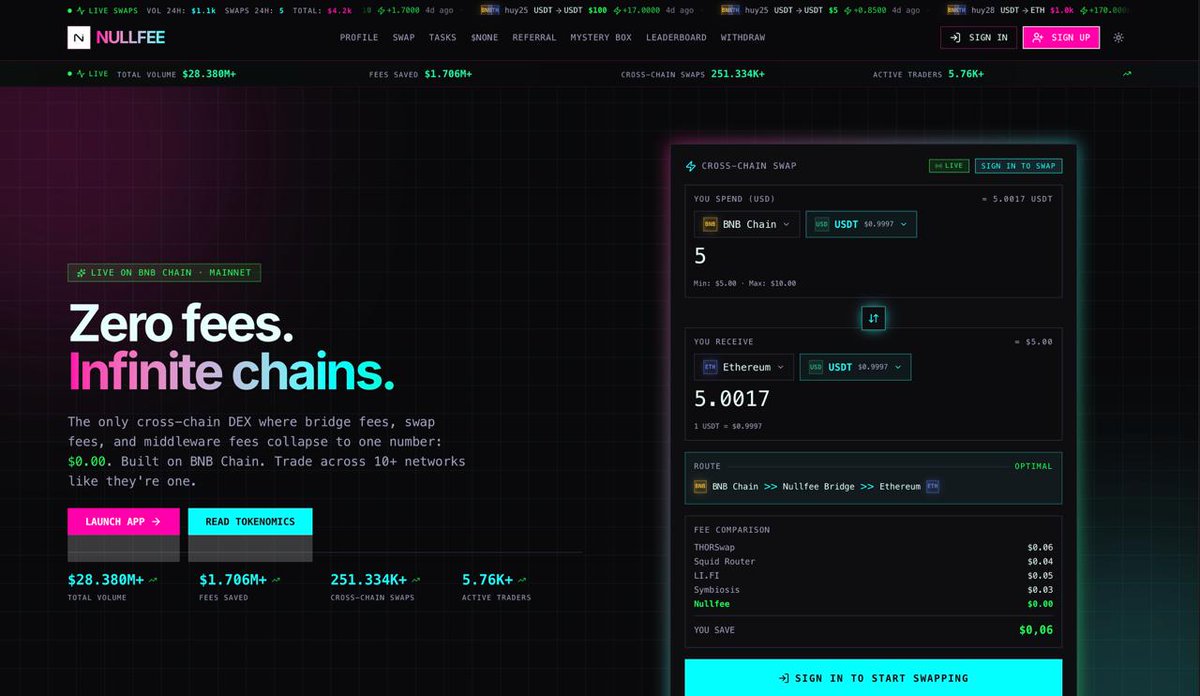
The first cross-chain DEX with zero swap fees is already live.
Farming starts now.
———
NullFee is fully operational:
• Zero-fee cross-chain swaps.
• Live farming system.
• Real-time $NONE generation.
• Instant allocation tracking in USD equivalent.
This is not a testnet.
This is not “coming soon”.
It’s already running.
———
Every user receives $1,000 virtual trading balance on signup.
Use it to:
• Execute swaps across supported chains.
• Test strategies in real market conditions.
• Generate farming activity from day one.
More activity = more $NONE.
———
$NONE is not just a reward token.
It is the economic layer of NullFee.
Every action inside the platform contributes to $NONE generation.
———
• 70% of total supply allocated to users.
• Distribution based on real activity.
• Allocation updates in real time.
• Displayed in USD equivalent inside the app.
You don’t wait for an airdrop.
You build it.
———
Competitive system across the platform:
• Trading activity leaderboard.
• Quests & task leaderboard.
• Overall ecosystem contribution ranking.
Each leaderboard distributes a BNB prize pool to top users.
———
TGE TIMER IS LIVE:
•The countdown has officially started.
•This is not a future event anymore.
It’s a live phase.
———
NullFee is not a promise.
It’s an active system.
0 fees. Real swaps. Live farming. $NONE economy.
https://t.co/TH1LkLyXEa
Absolutely thrilled to have been verified from @hotspotty! 💜
Marked against critical criteria for a DePIN project, we’re proud to have received one of the top scores in the history of their evaluations.
DePIN Hub sees the potential. How about you?
TLDR: Why Web3 Gaming Actually Makes Sense (Part 2: Integration Nightmares)
Here's why most Web3 games fail: they're basically building two games at once.
Game 1: The actual game. Unity. Game mechanics. Fun stuff.
Game 2: All the Web3 features. Wallets. Assets. Blockchain.
Two different codebases.
Two different teams.
Double the headaches.
Triple the bugs.
What usually happens:
- Unity devs fight with blockchain integration
- Wallet connections break everything
- Assets don't sync properly
- Players get stuck between systems
- Everyone blames "blockchain issues"
Players don't care if something's "on chain." They care if it works.
This is what actually matters:
- Can they use their items?
- Does the game run smooth?
- Are their assets safe?
- Does everything just work?
The fix? Stop treating Web3 like a separate game.
Your Unity devs shouldn't need to learn Solidity.
Your game shouldn't need five different backends.
Blockchain features should just be another tool in Unity.
Next up: What Web3 gaming looks like when it's done right...
TLDR: Why Web3 Gaming Actually Makes Sense (Part 3: Doing It Right)
Let's talk about what works. No hype. No buzzwords. Just real infrastructure that makes sense for game devs.
Web3 gaming done right means one thing:
Everything works in your game engine.
No platform switching.
No extra tools.
Your game needs:
- Asset management
- Player inventories
- Marketplace features
- Social systems
- Trading mechanics
All of this should just... work.
In your development environment. Where you build games. Simple as that.
Here's what we're seeing with games doing it right:
- Devs work in their native language
- Assets move automatically
- Systems scale on their own
- Infrastructure costs drop
- Players keep their stuff
No crypto degree needed.
No blockchain expertise required.
Just tools that work where you already build games.
The big difference? Everything's built for game devs first.
Web3 features are just that - features. Not the whole game.
Next up: The numbers that actually matter...
TLDR: Why Web3 Gaming Actually Makes Sense (Part 4: The Numbers)
Time for real talk about metrics.
Not marketing stats.
Not whitepaper promises.
Actual numbers from live games.
Traditional game infrastructure:
- 6-12 months setup
- $150K minimum to launch
- 30-40% ongoing costs
- Multiple teams needed
- Regional scaling issues
What we're seeing with decentralized infrastructure:
- 85% faster deployment
- 70% cost reduction
- Sub-50ms latency
- 99.99% uptime
- Global coverage by default
But here's what really matters:
Your devs spend time making games better instead of babysitting servers.
Your players get games that work, assets they own, and features that scale.
And the best metric? When your team stops talking about infrastructure because it just works.
Next up: Where this is all heading...
Game developers need three things: speed, reliability, and sensible costs. Everything else is noise.
@solana's architecture matches how games actually work:
- Transactions finish before your next frame renders
- Costs stay low even at massive scale
- Infrastructure that handles millions of players
We're not building for crypto traders. We're building for game developers who need infrastructure that just works.
This is about making games better, not more complicated. 💜
PlayFab walked so the Beamable Network could run.
But PlayFab got acquired by Microsoft.
GameSparks got sunset by Amazon.
The Beamable Network is different:
Decentralized. Composable. Built to last.
Unstoppable games need unstoppable infra.
And when you put the backend into the hands of the community, there’s no off switch.
Looking for real signal in DePIN? 👀
We just dropped a recap on 4 projects that met the Verified standard you’ve all been asking for! 🛠️
💻 @HivelloOfficial – multi-DePIN earnings in one app
🚗 @NATIXNetwork – your dashcam, but onchain
🕵️ @session_app – the most private messenger out
🎮 @BeamableNetwork – 86 live games, and counting
🎥 Watch now: https://t.co/mDeobc58pt
Shipping once isn't enough anymore.
Top titles now dominate engagement and revenue. F2P churn is brutal.
LiveOps cadence is everything.
Live Service isn’t a genre. It’s the market.
So this is a message to current and future game devs:
Power your game with infra built for iteration. We’ve got you covered.
TLDR: Why Web3 Gaming Actually Makes Sense (Part 5: The Future)
Let's cut through the noise about "the future of gaming."
Most of it’s hype. Here's what's actually happening.
Games are getting more expensive to run.
Live service is standard now.
Players expect more features, better performance, instant scaling.
The old way isn't sustainable:
❌ Rising server costs
❌ Complex infrastructure
❌ Centralized points of failure
❌ Assets locked to one game
❌ Teams drowning in maintenance
What decentralized infrastructure enables:
✅ Games that outlive their studios
✅ Tools that devs can share and monetize
✅ Infrastructure that scales with demand
✅ Assets that players actually own
✅ Communities that power their own games
This isn't about blockchain changing gaming.
It's about giving devs better tools to build sustainable games.
Web3 gaming was inevitable - not because of crypto or NFTs, but because game infrastructure needed to evolve.
The future is simple: build games, not infrastructure.
(Web3 gaming is inevitable)
There are 2 kinds of composability in decentralized infra:
→ Intra-DePIN: Build modularity inside your network (like Beamable’s swappable LiveOps modules)
→ Inter-DePIN: Connect across networks (e.g., using Helium + Beamable + Filecoin together)
Infra that stacks becomes infra that scales.