“We visited multiple Croma and Vijay sales stores and found that smartphone financing is approved for 99% people saying these are prime CIBIL score customers.”
“But as per CIBIL data, only 55% people have CIBIL score of more than 745 which is considered as prime.”
“So we went back to our office and got rid of the lenders in our portfolio because this data didn’t stack up. There’s lot of subprime lending going on in India.”
- Saurabh Mukherjea (Founder Marcellus Investment Managers)
BREAKING: The US has issued Iran a general oil-related license allowing the production, delivery, and sale of Iranian-origin oil, petrochemical, and petroleum products through August 21st.
Iranian oil is officially returning to global markets for the first time since 2018.
Most software engineers are facing an identity crisis bordering on depression.
As CTOs aggressively evangelize tokenmaxxing, a class divide ensues.
The lazy. The lazy push code. They don't write it. They don't manually test it. They don't even read it. They're on autopilot. See Jira ticket, prompt for task, submit code. Many of them are barely on their computer the whole day. A comment on the PR asking why they did this? The lazy ask AI. A Slack message? The lazy ask AI. Need to prepare for standup? The lazy ask AI. As long as it sounds enough like them and isn't detected. Some of the lazy are even overemployed, and work multiple jobs. The lazy smart ones get away with this, and even rewarded. After all, software engineering for the lazy is just a dance to convince your colleagues you're smart and hard working.
The craftsmen. The craftsmen are tired. Very tired. 15 PRs in queue. Slack blowing up. The entire burden of review falls on the craftsman. The burden of understanding. They try. They work their way through the code, thoughtfully commenting to improve what ships. The response? A lazy: "That's a clever idea! You're absolutely right." with an incorrect change. It's fine, the craftsman says. I can fix them. They write a doc urging his colleagues to be better. The next day? 20,000 line PR to review. Day after day, their workload grows. Bugs seep into production. No one seems to care. Another round of AI is thrown at it. Their animosity to their colleagues rises. Eventually, they give up. It's just not what it used to be. The craft they loved is dead. They eventually wake up, a lazy.
This isn't all companies. Many companies are genuinely more productive, adopt the right set of principles and practices around AI development and have highly talented teams that trust each other. It tends to happen in bigger companies that are 10+yrs old with a higher talent variance. But it happens. A lot.
FIIs relentlessly withdrawing money is no joke. Going forward, we can witness a fairly serious economic crisis.
> Retail eventually runs out of patience.
> DII flows slows down.
> We go long-term sideways.
It is easy to say: change tax, do this, do that.
I'm sure all these options would already been explored.
Changing taxes do NOT bring FIIs back.
FIIs invest for growth.
Growth comes from fair economic competition.
Not monopolization of businesses.
Look at the US: NVIDIA itself is helping IREN, Nebius, ServiceNow, Coreweave etc. 1 person is not eating everyone's lunch. They are grooming the entire ecosystem. Competing. And, winning.
Somewhat fair competition is the basic essence of capitalism. It acts as a catalyst for building a winning ecosystem.
Unpopular opinion: a lot of Engineering Managers are just meeting schedulers with Jira access.
1. No measurable ownership (latency, error rate, throughput, on-call load)
2. “Unblocks” by asking engineers to work weekends
3. No roadmap tradeoffs, just “alignments” and status decks
4. Promotes vibes over technical judgment, then wonders why quality drops
My message to them: If you manage engineers, ship outcomes - fewer incidents, faster cycle time, clearer priorities. Otherwise you’re overhead with a calendar.
A Middle Class Tax Paying Citizen visits a local Honda Showroom to Buy a 110 CC Honda Activa Standard Model. Their First Vehicle.
He has already paid proper Income Tax and only then gets Salary.
He gets a quotation of ₹97456 + extra for Accessories.
He asks for Breakup.
He sees that the Basic Price of the Vehicle is only ₹66337.
GST (18%) comes to ₹11940 (9% to State & 9% to Central)
Then Road Tax + Registration + Smart Card etc comes to ₹13279.
Insurance is ₹5000 + ₹900 GST.
So basically he pays ₹66337 to Honda & ₹26089 in the form of GST & Road Tax & other charges.
For accessories, he has to pay additionally ₹4000 to ₹5000 which also includes GST.
He closes his eyes and imagines the Road on which they will be riding in the Monsoon which will come now. He imagines riding on the roads filled with water logging. He knows that the roads are not upto the mark. He wishes his Road Tax was fully utilized on High Quality Pothole Free Roads.
He feels bad for paying Road Tax for Roads which have potholes in the city. He knows that his Health will go down. But he has no choice. He cannot take a Car because he would be stuck for hours in a jam.
He feels that he has paid Income Tax, but has to pay 18% GST for a basic 2 wheeler. He has to pay 18% GST on Vehicle Insurance. On Accessories.
Then he looks at his family. He sees the joy on their faces as they purchase their first vehicle. He takes his phone out.
He makes the payment using Digital India UPI & takes the vehicle home !!! His family is happy. He goes to work next day.
Story of Middle Class.
#FI
Stop buying a car for at least the next 6 months. Seriously, don’t. Rushing into it now could turn into a costly regret later. Wait, watch what unfolds, and you might end up thanking yourself later.
2024 - software engineers are dead.
2025 - AI will replace all coders in 6 months.
2026 - just 6 more months bro, agents are almost there.
2027 - why is production down every Friday because some AI generated retry logic created infinite retries and killed the database?
2028 - hire back the same software engineers for 3x salary to understand the codebase, fix the architecture and remove 40 microservices that nobody asked for.
2029 - “AI is amazing, but we need engineers who understand systems.”
So you see, coding was never the full job.
The real job as a software dev is understanding messy business requirements, making tradeoffs, debugging weird production issues, saying no to bad ideas, designing systems that do not collapse under scale, and taking ownership when things break.
AI will remove a lot of boring coding.
But it will also increase the demand for engineers who can think clearly.
The industry has gone completely nuts.
Use tokens to generate AI code and documentation slop. Then use even more tokens to understand and review that slop.
Then judge engineers by token usage instead of how empathetic and clear their docs and code actually are, and completely neglect human comprehension.
Utter nonsense.
Only $AMZN is set to deliver a positive ROI from AI capex by 2030.
This is why it insisted on using custom chips, even at the cost of initially falling behind peers in growth.
$AMZN’s custom chips now make up 41% of its compute capacity, and they are fully subscribed.
Among hyperscalers, only $GOOG gets a larger share of its compute from custom chips than $AMZN, but it has not monetized that capacity as broadly as $AMZN has.
This is why $AMZN will have the best margin structure of all hyperscalers going forward.
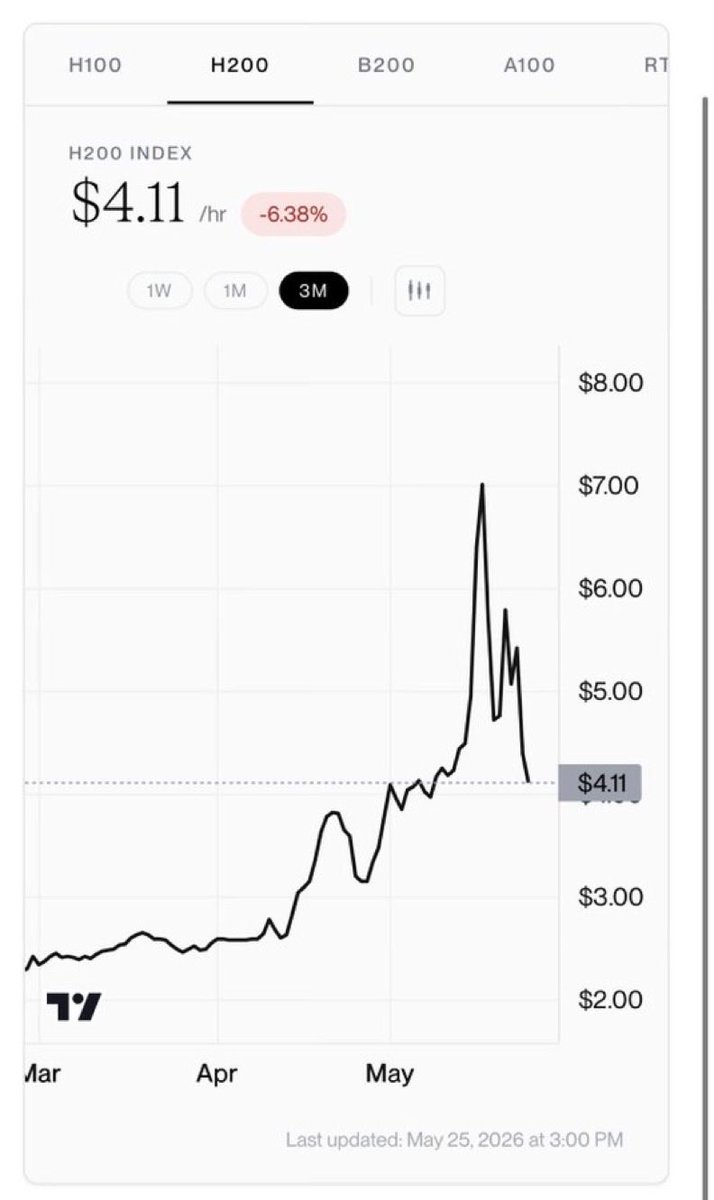
The price to rent an Nvidia H200 just collapsed from $7/hr to $4/hr in three weeks.
A -40% drop in the cost of the single most strategic asset in tech.
When the underlying commodity that powers your entire thesis loses 40% of its value in a month, that usually means one of two things: supply finally caught up, or demand was never as deep as the headlines said.
Either way, somebody is selling.
So why is the AI trade still pricing in scarcity?
🚨 The AI ROI numbers are starting to look very ugly.
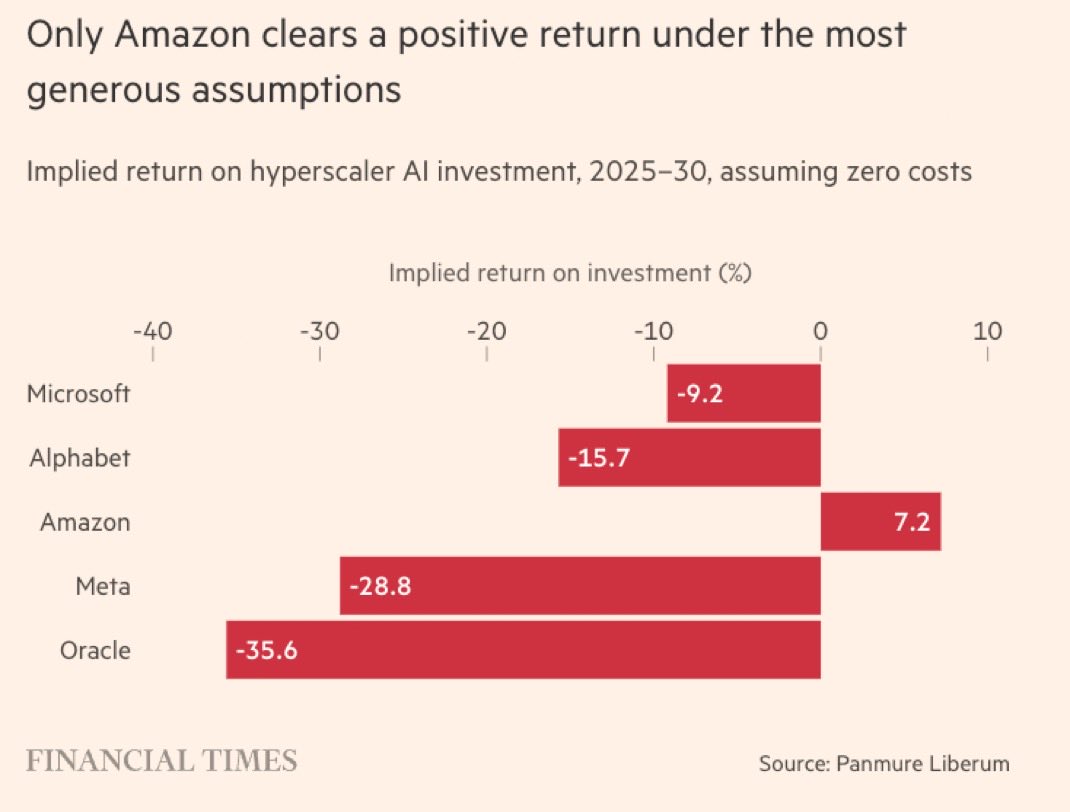
Even under "best case" assumptions — assuming zero costs, just revenue against capex — the Financial Times calculated the implied return on hyperscaler AI investment from 2025 to 2030.
Only one of them clears positive.
Implied return on AI investment (FT / Panmure Liberum)
– Microsoft: -9.2%
– Alphabet: -15.7%
– Amazon: +7.2%
– Meta: -28.8%
– Oracle: -35.6%
And remember: that's assuming zero costs. In reality, GPUs depreciate, power bills run, salaries get paid.
The real returns are worse.
This is exactly why the dot-com comparison keeps coming up. Incredible technology does not automatically mean sustainable economics. The internet survived. Most internet companies didn't.
Two anecdotes from this week alone
Vivek Garipalli, Fortune 20 insider: a CEO asked for $1B in AI-driven opex savings this year. The team spent $200M on tokens chasing it. The results? Modest customer service savings and slightly less hiring in engineering. The CEO has now ordered token costs to be dramatically slashed because the ROI isn't there.
Axios: an AI consultant reported a single client spent half a billion dollars in one month after forgetting to put usage limits on Claude licenses for employees.
Right now hyperscalers are spending trillions hoping future demand catches up to present capex.
That's not certainty. That's a leveraged bet.
The technology is real. The infrastructure buildout is real. The eventual winners will be real.
But "AI is transformative" and "every hyperscaler will earn its capex back" are two completely different statements.
In 2000, the internet was real too.
Cisco has recovered.
After 26 years…
🦔Microsoft canceled its internal Claude Code licenses this week after token-based billing made the cost untenable, even for a company with effectively infinite cloud resources. Uber's CTO sent an internal memo warning the company burned through its entire 2026 AI budget in just four months. American AI software prices have jumped 20% to 37%, and GitHub (owned by Microsoft) is dropping flat-rate plans for usage-based billing across its products.
My Take
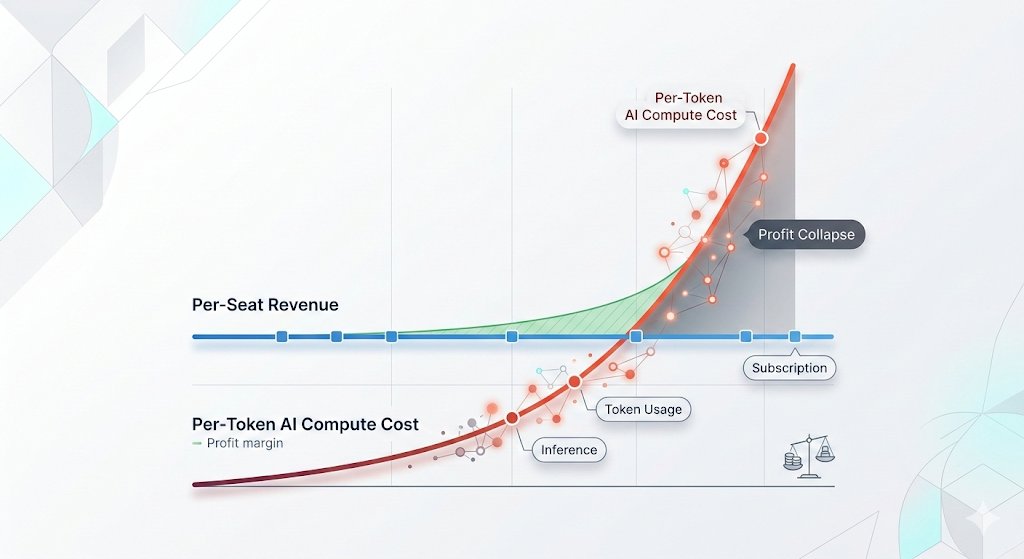
The AI subsidy era is ending in real time. The same company that put $13 billion into OpenAI and built the Azure infrastructure powering most of Anthropic's compute just looked at the bill from a competitor's coding tool and decided it was not worth paying. That is not a productivity failure on Anthropic's end. Token-based pricing is forcing every enterprise customer to confront the actual cost of running these models at scale, and the number turns out to be far higher than the flat-rate experiments suggested.
This ties directly to my Gemini Flash post yesterday. Anthropic, OpenAI, and Google all raised effective prices in the last six months. Enterprises that built workflows assuming AI costs would keep falling are now watching annual budgets evaporate in months. Two outcomes look likely from here. Either enterprises scale back AI usage to fit budgets, which slows the revenue ramp the labs need to justify their valuations ahead of IPOs, or the labs cut prices and absorb the losses, which makes the unit economics worse at exactly the wrong moment. Both paths land in the same place, the numbers stop working, and somebody has to take the writedown.
Hedgie🤗
Yes, please pay your taxes on time.
And, expect the government to do nothing like build:-
1) Roads
2) Airports
3) Power plants
4) Telecom
5) Let free media
Pass that onto private players.
Keep Onion in your pocket. And, keep paying fund managers their rightful 1-2% to underperform Index.