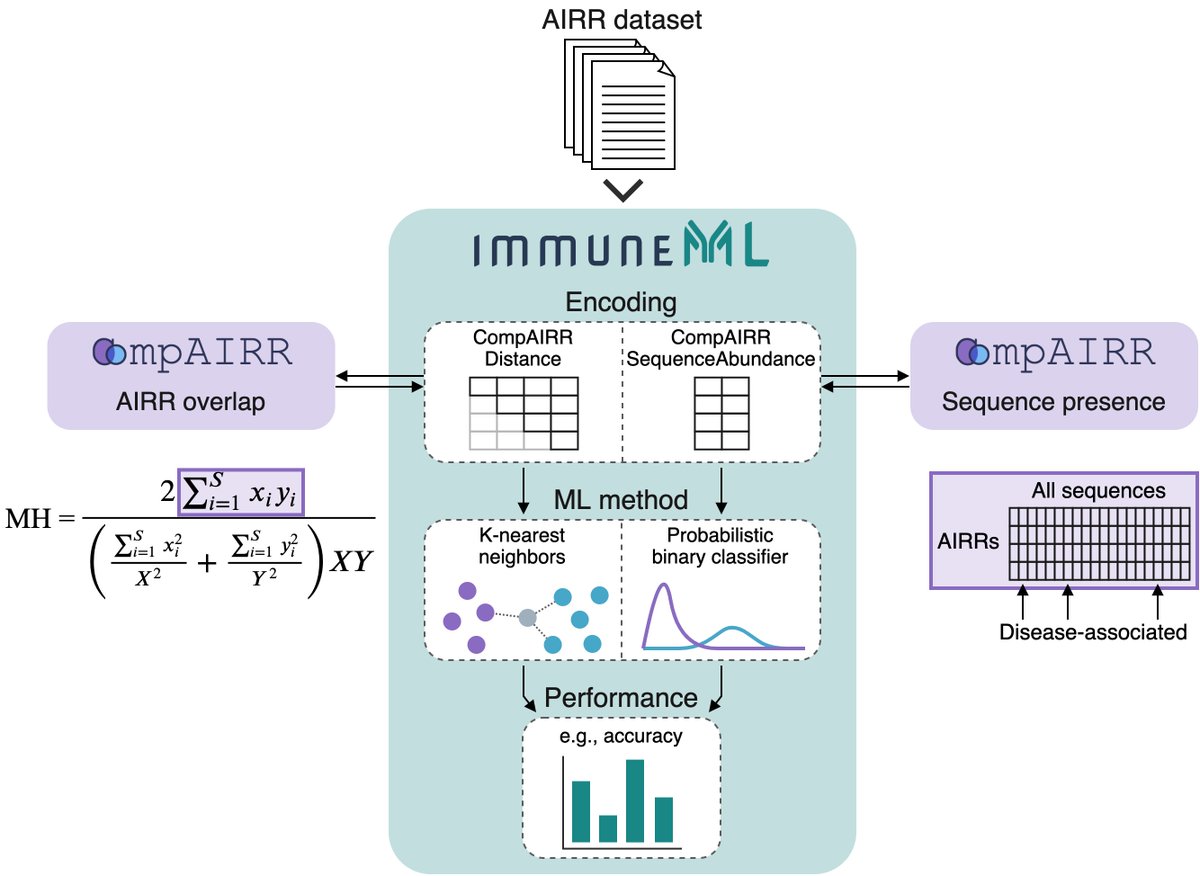
immuneML v2.1 is now live! In this version, we integrated the ultra-fast AIRR overlap tool CompAIRR to speed up (i) the computation of Morisita-Horn (MH) distance matrices between AIRRs and (ii) the AIRR-based immune state classifier originally introduced by Emerson et al. (2017)
We are hiring a PhD student to work on trustworthy machine learning in the SCML group, University of Oslo! 🎓
More details on the project, working at UiO and applications in the link below.
🗓️Deadline: 24 March
https://t.co/NsEJj8Blbv
If this sounds interesting to you, come join our deep dive tutorial at the AIRR-C meeting VII hosted by the @airr_community, where we will teach you all the tips and tricks regarding method integration! (3/3)
Are you developing new machine learning methods for immune receptor/repertoire data? You can save yourself a lot of time by developing your method inside immuneML. Read all about it in our updated documentation: https://t.co/wq5d88E8il (1/3)
Our new documentation contains more detailed tutorials on how to design and integrate your new AIRR-ML method, code examples, as well as scripts for automatic testing of integrated components. (2/3)
Machine learning on immune receptors/repertoires is an exponentially expanding field, but labeled data to benchmark ML methods are missing. We address this need with our new simulation framework LIgO. https://t.co/Z4qJP63kEV Led by @mchernigovskaia + @milenapavl. See 🧵⬇️.
New work from my lab on "Weakly supervised identification and generation of adaptive immune receptor sequences associated with immune disease status" led by @rlyhighvariance and @PRobertImmodels. Great collaboration with @SandveGeir and L. M. Sollid. See 🧵 below.
Looking for a PhD position in computational immunology?
And would you like to experience both living in a winter wonderland (Oslo) and a sunny paradise (San Diego)?
Open the thread below 🧵⬇️
While R is succinct and intuitive for numbers, I have mostly found it cumbersome for use with text or biosequence data. With the new BioNumPy library (https://t.co/4rA0O9SNIA), working with sequence data in Python feels like any other (numeric) vectors/matrices/arrays. 1/3
With BioNumPy, I claim my postdocs @ivargrytten and Knut Rand have given the entire bioinformatics community a Christmas present🫢☺️. This is the fundamental library for working effectively with sequence data that I have been missing since I entered bioinformatics 17 years ago!
The peer-reviewed version of our antibody-antigen simulation framework Absolut! is now online @NatComputSci. We now provide additional support for the real-world relevance of Absolut!-data for benchmarking antibody specificity predictions.
link: https://t.co/vmN1kt8sEn
Simulated data are for sure not perfect, but are they really subordinate to experimental data for bioinformatics method development and benchmarking? We don't think so! Rather, we see them as complementary, filling different but equally important roles:https://t.co/Lyth5kLEc2 1/3
Happy to share my first preprint in the Immunolingo project “Advancing protein language models with linguistics: a roadmap for improved interpretability”, a perspective on adapting LMs for protein sequences with the help of linguistic knowledge.
https://t.co/5U1nzoYdR5
A new episode of #OnAIRR - the podcast of the AIRR Community is available. @victorgreiff and Lindsay Cowell discuss machine learning; identifying and understanding immune signals in AIRR. Subscribe and listen in your favorite app or grab the episode at https://t.co/btLfI1hi0P
Benchmarking study of baseline methods for immune repertoire classification (using immuneML 🤓) is now published! Congrats, Chakri! 🎉For details, see the thread 🧵
Out now in @GigaScience after substantial improvement since the first version: https://t.co/aEIZPQE0Cl. Improvements since the first version are briefly summarised in the 🧵