This is a tight collaboration with Alfred Sun, following many rounds of discussion on how single-cell omics can improve the quality of mDA differentiation, a key focus of his lab for PD. Many thanks also to @PengyiYang82 and @carissaynchen for their contributions and advice.
Excited to share BrainSTEM, a two-tier mapping framework for single-cell data of midbrain cultures. We first map to a human fetal whole brain atlas, then refine to a midbrain subatlas to benchmark mDA identity and brain region fidelity. #scRNA#Parkinsons https://t.co/W03l7W1YKp
BrainSTEM provides open tools to improve PD modelling and cell therapy optimisation. It flags off target DA like cells that inflate reported mDA yields. This matters because high purity mDA products are essential for safe and effective PD cell replacement.
Most PhD students stare at a blank page for months.
They have smart ideas but no mindmap.
The difference between finishing and forever-editing?
A bulletproof thesis structure.
Here's what successful PhDs know from day one:
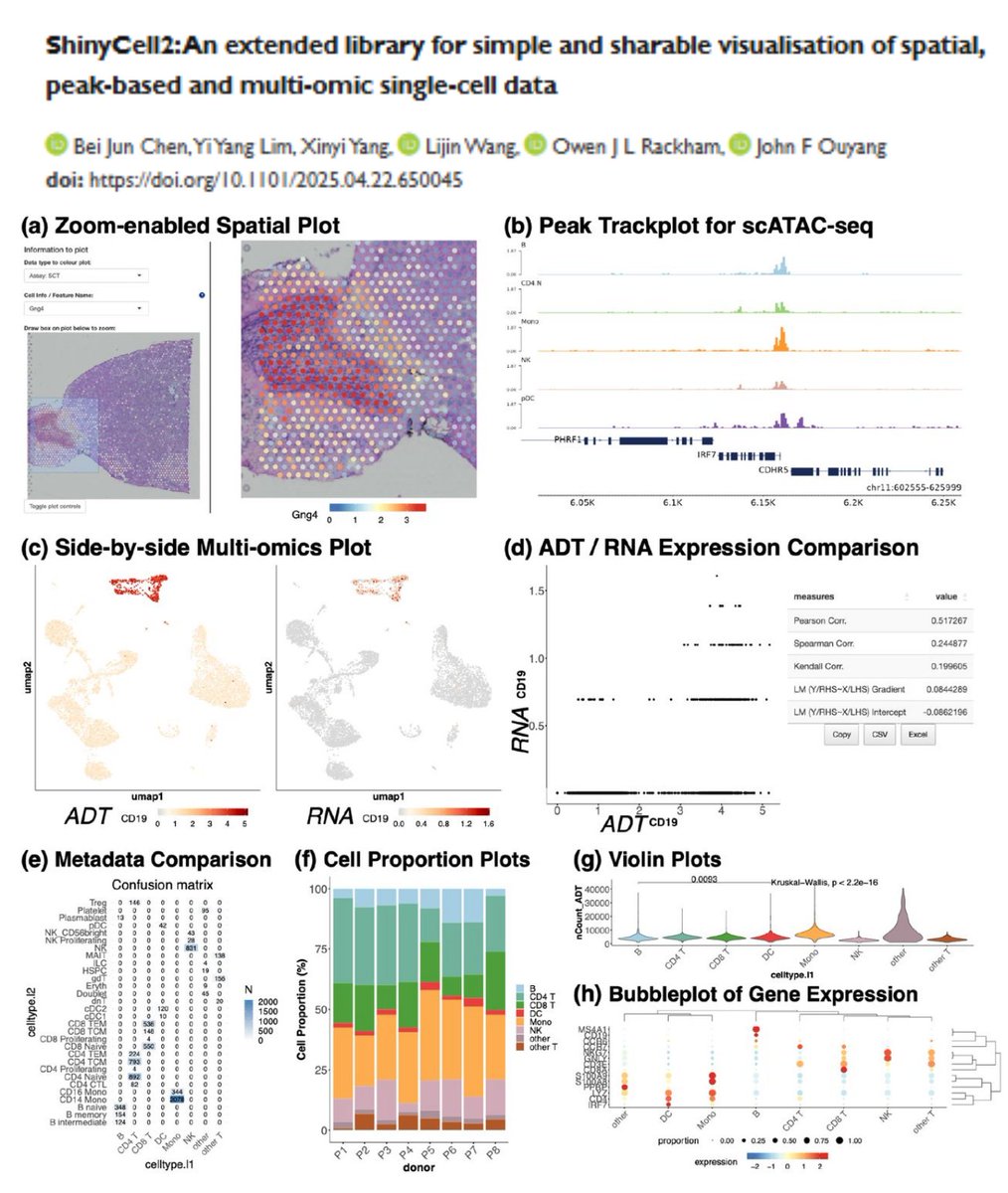
Want to visualize & create a website for your omics data (+CITEseq scATACseq #SpatialTranscriptomics)?
Try ShinyCell2!😆
Compatible with data formats Seurat Signac ArchR Scanpy (other formats converted by sceasy) (also imaging-based ST data?😁)
vs cellxgene WebAtlas Vitessce
https://t.co/89xxAVwVnN
@OwenRackham@imouyang bioRxiv 2024
https://t.co/gLDW6DBMgm
Excited to launch ShinyCell2, which now supports interactive visualisation of spatial data, scATAC-seq and multimodal single-cell data! We also made quality of life improvements to existing plots. https://t.co/RTMZ1Uk3TW
Fibrosis is a typical tissue injury pattern for age-related diseases. Targeting fibrosis is a major front in the path to anti-aging therapeutics💊
This review sums a massive amount of literature on the biology of fibrosis and the evolving drug development landscape❗️
🔓open access link👇
🎇Our new paper in @ScienceMagazine: Kidney Multiome-Based Genetic Scorecard Reveals Convergent Coding and Regulatory Variants.
@Hongbo919Liu
https://t.co/t9IdHiPcsF
1. Full spectrum of genetic variants related to kidney function (1,000 loci). 2. Comprehensive annotation of discovered genetic variants using 32 new omics datasets and tools (QTLs, single cell data), uncovering 600+ genes for kidney function. 3. 161 genes previously believed to contribute only to rare monogenic diseases, which harbor common variants affecting CKD in the general population. 4. Discovered a large number of new druggable targets for kidney disease. 5. Developed a Kidney Genetics Scorecard for integration and interpretation
Kidney fibrosis as a molecular process is poorly understood. In this new study together w/ Pepperkok lab @EMBL, we present a time-resolved #multiomics + computational network modeling approach in combination w/ phenotypic assays to study #kidneyfibrosis https://t.co/9I1axrjUYl
Excited to share scPanel, a computational tool to identify sparse biomarker panels for patient stratification (think disease severity, treatment response) from #singlecell data. Developed by talented @Yi_Carissa_Xie and co-supervised with @Enrico_Petretto. https://t.co/mzhNt4fXgd
4/4 The wholebrain and midbrain atlases are available for browsing at https://t.co/IGTN9mVCnd and preprint at https://t.co/a9kfLBsoB4. This work was spearheaded by myself and Alfred Sun, who is great company to work with and many thanks to @PengyiYang82 for being in this work.
1/4 Excited to launch #BrainSTEM, a framework for assessing transcriptional fidelity in midbrain cultures using #singlecell data. As neural systems grow in complexity, our approach adapts computational practices to match the biological scale via a two-tier projection approach.
3/4 This two-tier projection mirrors iterative clustering, key for cell type annotation in large datasets. BrainSTEM ensures precise mapping without spurious assignments by distinguishing midbrain-specific neural cells, allowing for refined cellular insights in midbrain cultures.