Conventional wisdom says China should be one of the biggest losers from a prolonged closure of the Strait of Hormuz. The data says different.
China’s massive petroleum reserves, growing overland supply routes, and unique coal-to-chemicals industry have given it an unexpected advantage. Meanwhile, some of the countries companies turned to as alternatives to China may be more vulnerable to shortages of critical industrial inputs.
If you want to understand how the Hormuz crisis could reshape global manufacturing — and why the real story is about chemicals and supply chains rather than oil — this edition of 𝘛𝘩𝘦 𝘔𝘢𝘯𝘪𝘧𝘦𝘴𝘵 is for you. Link in the replies.
Meet the innovators
𝗧𝗲𝗹𝗹𝗶𝗻𝗴 𝘁𝗵𝗲 𝘀𝘁𝗼𝗿𝗶𝗲𝘀 𝗵𝗶𝗱𝗶𝗻𝗴 𝗶𝗻 𝗲𝘃𝗲𝗿𝘆 𝘀𝗵𝗶𝗽𝗺𝗲𝗻𝘁
𝘛𝘩𝘦 𝘱𝘦𝘰𝘱𝘭𝘦 𝘣𝘦𝘩𝘪𝘯𝘥 𝘐𝘮𝘱𝘰𝘳𝘵𝘎𝘦𝘯𝘪𝘶𝘴
William George
Director of Research
William enjoys growing cactuses. He says they’re like living sculptures: no two are the same, and they are full of surprises.
Trade data is like that, too.
William joined ImportGenius as a summer intern in 2018 with one job: mine the database for stories and pitch them to the media. He’d never delved into trade data before. He had no idea what he’d find.
It turned out the data was a bottomless well of headlines. His first major project tracked how proposed tariffs on rare earth metals would ripple through supply chains from electric vehicles to MRI machines. He pitched it to CNBC. They ran it.
What started as cold outreach to journalists has become a research function that media organizations now rely upon. William and his growing team teach reporters how to read shipping records and show them what granular trade data can reveal.
Today, over 10,000 stories per year are published worldwide crediting ImportGenius’ data and research, and William has personally contributed to numerous major investigations. “Trade data will change the way you see the world,” he says.
Learn more about William and his work at ImportGenius: link in the comments.
Everyone is watching oil prices. Fewer are watching the industries built on top of oil.
The closure of the Strait of Hormuz is about chemicals, plastics, fertilizers, automotive components, packaging, and countless other products. And it’s about the Gulf-dependent Asian economies now facing critical shortages of petroleum-derived inputs.
In their report for the Hinrich Foundation, ImportGenius Director of Research William George and Lead Analyst Lynn Hughes delve deep into the data to unpack the Hormuz “chokepoint effect.” They detail the battery of surprising strategies China has employed to remain resilient. And they show why the economies of Japan and Vietnam are in a much more precarious position — which means their trading partners are too.
This research will change the way you understand the Hormuz Crisis and its impacts. Link in the replies.
Most companies analyzing U.S. imports are missing the majority of U.S.–Mexico trade.
Why? Because most traditional U.S. import datasets only cover maritime shipments.
Meanwhile:
• 80%+ of U.S.–Mexico trade crosses by land
• 73% moves by truck
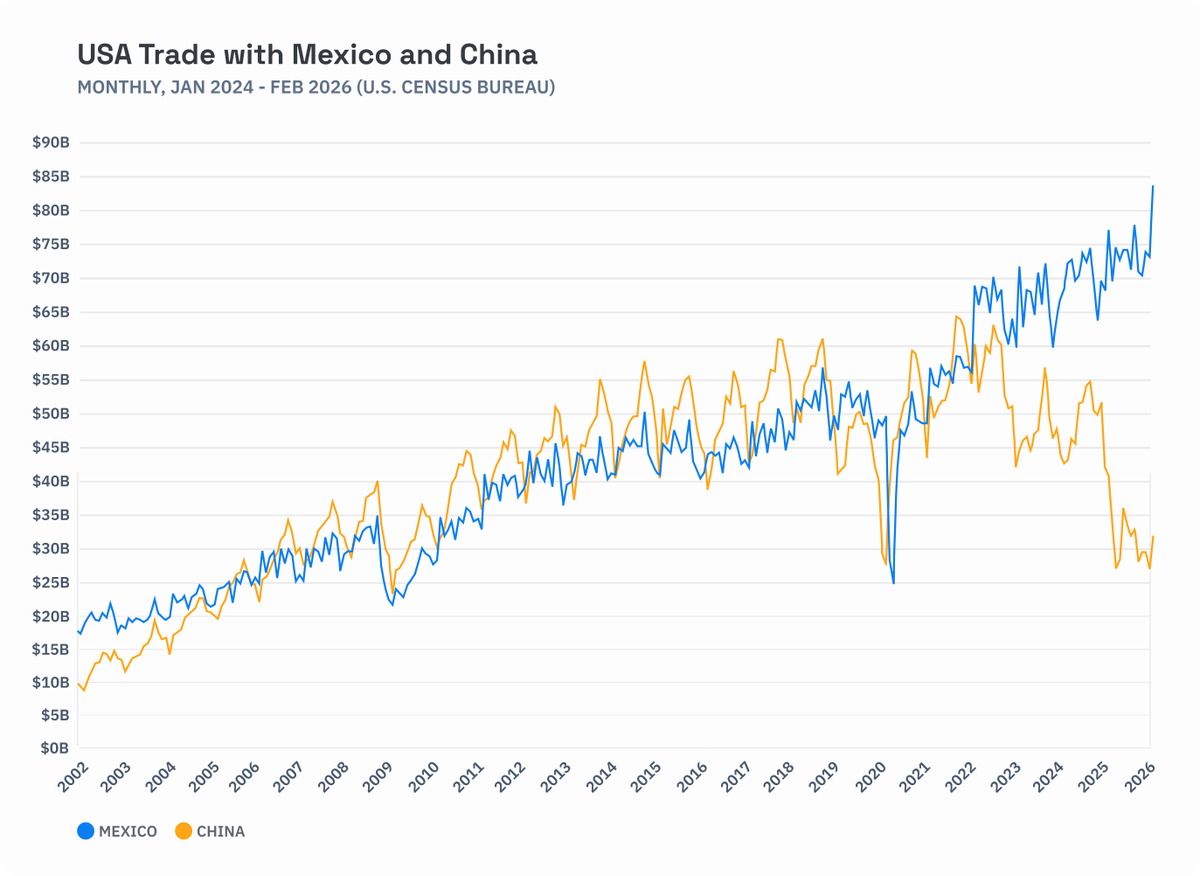
• Mexico is now America’s largest trading partner
In this webinar, our team breaks down what most trade intelligence platforms miss — and how companies are using all-modes data to uncover suppliers, competitors, and cross-border supply chain activity.
Watch the webinar below. ↓
Are European companies unknowingly doing business with a figure allegedly funding Russia's largest nationalist vigilante network?
BBC investigated. ImportGenius trade data helped reveal that the group's alleged financier still operates an agricultural conglomerate actively trading with the EU.
Link in the replies.
Two charts tell the story. The first shows Mexico steadily overtaking China in U.S. trade value, with the gap widening sharply after 2020. The second breaks down how that trade moves: trucks dominate Mexican exports, while imports are split across truck, maritime, air, and rail.
That mix is exactly why maritime-only data leaves so much on the table. In our recent webinar, Carolyn James, Director of Strategic Sales at ImportGenius, walks through how Mexico All Modes closes that gap, from faster supplier validation to catching competitor activity that never shows up in ocean shipping records.
The full recording is available now: link in the replies.
China granted zero-tariff access to 53 African nations. If you source from, sell to, or compete in African markets, what does that do to your supply chain math?
Cameroon is one to watch. As CEMAC's economic gateway, it connects Central and West Africa to global markets through the Port of Douala and Kribi deep-water port, with major exports in wood, coffee, petroleum, cocoa, and aluminum. Zero tariffs into China could reshape sourcing patterns, shift competitive dynamics, and redirect trade flows across the region.
Learn more about Cameroon's trade data. Link in the replies.
If your competitors are sourcing through the Port of Laredo, Texas, would you know? Mexico has overtaken China as America’s top trading partner, and ImportGenius’ Mexico all-modes data tracks road, rail, air, and maritime trade. Read the latest Manifest to find out how to discover the supplier shifts and market signals that ocean data misses.
Link in the replies.
This month, ImportGenius helped journalists expose Chinese tariff evasion tricks, track global opioid pipelines, and uncover supply-chain workarounds. The same trade intelligence helping reporters break stories can help your business uncover risks, suppliers and opportunities hiding in plain sight.
Read the latest edition of Tradebreaker to see how reporters use trade data to reveal the secrets of global commerce — and how your business can too.
Link in the replies.
Sierra Leone has declared a national emergency over synthetic opioid abuse. A major driver: more than 320 million tapentadol pills exported from India to West Africa in three years, with export value jumping from $27 million to nearly $130 million.
Most of the destination countries don't even approve the drug. Investigators used ImportGenius trade records to confirm that Sierra Leone and Ghana accounted for over 80% of the total shipment value, exposing a regulatory gap between Indian export controls and West African enforcement.
Link in the replies.