Based on a study of over a hundred thousand moves, I have found that most momentum bursts last 3 to 5 days, and they give you 8 to 40% in 3 to 5 days. So I just sell on the 3rd, 4th, and 5th days. Some give you very little, some give you more gains. So, just time stop kind of thinking.
Most traders are focused on the wrong stocks at the wrong time. They discover market leaders after the move has already happened.
The biggest winners in the market often share similar characteristics before they make their biggest moves.
My proprietary Behavioral Analytics were built as an early detection system to identify true market leadership, using insights derived from more than a century of market history and my personal database.
Put the Minervini process on your desktop—and the probabilities in your favor.
Minervini Markets 360
https://t.co/JXzFFTmMtn
It is humbling to consider that if we harness just 1 millionth of the Sun’s power for AI, that will be much more than a million times the intelligence of all of humanity
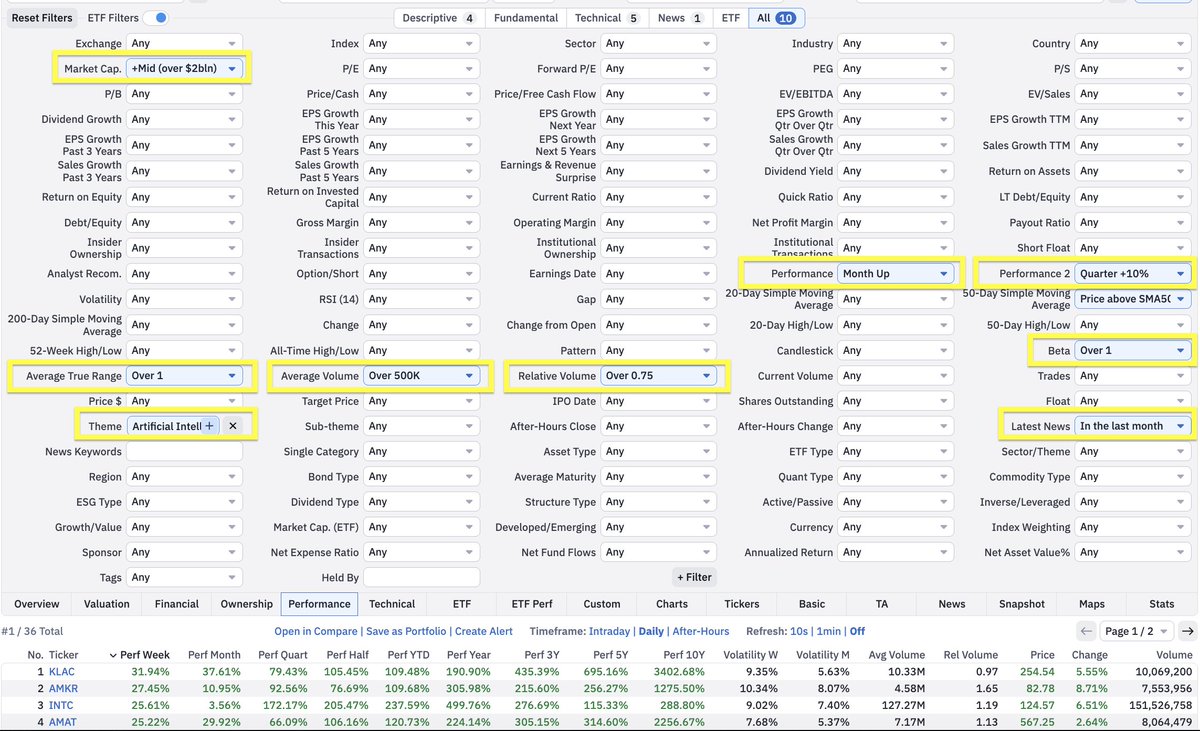
My high-level workflow for finding the strongest themes + scanning for which stocks to actually enter:
1)
- go to finviz, click maps in the nav bar
- click "themes" in the left panel
- select 1-week (or month) from the dropdown
- observe what's strongest/greenest
2)
- go back to the nav bar
- click screener
- click "theme" box
- scroll all the way down, click custom
- select the strongest themes from step 1
3)
- add supporting filters
- performance
- market cap
- relationship with moving avgs
-etc (see mine attached)
Super high level, but this should give you a good starting point.
- Luc
I've realized the majority of my profits have never come from buying the breakout itself.
It's come from buying the pullback after the breakout.
Almost every trade I take starts with a stock coming out of a large base. I'm talking about names that have spent months, and sometimes years, moving sideways while institutions accumulate.
Then eventually something changes... maybe it's earnings, or it's a new product cycle. Maybe it's a theme gaining momentum? Whatever the catalyst is, price finally starts leaving the range.
And funny enough, that's where the 99% get excited.
Ironically, that's where I usually become patient.
The breakout gets my attention, but the pullback is often where I get involved.
1 of my favorite setups is the first pullback after a major base breakout. If I miss that one, I'll usually focus on the second consolidation. In my experience, these are often the "highest quality" opportunities because the stock has already proven it can break out, institutions have already shown their hand, and now I'm simply waiting for the market to give me a lower-risk entry.
I like to think about it this way:
- A breakout is the market making a statement.
- The pullback is the market asking a question.
"Are buyers actually willing to defend this area?"
That's what I'm trying to figure out.
When a stock pulls back after breaking out of a large range, I'm paying very close attention to how it behaves. Does it immediately fall apart? Or does it hold key levels and refuse to give back much ground?
When it comes to behavior, I look for TIGHTNESS.
If a stock breaks out 20%, then spends the next two weeks trading in a very tight range while volume dries up, that's constructive behavior to me. Sellers are becoming exhausted while buyers continue absorbing supply. The tighter the action becomes, the more interested I become!
Volume is another huge clue.
During the breakout, I want to see volume expand. That's evidence that institutions are participating. Then during the pullback or consolidation, I want volume to contract. If volume is exploding on every red day, that's usually not what I want to see. But if volume starts drying up while price remains near highs, that's often a sign that selling pressure is becoming limited.
1) Price tells me what happened.
2) Volume tells me how much conviction was behind it.
I also spend a lot of time studying the personality of a chart.
Some stocks are constructive, and some stocks are sloppy.
Some names respect the 9EMA for weeks + months. Others constantly undercut and reclaim support before moving higher. Some stocks have violent shakeouts. Others grind methodically higher.
This is why I constantly study prior winners.
I'm trying to understand how a stock behaves when it's healthy.
> Does it respect moving averages?
> Does it recover quickly after pullbacks?
> Does it close near highs?
> Does it show relative strength on market weakness?
> Does it stay tight?
Those are the little nuances that I look for from a potential leader.
A simple list I look for:
1) Find a stock breaking out of a large base.
2) Confirm relative strength v.s. the market + sector.
3) Wait for the first or second pullback.
4) Watch volume dry up.
5) Look for tightness near major support.
6) Execute on 15 or 30min pivot reclaim.
7) Risk against the low.
Most people think the money is made by finding the perfect breakout... but I've found the money is usually made by finding the strongest stocks and then having the patience to wait for the first real opportunity to join the trend.
If the stock is truly a leader, the breakout is often just the beginning.
The first pullback is where the real asymmetric opportunity tends to show up. That's where I want to be positioned. That's where risk is usually the smallest.
And if the trend continues, that's often where the biggest winners begin!
Chart: $AMKR.
A lot has been written about technical analysis over the years, and even now there is no conclusive answer on whether the thing works or whether it is just astrology for men.
So I put together an article that goes in depth on the topic. Shares data from a range of research, my own backtests, and a general guide to the different concepts, why they work and when to use them.
road to (hopefully) $30m | month 2 recap
the goal, for anyone new: started with $5m cash in march, $5.9m end of april, $10.4m end of may. crypto as an asset class barely moved. "round 2" is me documenting going from $5m to $30m in spot crypto with proof of every position. fortunately sold solana near the top last cycle. doing this one in public.
a good month doesn't mean i'm right. just means i'm up *right now*. things can get ugly very quickly.
section 1: what changed
ZEC roughly doubled, then gave a chunk back. HYPE gained ~80% and held most of it. BTC sideways the whole month.
the portfolio went over $10m mid month, pulled back to the mid-8s on a hard ZEC dip, then recovered into the close. closing the month at $10.4m (up $4.5m from april). i'd be lying if i said i was unfazed by the round-trip to the mid-8s. that pullback was the first time round 2 felt real, not theoretical.
the rotation thesis i've been writing about since march is what drove the run. crypto's overall pie isn't growing. BTC is flat since i bought in late march while AI stocks, prediction markets, sports betting, and quantum stocks all soak up speculative capital that used to flow into crypto. that's the structural backdrop. the only way an alt rips in that environment is intra crypto rotation. and the math here is the part most people are missing.
HYPE and ZEC combined are ~$25b of circulating market cap. ETH alone is ~$250b, 10x the size of both of my bags put together. if even a small fraction of ETH holders look at a five year flat price chart and ask "why am i still here" and rotate, the math doesn't have to work hard. ETH drops 10%, that's $25b looking for a home, and if even half of it lands in HYPE and ZEC, those coins fly on their own.
stablecoin holders are the other half of the story. a lot of people sat in stables waiting for an october 2026 bottom that may or may not arrive. the stablecoin share of total crypto market cap has been declining for two months as that money chases winners. ZEC and HYPE were the winners. some of that stable money found its way in.
no new capital required. just rotation, from ETH into the narrative leaders, from stables into the price leaders. that's what drove the run. the late month chop gave some of it back and then took it back again. which brings me to what i actually did about all of it.
section 2: what i did
nothing.
doing nothing through a runup is harder than doing nothing through a flat month. and doing nothing through the pullback that followed is a different kind of hard. when things are flat the inaction defends itself. when things rip, reverse, and recover in the same week, every day you don't act is a day you're choosing a path.
there are two playbooks available for spot plays this cycle. worth naming them both.
playbook 1: hold towards the cycle top. buy in the bear, ride the drawdowns, sell when the framework says sell. this is what i did with solana last cycle. it requires stomaching real drawdowns. i sat through significant pullbacks on sol after it had already 10x'd. one decision at the start, one decision at the end, a lot of nothing in between.
playbook 2: swing and rebuy. trim into strength, buy back on weakness, repeat. on paper this is more profitable if you get it right. in practice you have to be right about three things instead of one: when to sell, when to buy back, what to buy back into. miss any one and you're worse off than just holding. plus short-term cap gains, a ~20% drag on every round-trip. plus you have to find a better asset than what you already own, and i don't. if i did i'd be holding it instead of HYPE and ZEC.
i'm picking playbook 1.
and this month was the first real test of that. ZEC ran to ~$675, came all the way back to $500, then bounced to $570 into the close. still meaningfully off the high. the playbook 2 move was to have trimmed in the 600s and plan to rebuy lower. the playbook 1 move was to do nothing. the real reason i didn't trim isn't discipline, it's opportunity cost. i want to be in ZEC. if my thesis is right, the pullback might not be deep enough or long enough for a clean rebuy, and i'd end up sidelined in a position i was already correctly in. trimming to chase a better entry when you already have a good one is playing it too cute. so i didn't.
obvious caveat: it's easy to talk about playbook 1 when the screenshot i just posted is green. the real test isn't the run up, it's the first 40% drawdown. i sat through one on sol last cycle. i'll find out if that experience transfers when it happens. this week was a small preview, not the real exam.
here's the thing about playbook 1 that nobody talks about: it's not easy because it's lazy. it's hard. the entire crypto information environment is built to pull you off it. every week, something else is running. every day, someone on CT is telling you to rotate. when ZEC pulled back this week, my replies filled up with "is it time to rotate to [other coin]?" because the other coin had started moving and ZEC had paused. that's the trap. attention follows momentum, momentum follows attention, and the loop runs on you mistaking short term price action for an actual thesis change.
what i keep telling myself: my thesis hasn't broken. HYPE and ZEC were the call when i bought them and the case for both got more confirmed this month, not less. a coin running for a week elsewhere, or my own bag giving back 20% off a high, is noise unless something has actually changed in the coins. nothing has.
at my core i'm lazy, and the lazy move and the right move are the same here. it is to do nothing.
section 3: what would change my mind
a few things, none of them tight rules.
if ZEC or HYPE make a meaningful move up over the next month or two, i'd consider trimming some. "meaningful" is intentionally vague. i don't know what the number is until i see it. probably small if i do it.
what i'm explicitly not going to react to: ETH or SOL outperforming HYPE and ZEC for a month or two. that's going to happen. these things ebb and flow inside a cycle. ZEC consolidating after a double, or HYPE giving back 20-30% while another major runs, is normal. doesn't break the thesis. doesn't move me.
the coin specific thesis break would be one of my bags doing something actually wrong. HYPE's revenue dropping, ZEC failing to capture the privacy narrative when conditions are obviously favorable, a regulatory action targeting either of them directly. and if either ever round trips back to my cost basis, that's when i find out how strong the conviction really is. i don't think it happens, but i'd rather say that now than figure it out in the moment.
what won't change my mind: a 20-30% drawdown without a thesis problem. one bad week. one scary headline that doesn't touch the actual reasons i own these.
a note before next month
at some point i'll publish my full sell framework, the actual conditions that would move me from holding to selling. but that's bull-market content, and right now the more honest question is whether i'd hold these through a real drawdown. so i'll write whichever one the market makes real. probably get to both before this is over.
everything in this recap is a snapshot, not a vow. i'm picking playbook 1 today, end of may 2026, with the information i have. if conditions change i'll change with them. and you'll see me say so. flexibility is the point.
things are going very well *so far*, but things can change very fast in crypto.
Making money trading over a long period of time is quite simple...
It comes down to 2 things:
1. Make a ton of money when the markets are in strong trend
2. Keep your money when the markets become choppy
Most don't have the patience for #2
There are three vitally important components to each trade
-Timing
-Direction
-Sizing
Get any one of these wrong and the trade is wrong
All three need to be correct
William O'Neil spent 50 years studying the market's biggest winners
— the stocks that ran 100%, 500%, even 1,000%.
Almost all of them launched from just 8 chart patterns.
And amateurs get shaken out of every one, right before the move.
Here's how pros read them —
and stop leaving that money on the table ↓
I've been trading for 8 years.
Tried everything...
ICT.
SMC.
CRT.
Fibonacci.
Trendlines.
Liquidity.
VWAP.
Order Flow.
Footprints.
EMA.
RSI.
MACD.
Bollinger Bands.
All I can say is...
NOTHING WORKS BETTER THAN SIMPLE SUPPORT & RESISTANCE.
There's ZERO debate here.
Since most of my timeline is just predications and shit-posting...
I wanted to give you a valuable process you can use for days like Friday
Post Sell-Off Market Reset Plan:
A large down day often changes the market's character.
Breakouts fail, leadership rotates, support levels break, and many charts that looked attractive a few days ago are no longer actionable.
The goal after a large market sell-off is not to immediately find new trades.
The goal is to identify what held up best, remove what is no longer working, and rebuild a watchlist around the new leaders.
Step 1: Accept That the Market Has Changed
After a significant down day, assume that some of your previous watchlist is no longer relevant.
Many stocks will:
-Break key moving averages
-Lose momentum
-Trigger stops
-Require weeks to rebuild proper bases
Avoid forcing old ideas simply because they were on your watchlist before the sell-off.
The market does not care about yesterday's focus list.
Step 2: Clear Out Weak Charts
Review every stock on your watchlist and ask:
-Did it break key support?
-Did it lose the key moving averages?
-Did volume expand on the breakdown?
-Is the chart now damaged?
If the answer is yes, remove it.
A smaller list of quality setups is more valuable than a large list filled with broken charts.
Step 3: Scan for Relative Strength
The most important task after a large down day is finding stocks that resisted the decline.
Look for names that:
-Held up well relative to market weakness
-Closed near the middle of the candle range
-Held above key moving averages
-Refused to break support
These stocks often become future leaders once the market stabilizes.
When institutions continue buying during market weakness, that information matters.
Step 4: Re-Evaluate Themes and Sectors
Leadership often changes after corrections.
Ask:
-Which sectors held up best?
-Which themes continue attracting volume?
-Where is money flowing despite market weakness?
Focus on the strongest sectors first, then identify the strongest stocks within those sectors.
Strong themes produce strong leaders.
Step 5: Build a Fresh Watchlist
Create three categories:
Tier 1 – Relative Strength Leaders
Stocks that held up exceptionally well during the sell-off.
Tier 2 – High Quality Pullbacks
Strong trends that experienced healthy pullbacks into support.
Tier 3 – Rebuild Candidates
Stocks that were damaged but may become actionable again after forming new bases.
Prioritize Tier 1 names.
Step 6: Let the Market Prove Itself
Do not assume the first bounce is the bottom.
Allow:
-Support levels to hold
-Breakouts to follow through
-Volume to confirm
-Market indexes to stabilize
The best opportunities usually appear after the initial panic, not during it.
Step 7: Reduce Aggression Until Conditions Improve
After a large sell-off:
-Trade smaller
-Be more selective
-Demand stronger confirmation
-Focus on execution over P&L
Market conditions determine aggressiveness.
When conditions improve, exposure can increase naturally.
Key Question Every Night
Instead of asking:
"What can I buy tomorrow?"
Ask:
"What stocks are proving they deserve a spot on my watchlist?"
The stocks that continue showing relative strength during market weakness are often the same stocks that lead the next advance.
I spent over two decades as a full time futures trader and scalper, and I learned your edge isn’t just your strategy. It’s your focus.
It’s the amount of hyperfocus it takes every single day. Blocking everything out, slowing your heart rate down, staying calm, believing in your homework, executing at a high level. Trading has to be your number one focus each day. So if you’re learning to become a successful trader, here are three things you may be focusing on that are working against you.
First, other people’s money. Stop looking at how much everyone else is making. That’s the number one thing you have to look away from. I was around thousands of traders on the floor and I barely remember us talking about money. It was private. The goal was to build a life. It felt blue collar. Today everyone talks about what they make, trying to prove someone wrong about the market. It’s a different place, and a lot harder for a new trader to block the noise out.
Second, the access. Overnight used to just be overnight, where you managed a position if you had one. Set time to start, set time to break, set time to come back. We traded mornings, skipped midday, came back for the close. Now the access never stops, and it’s spread everyone’s focus too thin to stay locked in.
Third, understanding the market environment. We move between environments at a very rapid rate. We go from trending higher with no signs of a pullback, buy the dip and hold on, straight into sell off mode. Trying to guess what those days will be like going into them is very difficult. You have to stay open minded and understand how quickly the tape can change. Last Friday was the perfect example. A market runs higher a lot further than most thought, then unravels all at once. It’s the same psychology we see in traders. They stay in their own trend for only so long, then unravel all at once. If you’re not focused, or you’re clinging too hard to one market environment as you move into the next, you aren’t allowing things to be what they are. You’re fighting them for what they were.
So here’s the simple part. Slow everything down. Survive a game where you pay your bills and stay in long enough to make a living. There will be moments this business really pays you, and you won’t choose them. They choose you. The rest is grinding, surviving, enjoying the process. Arguing with people on social media is a time waster, and the people who do it are usually unhappy in their own lives. Spend your time wisely.
Focus is the whole game. Protect it like your account depends on it, because it does.
Enjoy your life. Have fun. This is the greatest business in the world if you let it be. And it’ll be the worst, and destroy your life, if you let it.
Cheers, DELI
A 24-year-old Polish tennis player arrived in Paris last week ranked 114th in the world, with no sponsors, no guaranteed income, and no certainty she could even pay for her hotel room.
She had to win three qualifying matches just to enter the French Open main draw. Prize money is only paid at the end of the tournament, so a Polish sports drink brand quietly stepped in and covered her hotel bill.
Her name is Maja Chwalinska. And today, she plays in the French Open final.
Before this tournament, she had won exactly one Grand Slam main draw match in her entire career. She had battled depression so severe that in 2021 she couldn't get out of bed. She underwent knee surgery in 2022. She spent years grinding through small tournaments across Europe just to stay afloat.
Then she arrived in Paris, won three qualifiers, and kept winning. Zheng Qinwen. Elise Mertens. Maria Sakkari. Diana Shnaider. Nine straight matches. One set dropped.
She is now the first qualifier in French Open history to reach the final. The last time a qualifier reached a Grand Slam final, it was Emma Raducanu at the 2021 US Open. Raducanu won.
By simply making the final, Chwalinska has earned more prize money than her entire career combined. The runner-up cheque alone is $1.6 million. If she wins today, she takes home $3.25 million.
One week ago she couldn't pay for her hotel room.
The biggest stock market winners don't look random.
They leave clues long before the big move starts. That's why I study them.
What I look for 👇
1. A strong market uptrend. Most big winners emerge after a follow-through day.
2. A long base formation. Many leaders spend weeks or months building a foundation.
3. Tight closes near the highs. This shows institutions are supporting the stock.
4. Volume drying up during the base. Selling pressure is disappearing.
5. Explosive earnings and sales growth. Great charts are often backed by great numbers.
6. Heavy volume on the breakout. That's when institutions reveal their hand.
7. Support at key moving averages. The best stocks often respect the EMA21 or 10-week line during their advance.
8. Rising volume throughout the move. The biggest winners attract more buyers as they go higher.
Most traders study the move after it happens.
I study the clues before it happens.
I've spent 20+ years analyzing past market leaders.
The names change.
The patterns repeat.
I've taught this process to thousands of traders.
You can learn it too.
Manas Arora is overrated.
His strategies don't work.
Is what his jealous haters say.
But I took his 1-On-1 Mentorship and it transformed my trading.
Here are 8 powerful ideas I learned that you won't find anywhere else on X👇
Opinions are a dime a dozen
Narratives only get traders in trouble
In my trading I have no desire to have an opinion or a narrative
I trade price and price alone
Today is a good lesson.
I said it recently, but I’d rather sell 10% too late than 100% too early.
It’s so easy to flip bias on the first red candle, but:
- is your thesis still intact?
- is the trend still intact?
- are leaders still leading?
- have there been any major changes fundamentally, technically, catalytically in the last few days?
If nothing changes for $SPY, or most individual names…I’m chilling.
I prefer to wait for an obvious change of character or a major event/catalyst that could meaningfully change the thesis or trend.
But until then, I rarely flip bias for absolutely no reason.






![ThePumponomics's tweet photo. road to (hopefully) $30m | month 2 recap
the goal, for anyone new: started with $5m cash in march, $5.9m end of april, $10.4m end of may. crypto as an asset class barely moved. "round 2" is me documenting going from $5m to $30m in spot crypto with proof of every position. fortunately sold solana near the top last cycle. doing this one in public.
a good month doesn't mean i'm right. just means i'm up *right now*. things can get ugly very quickly.
section 1: what changed
ZEC roughly doubled, then gave a chunk back. HYPE gained ~80% and held most of it. BTC sideways the whole month.
the portfolio went over $10m mid month, pulled back to the mid-8s on a hard ZEC dip, then recovered into the close. closing the month at $10.4m (up $4.5m from april). i'd be lying if i said i was unfazed by the round-trip to the mid-8s. that pullback was the first time round 2 felt real, not theoretical.
the rotation thesis i've been writing about since march is what drove the run. crypto's overall pie isn't growing. BTC is flat since i bought in late march while AI stocks, prediction markets, sports betting, and quantum stocks all soak up speculative capital that used to flow into crypto. that's the structural backdrop. the only way an alt rips in that environment is intra crypto rotation. and the math here is the part most people are missing.
HYPE and ZEC combined are ~$25b of circulating market cap. ETH alone is ~$250b, 10x the size of both of my bags put together. if even a small fraction of ETH holders look at a five year flat price chart and ask "why am i still here" and rotate, the math doesn't have to work hard. ETH drops 10%, that's $25b looking for a home, and if even half of it lands in HYPE and ZEC, those coins fly on their own.
stablecoin holders are the other half of the story. a lot of people sat in stables waiting for an october 2026 bottom that may or may not arrive. the stablecoin share of total crypto market cap has been declining for two months as that money chases winners. ZEC and HYPE were the winners. some of that stable money found its way in.
no new capital required. just rotation, from ETH into the narrative leaders, from stables into the price leaders. that's what drove the run. the late month chop gave some of it back and then took it back again. which brings me to what i actually did about all of it.
section 2: what i did
nothing.
doing nothing through a runup is harder than doing nothing through a flat month. and doing nothing through the pullback that followed is a different kind of hard. when things are flat the inaction defends itself. when things rip, reverse, and recover in the same week, every day you don't act is a day you're choosing a path.
there are two playbooks available for spot plays this cycle. worth naming them both.
playbook 1: hold towards the cycle top. buy in the bear, ride the drawdowns, sell when the framework says sell. this is what i did with solana last cycle. it requires stomaching real drawdowns. i sat through significant pullbacks on sol after it had already 10x'd. one decision at the start, one decision at the end, a lot of nothing in between.
playbook 2: swing and rebuy. trim into strength, buy back on weakness, repeat. on paper this is more profitable if you get it right. in practice you have to be right about three things instead of one: when to sell, when to buy back, what to buy back into. miss any one and you're worse off than just holding. plus short-term cap gains, a ~20% drag on every round-trip. plus you have to find a better asset than what you already own, and i don't. if i did i'd be holding it instead of HYPE and ZEC.
i'm picking playbook 1.
and this month was the first real test of that. ZEC ran to ~$675, came all the way back to $500, then bounced to $570 into the close. still meaningfully off the high. the playbook 2 move was to have trimmed in the 600s and plan to rebuy lower. the playbook 1 move was to do nothing. the real reason i didn't trim isn't discipline, it's opportunity cost. i want to be in ZEC. if my thesis is right, the pullback might not be deep enough or long enough for a clean rebuy, and i'd end up sidelined in a position i was already correctly in. trimming to chase a better entry when you already have a good one is playing it too cute. so i didn't.
obvious caveat: it's easy to talk about playbook 1 when the screenshot i just posted is green. the real test isn't the run up, it's the first 40% drawdown. i sat through one on sol last cycle. i'll find out if that experience transfers when it happens. this week was a small preview, not the real exam.
here's the thing about playbook 1 that nobody talks about: it's not easy because it's lazy. it's hard. the entire crypto information environment is built to pull you off it. every week, something else is running. every day, someone on CT is telling you to rotate. when ZEC pulled back this week, my replies filled up with "is it time to rotate to [other coin]?" because the other coin had started moving and ZEC had paused. that's the trap. attention follows momentum, momentum follows attention, and the loop runs on you mistaking short term price action for an actual thesis change.
what i keep telling myself: my thesis hasn't broken. HYPE and ZEC were the call when i bought them and the case for both got more confirmed this month, not less. a coin running for a week elsewhere, or my own bag giving back 20% off a high, is noise unless something has actually changed in the coins. nothing has.
at my core i'm lazy, and the lazy move and the right move are the same here. it is to do nothing.
section 3: what would change my mind
a few things, none of them tight rules.
if ZEC or HYPE make a meaningful move up over the next month or two, i'd consider trimming some. "meaningful" is intentionally vague. i don't know what the number is until i see it. probably small if i do it.
what i'm explicitly not going to react to: ETH or SOL outperforming HYPE and ZEC for a month or two. that's going to happen. these things ebb and flow inside a cycle. ZEC consolidating after a double, or HYPE giving back 20-30% while another major runs, is normal. doesn't break the thesis. doesn't move me.
the coin specific thesis break would be one of my bags doing something actually wrong. HYPE's revenue dropping, ZEC failing to capture the privacy narrative when conditions are obviously favorable, a regulatory action targeting either of them directly. and if either ever round trips back to my cost basis, that's when i find out how strong the conviction really is. i don't think it happens, but i'd rather say that now than figure it out in the moment.
what won't change my mind: a 20-30% drawdown without a thesis problem. one bad week. one scary headline that doesn't touch the actual reasons i own these.
a note before next month
at some point i'll publish my full sell framework, the actual conditions that would move me from holding to selling. but that's bull-market content, and right now the more honest question is whether i'd hold these through a real drawdown. so i'll write whichever one the market makes real. probably get to both before this is over.
everything in this recap is a snapshot, not a vow. i'm picking playbook 1 today, end of may 2026, with the information i have. if conditions change i'll change with them. and you'll see me say so. flexibility is the point.
things are going very well *so far*, but things can change very fast in crypto.](https://pbs.twimg.com/media/HJukI3PXQAIocg5.jpg)





