Improving Long-Term Outcomes Research for Acute Respiratory Failure: Johns Hopkins Outcomes After Critical Illness & Surgery(OACIS) project funded by NIH/NHLBI
🧠 ICU Survival Is Not Enough: Memory Matters
For decades, critical care focused on keeping patients alive.
Today, a different question is emerging:
What kind of life are we returning survivors to?
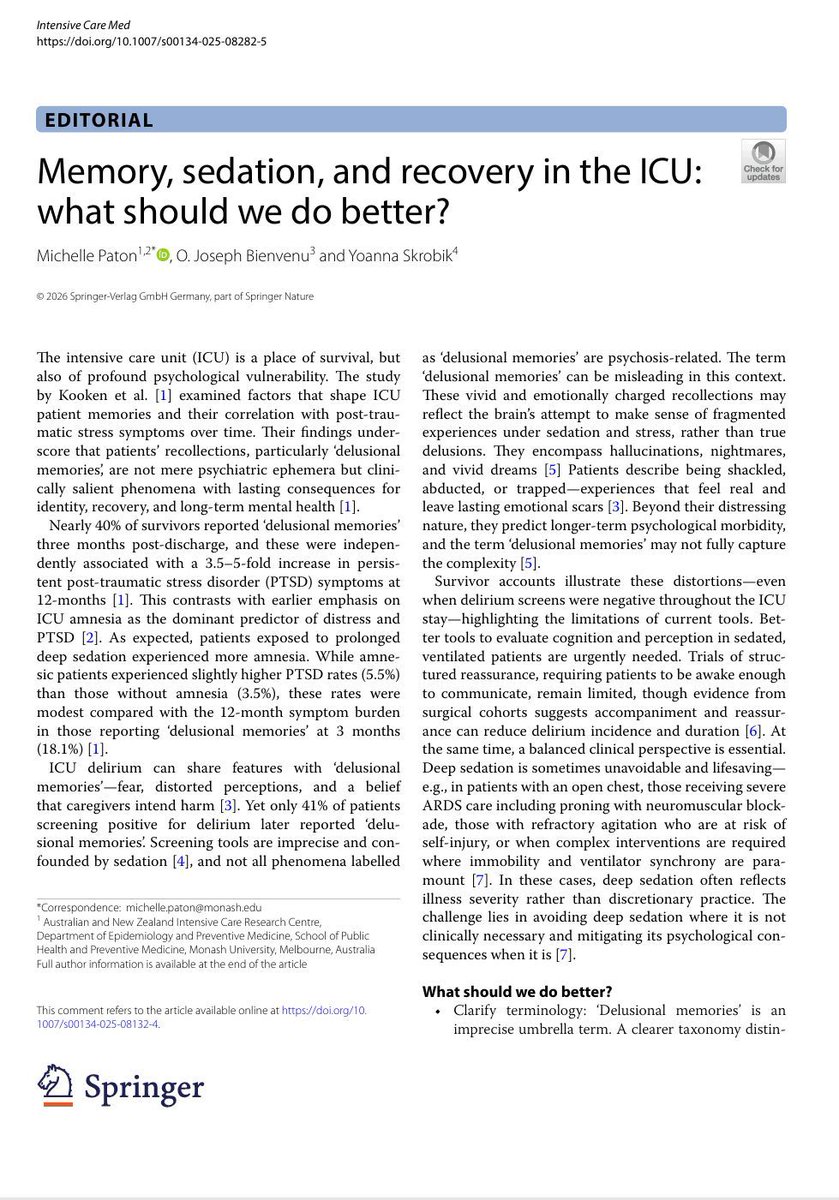
A thought-provoking 2026 editorial in Intensive Care Medicine reminds us that ICU recovery is not only physica, it is deeply psychological.
The article discusses findings showing that nearly 40% of ICU survivors reported "delusional memories" three months after discharge, and these memories were independently associated with a 3.5–5-fold increase in persistent PTSD symptoms at 12 months.
Interestingly, ICU amnesia itself was not the strongest predictor of long-term distress.
The strongest signal came from vivid, emotionally charged recollections such as:
• hallucinations
• nightmares
• terrifying dreams
• feelings of being abducted, trapped, restrained, or harmed
Experiences that felt completely real to the patient.
The authors challenge the term "delusional memories."
Many of these recollections may not represent psychosis at all.
Instead, they may reflect the brain's attempt to reconstruct fragmented experiences occurring during:
• severe illness
• sedation
• mechanical ventilation
• delirium
• extreme physiological stress
This editorial also provides an important clinical reminder:
Deep sedation is not always a failure of practice.
Sometimes it is lifesaving.
Patients with: • severe ARDS requiring proning
• neuromuscular blockade
• refractory agitation
• complex life-support interventions
may require deep sedation to survive.
The challenge is not eliminating deep sedation.
The challenge is avoiding it when unnecessary and mitigating its psychological consequences when unavoidable.
The authors propose several practical targets for ICU teams:
✅ Analgesia-first strategies
✅ Light sedation whenever feasible
✅ Early communication and reassurance
✅ Early mobilization
✅ ICU diaries documenting the patient's journey
✅ Structured post-ICU follow-up and psychological support
One of the strongest messages of this editorial is simple:
Memory is a vital sign of recovery.
As intensivists, we routinely monitor blood pressure, oxygenation, renal function, and ventilation.
Perhaps we should pay equal attention to the memories we leave behind.
Because surviving critical illness is only the beginning.
Helping patients make sense of what happened may be just as important as helping them survive it.
Reference
Paton M, Bienvenu OJ, Skrobik Y. Memory, sedation, and recovery in the ICU: what should we do better? Intensive Care Medicine. 2026.
#CriticalCare #ICU #Delirium #Sedation #MechanicalVentilation #PICS #PostICUSyndrome #MentalHealth #CriticalCareMedicine #IntensiveCare #ICURecovery #PatientCenteredCare
🧠 Can We Protect Cognitive Health After ICU Discharge?
This study identified 7 non-pharmacological approaches that may help PICS, including exercise, cognitive training, VR, music therapy, environmental modifications & ICU follow-up care.
🔗 https://t.co/aK88g0LwIG
#PICS
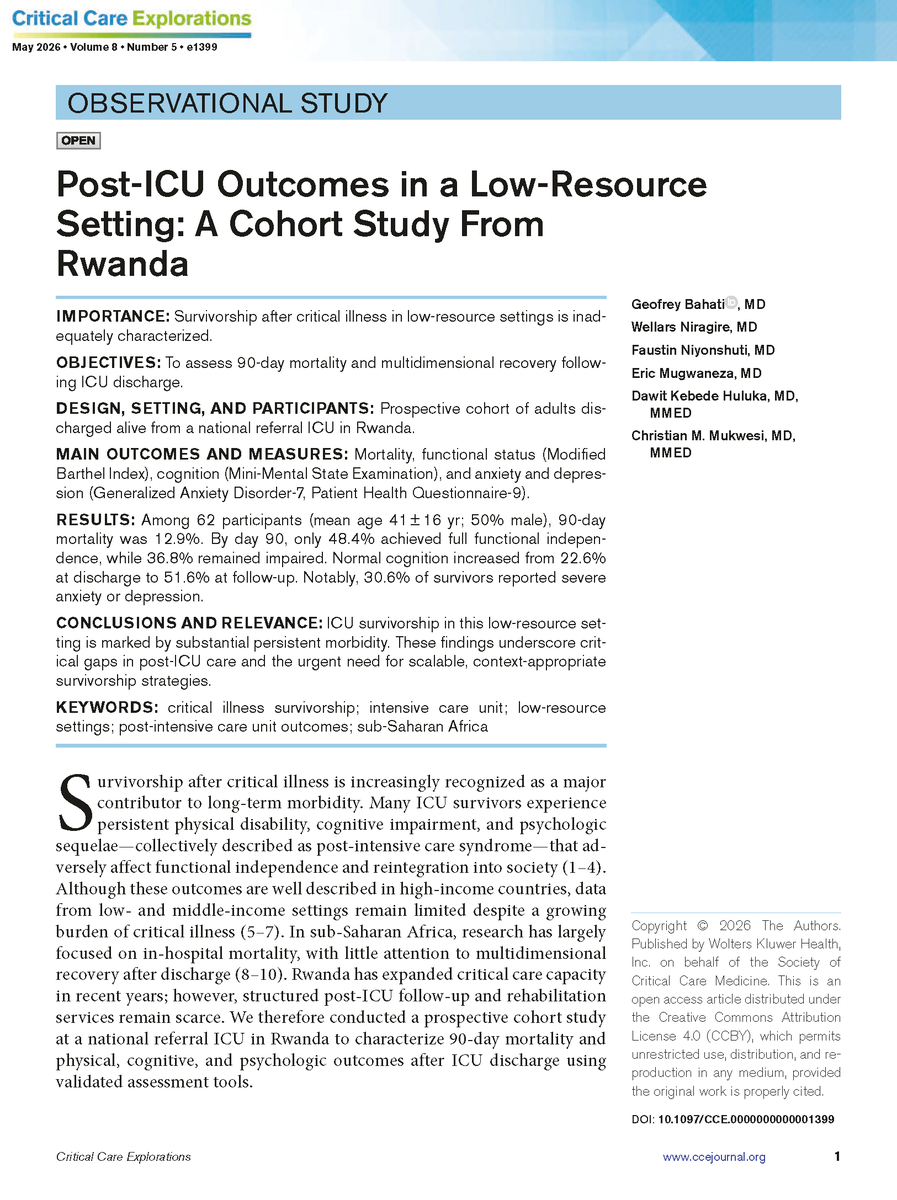
🏥 Post-ICU morbidity is common in low-resource settings and highlights the need for feasible follow-up and rehabilitation strategies.
➡️ Read the complete #openaccess article from Critical Care Explorations: https://t.co/Cs9xEPIwD1
#CritCareExplore#SCCM@SCCM
❓ "But they're too drowsy to assess."
I hear this regularly. A patient is lying quietly, eyes closed, not responding to questions. How can we screen for delirium if they won't engage?
✅ 𝐇𝐞𝐫𝐞'𝐬 𝐭𝐡𝐞 𝐜𝐥𝐢𝐧𝐢𝐜𝐚𝐥 𝐩𝐞𝐚𝐫𝐥: 𝐝𝐫𝐨𝐰𝐬𝐢𝐧𝐞𝐬𝐬 𝐈𝐒 𝐭𝐡𝐞 𝐚𝐬𝐬𝐞𝐬𝐬𝐦𝐞𝐧𝐭.
A patient who is drowsy or unrousable has altered consciousness - which is itself a key feature of delirium. You don't need them to answer orientation questions to recognise something is wrong.
The 4AT was designed with this in mind. Item 1 assesses alertness first. A patient who is clearly abnormally sleepy, or agitated, scores 4 points immediately - meeting the threshold for possible delirium before you even ask about the year or the months backwards.
𝑾𝒉𝒂𝒕 𝒕𝒐 𝒅𝒐 𝒘𝒊𝒕𝒉 𝒕𝒉𝒆 𝒅𝒓𝒐𝒘𝒔𝒚 𝒑𝒂𝒕𝒊𝒆𝒏𝒕:
Check their level of arousal. Are they sleepy but rousable? Only rousable to physical stimulus? Unrousable?
Consider this altered consciousness as clinical information. In most cases, the patient will fulfil criteria for delirium when assessed.
➡️ The sleepy patient isn't unsuitable for assessment. The sleepiness is a critical clinical sign.
What's your approach when the patient is too drowsy to complete cognitive testing?
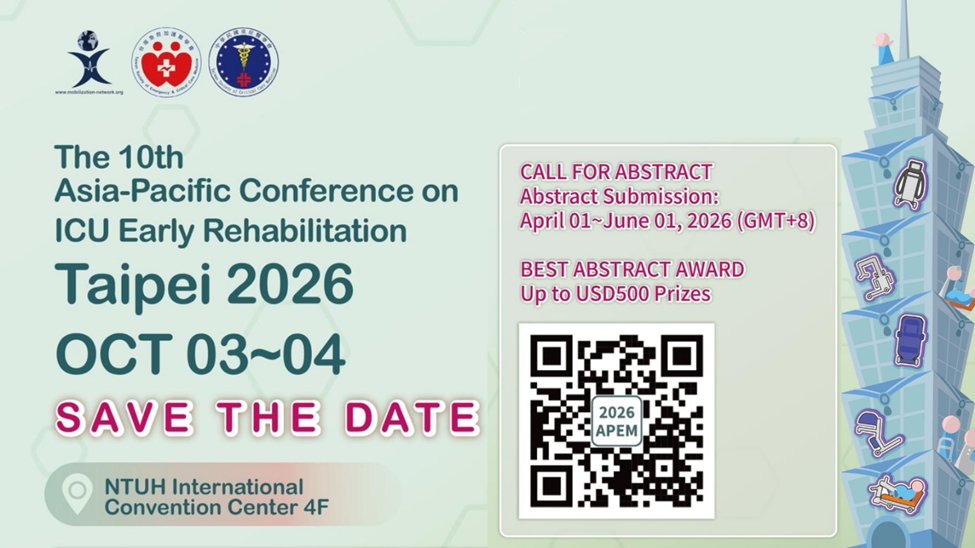
Call for abstracts on #ICURehab
Submit to 10th Asia Pacific
#ICURehab Conference
Share research &
quality improvement projects
Oct 3-4, 2026
Taipei, Taiwan
Abstract Deadline: June 1
More info:
https://t.co/bNPsNvwWkT
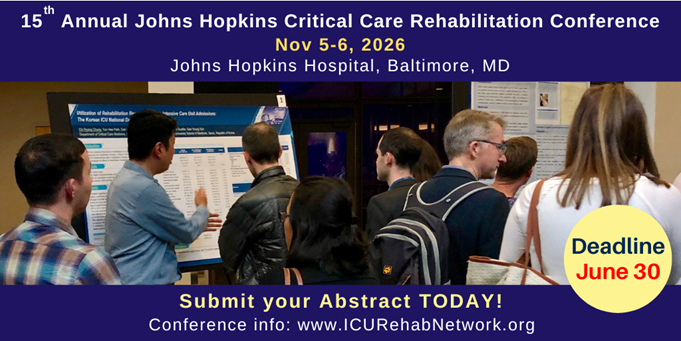
Important Deadline for
@ AcuteCareAPTA-sponsored event!
The 15th @HopkinsMedicine@ICURehab Conference
Abstract deadline:
June 30, 2026
In-Person Conference:
Johns Hopkins Hospital
Nov 5-6, 2026
Info: https://t.co/Gxk0NKWnQy
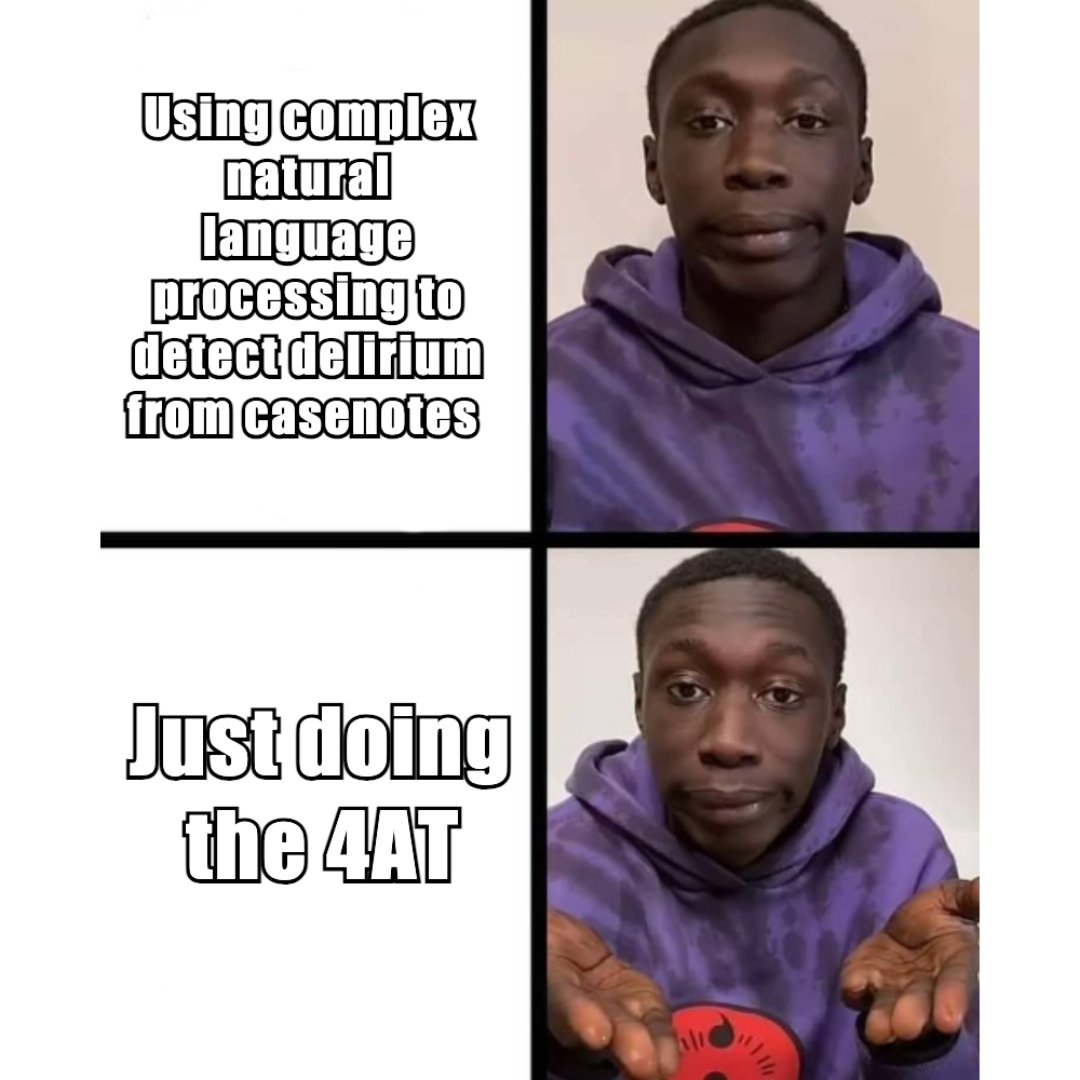
Why are we building complex AI systems to detect delirium from casenotes when we could just... do a 2-minute bedside test?
The 4AT exists.
It's well-validated (33 studies).
It's free.
Sometimes clinical medicine doesn't need machine learning.
#delirium
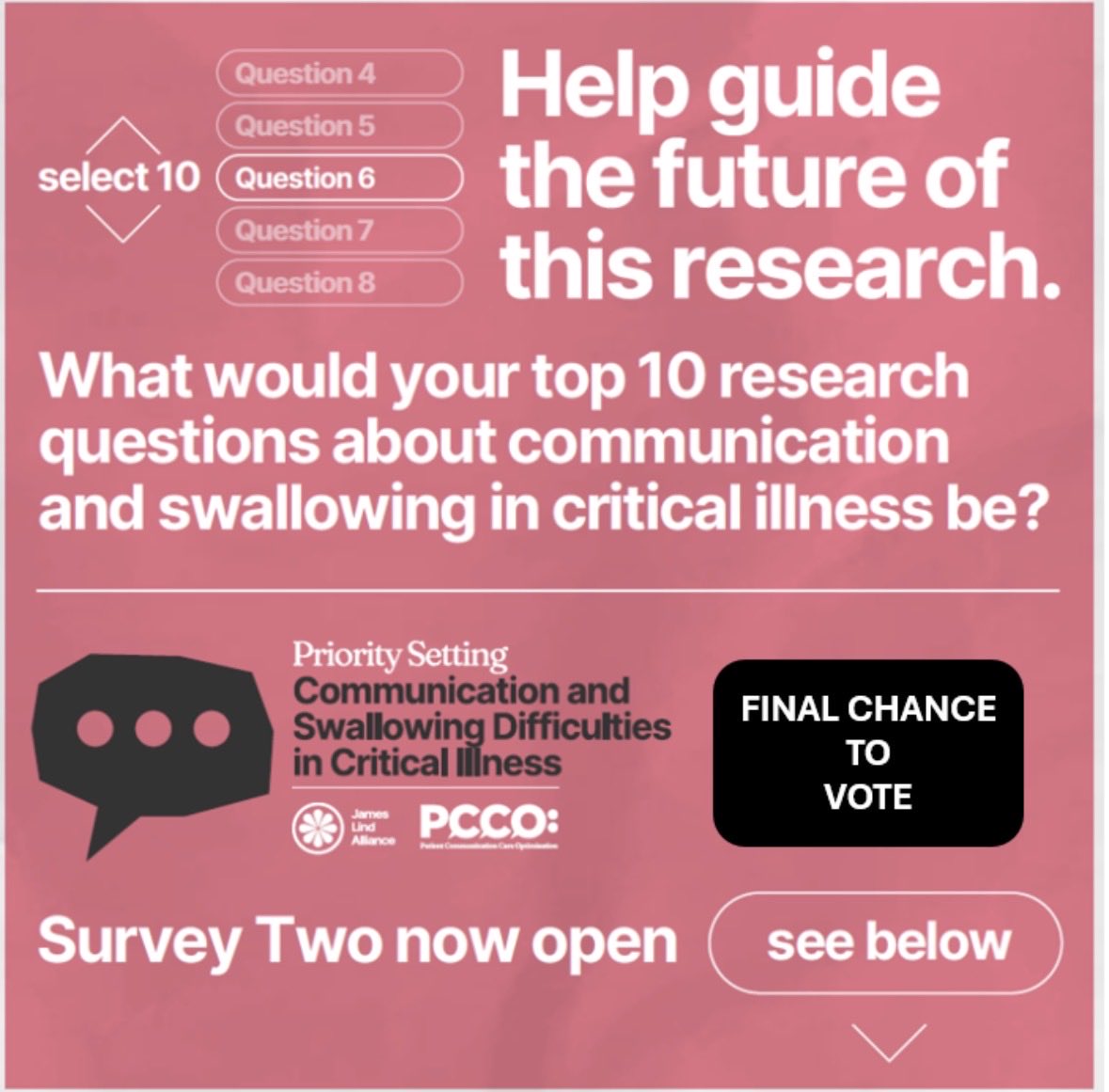
Last chance to vote!
If you’ve experienced critical illness, supported someone who has, or work in this area, we want to hear from you
This is your chance to help shape future research priorities.
👉Please vote before 31 May:
https://t.co/MjnrU17NTd
Thanks for sharing
Ultrasound assessment of muscle atrophy and its association with functional outcomes in critically ill patients: a systematic review and meta-analysis https://t.co/llvo5PgDMh #icurehab#A2Fbundle
Non-pharmacological rehabilitation strategies for pulmonary and physical recovery in ICU survivors after COVID-19: A systematic review https://t.co/z7aEEIck4A #icurehab#A2Fbundle
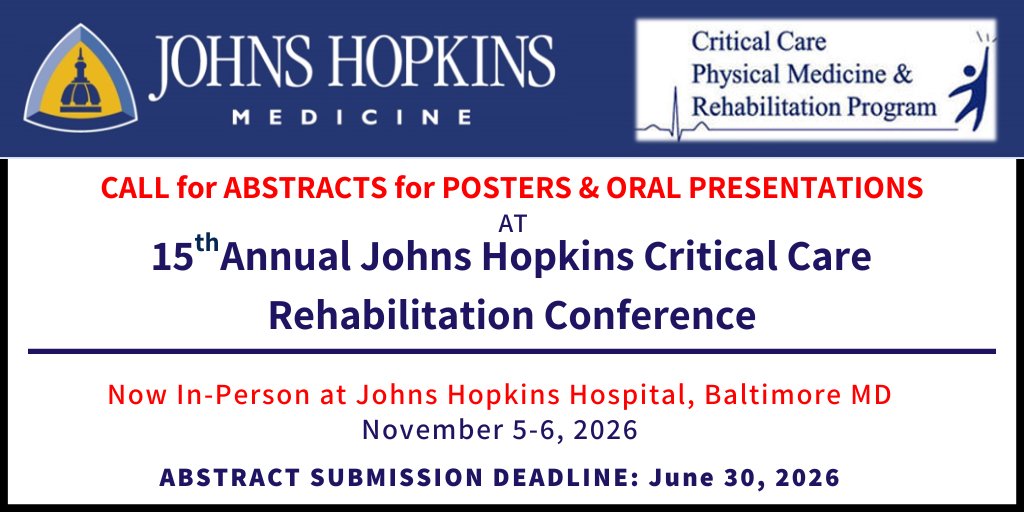
ABSTRACT DEADLINE!
June 30, 2026
15th Johns Hopkins
#ICURehab Conf is
in-Person!
Join us for lively
Abstract Discussion!
Oral & Poster
Abstract Presentations
Details in graphic
Info: https://t.co/ZtjyB7dPss
Post-intensive Care Syndrome (PICS): an American Association for the Surgery of Trauma Critical Care Committee Consensus Guideline – Defining, Recognizing, and Managing PICS Associated Physical Impairment, Cognitive Dysfunction, and Thromboinflammatory Dysregulation https://t.co/SJ3sWK4Z1X #icurehab #A2Fbundle
Arora et al contribute a scoping review evaluating telehealth pulmonary rehabilitation programs for individuals with COPD to identify trends, benefits, and gaps in current approaches.
https://t.co/9mfW42H9xV
Hear from @DrDaleNeedham, @DrKatzKatsukawa
and more…
10th Asia Pacific
#ICURehab Conference
Oct 3-4, 2026
Taipei, Taiwan
Abstract Deadline: June 1
Info: https://t.co/bNPsNvwovl
Feasibility of a Multicomponent Frailty Intervention During Post-Acute Rehabilitation in Skilled Nursing Facilities. #geriatrics https://t.co/NgtOo55Wx1