Everyone can vibe code now. A working app takes an afternoon. So what's left that's worth anything?
I just read a piece by Tw93, the developer of Mole (a Mac cleaner), and it's the best answer I've seen. His approach: let an AI agent install 853 Mac apps one by one, uninstall each, and check what's left behind. Then do the same for 30+ AI tools. Then hand-email 400+ users who bought but never activated.
The AI did most of the grunt work. But look at what the testing found. His first version treated the skills/ folders that skill installers drop into every agent's directory as leftover junk, and nearly deleted his own installed skills. Another case: "cache" cleanup looked safe until shared data turned out to be used by other apps. He says the places that should NOT be cleaned (30+ in the first batch) are as valuable as the new leftovers found.
That's the part vibe coding doesn't give you. A model will happily write a cleanup tool that runs, passes a demo, and deletes the wrong thing on someone else's machine. Knowing what not to touch comes from having been burned before.
So here's how I see the split:
>AI makes the code cheap, and makes tedious testing possible for one person.
>Security review and code review are still your job.
>Real-world edge cases are the other half: what happens on a machine that isn't yours, with data you didn't anticipate. (1/2)
>Experienced engineers matter more now, not less. Their job shifts from typing code to judging what's safe to ship.
When anyone can build the thing, the product is the details nobody asked for. Worth a read.
https://t.co/NVQAUgwe8Y
DeepSeek just shipped the whole app stack as API: web search, file parsing, URL reading, OCR, ASR, TTS, plus an open-source frontend demo. A few parameters turn it on.
The model isn't the product anymore. The app layer is, and anyone can now rebuild it for the cost of tokens. A weekend project can match what used to take a full chatbot team.
Worth reading the fine print: public-facing apps are told to enable the safety check and handle "model registration" and "AI labeling" themselves. The docs don't name the regulation, but those are obligations most global builders have never had to think about.
🚀 The full DeepSeek App experience, now via API
Search, files, links, safety, and voice. The capabilities behind the DeepSeek App are now available through the DeepSeek API.
Enable built-in features with a few parameters, or call standalone APIs such as OCR, ASR, and TTS. Build richer conversations or recreate the full DeepSeek App in your own application.
Try our open-source frontend demo, with support for importing DeepSeek conversation history.
🔗 Demo: https://t.co/TI0Iw5qLQK
📦 Code: https://t.co/ImA0LrgUgX
📖 Details: https://t.co/t0dJxXM6Lk
1/4
Nous Research fine-tuned Qwen to strip CCP-aligned censorship — and published the exact recipe to reproduce it. Bold move, but it reads like trading one bias for another rather than actual debiasing, and there are credible claims a chunk of the training data was just fabricated.
The real cost isn't the culture-war argument. It's that Alibaba now has a concrete reason to slow-walk future open-weight Qwen releases — that hurts the whole open ecosystem, not just one side of this fight.
No neutral model exists. But "reproducible recipe targeting politically sensitive content, aimed at users where that carries real legal risk" is a sharper move than just shipping different defaults — and it was foreseeable how it'd land.
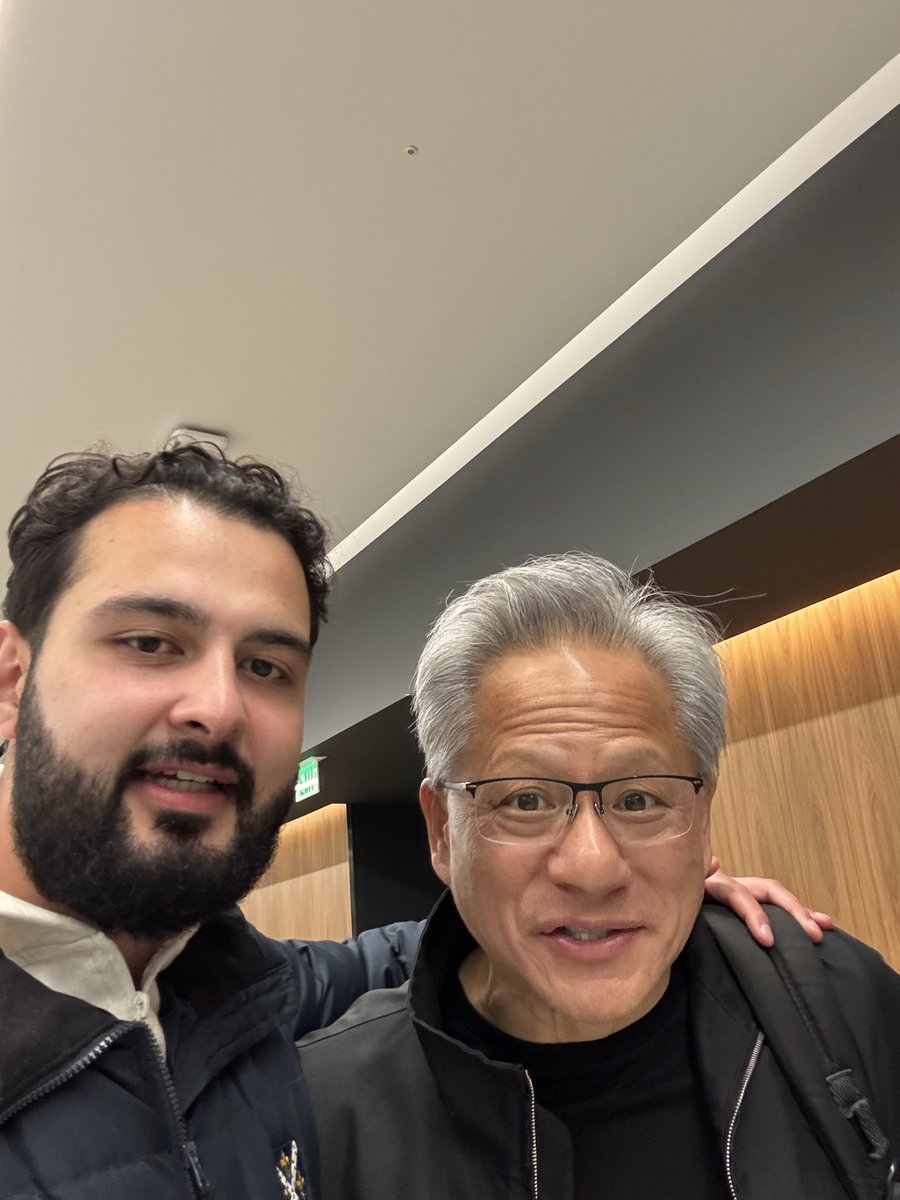
In June @NaderLikeLadder emailed Jensen about a crazy idea we had over dinner to make Local AI 10x better on NVIDIA hardware.
Jensen replied in 7 minutes. He saw this as important work, and approved a war room for us to work on this at NVIDIA HQ.
For a month, NVIDIA HQ was the @exolabs satellite office. We were overwhelmed by the support we got. We were back to back the first week with smart NVIDIANs coming in to our war room to help us. Creators of CUDA, Dynamo, people who built NVIDIA.
Long story short with NVIDIA we managed to improve their Local AI playbooks by 9.6x (almost the 10x goal we set out with). We’ll be publishing a whitepaper on this work.
We were just a small startup with a crazy idea. Jensen took a bet on us. Jensen cares deeply about Open Source AI and Local AI.
I don't believe Jensen is replaceable, he's a 1 of 1 human, but I hope NVIDIA will continue to aggressively support Open Source AI and Local AI, and continue to take bets on small startups with crazy ideas.
Thank you Jensen
Evan's right on context window blindness, but conflating 'AI code' with 'fragile code' misses the point. The leverage moves to code review and test coverage. Bad code is bad code—the source is less important than the catch.
https://t.co/7XrXdwwKYZ
The actual innovation: crackle and wow/flutter emerge naturally from the physics model, not post-processing. When 'imperfections' stay after you remove artifact layers, your model is doing something right.
Built a physical simulation of a record player with WebGL2 and Web Audio. It's *shockingly* accurate: https://t.co/MBNaTfKoai.
Instead of playing a song, it works by converting it into the physical shape of a groove. Then a simulated stylus rides those walls 384,000 times a second, and you hear the voltage that motion would induce in a cartridge.
So the crackle, the pops, the wow/flutter, the dull inner grooves are natural byproducts of the simulation. You can also "DJ" the record.
(The converted songs are in the public domain or CC-licensed. Code is linked for you to remix and re-deploy.)
Tests don't lie. Process (AI or manual) matters less than output. Vibe code + comprehensive tests = defensible engineering. Vibe code without tests = hoping, not shipping.
Actual software engineer here.
Vibe coding is when you use AI to write software without manually reviewing every single line of code. Instead, you rely on empirical tests, formal verification, and static analysis to verify that your code is correct.
Rewrites like the Discord rewrite are prime targets for vibe coding because you can easily verify them. Just take the old code, run it with a ton of random inputs (this is called fuzzing), and compare the output with the new code. Your rewrite is done when the output is always the same.
As for how you know it's vibe coded? Everything is vibe coded these days. Software engineers don't write code by hand anymore. Instead, we herd clankers writing code.
Claude solved a vault particle structure. Real question for credibility: what did Claude contribute—computational prediction or interpretation assistance? Methodology matters.
https://t.co/32iXe40Pfi
When Earth-based data centers hit physics limits, we put AI in orbit. That's not sci-fi—it's the next step when density maxes out and power hits a wall.
This is INSANE. A huge step for humanity.
Google Gemma 4 is a actually running at a Data Center in Space.
Read that again and let that sink in. Congrats project Suncatcher team!
Google misjudged parent acceptance. But backlash isn't 'no AI'—it's 'not black-box optimization of my kid's learning.' Teacher-driven AI survives this. Opaque tutoring doesn't.
📝STATEMENT: It’s clear that Google underestimated the rising parent backlash against AI and EdTech, and now it’s scrambling in the face of a PR nightmare. But this ‘clarification’ doesn’t appear to change the fact that students won’t be able to use Google Search without being subjected to Google’s AI. The company is clearly banking on Search’s popularity to lure schools into consenting to use Google’s AI.
Schools shouldn’t be fooled by this bait and switch. The good news is that it appears that Gemini, Gemini Notebook, and Search will now be off by default. Schools should leave them off, because Google’s AI tools aren’t safe for kids and undermine learning and critical thinking.
https://t.co/9XRi5LgHbH
OpenAI/Anthropic claim their AI broke a 27-year-old CS assumption (Exponential Time Hypothesis). Catch: the "faster" algorithm only wins past ~2⁵¹² variables — more than atoms in the observable universe. Formally verified, practically meaningless.
https://t.co/0DIlACv0aC
Claude running real-time fluid dynamics in Roblox. Not simulation wrappers—actual computational physics at consumer scale. Democratization isn't hype when the tech delivers.
AI didn't reduce work. It redistributed it. Less busywork, more strategy. Whether that's a win depends on what you care about—and whether you set boundaries.
https://t.co/Fc9PQmeo4O
claude-seo's 26-skill suite shows the play: abstract AI into reusable toolkits, ship community-first. One person's tool engineering becomes another's platform.
https://t.co/YQsII2wovE
A solo founder can now build a $1M/month business without a marketing team. 🤯
AI search is changing the game.
One AI-native tool can handle growth tasks that once required an entire team.
The founders who master AI today could have a massive advantage tomorrow.
Follow @rakib_hossen_ai for more AI tools, agents & automation updates.
Everyone: "Vibe coding is causing all these security bugs"
Reality: PHP, Node, Linux kernel, GitLab. All hand-written code by humans, some of it 20 years old.
AI isn't creating the slop. It's finding it 🫠
DeepSeek v4.1 Flash 1017 > GLM 5.3 Flash > Qwen 3.8 Next Flash. Local open-source now baseline production. On-device workloads no longer need cloud APIs.
DeepSeek-Huawei chip partnership isn't about AI leadership—it's about escaping supply chain hostage-taking. When everyone can train, whoever controls fabs wins. Geopolitics > architecture now.
https://t.co/VqlVFuoZKa