In this 4th episode of Manu through the lens of Dharmaśāstras, @purvaja_h explores the question:
If dharma is preserved in Smṛti, what keeps it alive in practice?
వారికి సోంత రాష్ట్రం మీద ప్రేమ ఉండదు
అస్థిత్వం భావన ఉండదు.
పక్కోల్లకు కూడా ఉండోద్దు అనే ముర్కులకు.
సరిగ్గా చెప్పుతో కోట్టినట్టు సమాధానం చెప్పారు సార్ 🙏
Apple Intelligence is cool and all... but my Mac just skipped the AI part and went straight to time travel. 🤨
Why are my files already dated tomorrow? 😂
#Apple#macOS#AI#MacBooks
Kashi Yatra: From Sacred Resolve to Ritual Comedy, A Call for Restoration of Meaning
In many contemporary Hindu weddings, the ritual of Kashi Yatra has been reduced to a lighthearted interlude, an opportunity for laughter, playful negotiation, and theatrical persuasion. The groom, clad in traditional attire, symbolically declares his intention to renounce worldly life and depart for Kashi in pursuit of spiritual knowledge. The bride’s father intercepts him, persuades him to abandon this path, and offers his daughter in marriage. What unfolds is often treated as comic relief.
Yet beneath this dramatization lies a profound philosophical tension, one that speaks to the very structure of Hindu thought: the balance between renunciation and engagement, between moksha and dharma, between withdrawal and responsibility.
At its core, the Kashi Yatra ritual represents a moment of existential choice. The groom symbolically stands at a crossroads between two legitimate paths: sannyāsa (renunciation in pursuit of liberation) and gṛhasthāśrama (the householder’s life). This is not a trivial decision. Classical Indian thought does not dismiss the world as mere illusion to be casually abandoned, nor does it celebrate worldly life without restraint. Instead, it organizes human aspiration through the framework of the puruṣārthas: Dharma (righteous duty), Artha (material well-being), Kāma (desire and emotional fulfillment), and Mokṣa (liberation).
The Kashi Yatra is, in essence, a ritualized negotiation between these aims.
When the bride’s father intervenes, he is not merely “stopping” the groom; he is making a philosophical argument. He asserts that the life of a gṛhastha is not inferior to that of a renunciate. Rather, it is foundational. The householder sustains society, enables the performance of rituals, supports dependents, and creates the conditions in which dharma can flourish. Classical texts reinforce this view. The Mahābhārata states that the householder stage is the root of all dharmas, and the Manusmṛti extols it as the most sustaining of the four āśramas.
Crucially, the father’s promise, that his daughter will be a sahadharmacāriṇī, a partner in dharma, is not ornamental. It reflects a deeply embedded Vedic ideal: that spiritual progress within the householder stage is a shared endeavor. Marriage, in this framework, is not merely a social contract or emotional union; it is a disciplined partnership oriented toward ethical living, ritual responsibility, and ultimately, transcendence.
However, when this ritual is reduced to humor, its pedagogical value is lost. The participants, especially the groom and his family, are rarely encouraged to reflect on the philosophical implications of the act. The groom’s “renunciation” becomes theatrical rather than contemplative; the father’s “persuasion” becomes playful rather than instructive.
This dilution has broader consequences. Without understanding the interplay of Dharma, Artha, Kāma, and Mokṣa, the householder stage risks being misinterpreted as merely materialistic or socially obligatory. Conversely, sannyāsa is romanticized without appreciation for its rigor and prerequisites. The original intent of the ritual, to emphasize that gṛhasthāśrama, properly lived, is itself a valid and powerful path toward mokṣa, is obscured.
Reclaiming the depth of Kashi Yatra does not require abandoning joy or celebration. Rather, it calls for informed participation. Priests, families, and especially parents can play a crucial role by explaining the symbolism before or during the ritual. The groom should be made aware that his symbolic departure represents a genuine philosophical option, and his acceptance of marriage signifies a conscious commitment to a life of responsibility, discipline, and spiritual partnership.
In an age where rituals are often performed mechanically or repurposed for entertainment, restoring meaning is itself an act of cultural preservation. The Kashi Yatra is not a relic to be modernized through humor, but a living expression of a sophisticated ethical vision, one that integrates worldly life with spiritual aspiration.
To honor it fully is to remember that the journey to Kashi need not be abandoned; it can be undertaken from within the home itself.
Among all spiritual texts, the Shiva Sutras remain closest to my heart. It opens with a statement that the entire text exists only to help a person remember. “Chaitanyam Atma”. Consciousness is the self. We don’t have to attain or achieve it. We have to just remember this. The ancient text calls the entire path Pratyabhijna, recognition, using the image of a person who has forgotten their own face and is shown a mirror. They do not develop a new face in that moment. They simply stop mis interpreting the one they already had. This single shift in language changes everything about how the spiritual path is understood. You are not climbing toward something far away. You are remembering something you misplaced it.
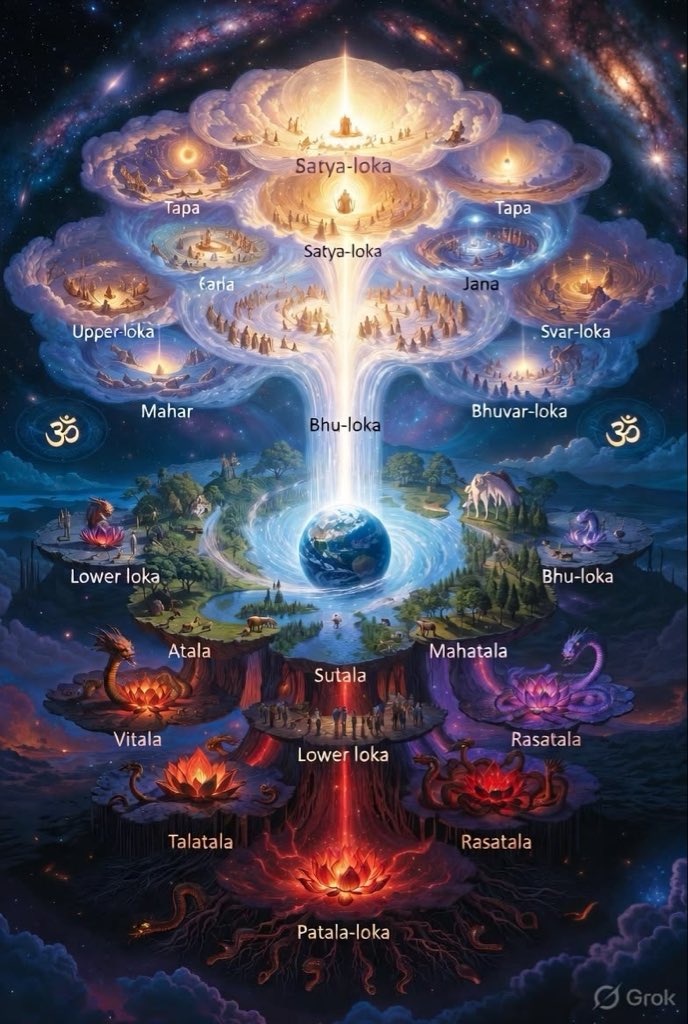
The Vedic cosmos is far more vast than the physical universe we perceive.
According to Sanātana Dharma, existence is arranged across multiple realms of consciousness known as the Lokas. Above Bhū-loka (Earth) lie the higher realms—Bhuvar, Svar, Mahar, Jana, Tapa, and Satya-loka—abodes of sages, devas, and enlightened beings. Below are the lower realms—Atala, Vitala, Sutala, Talātala, Mahātala, Rasātala, and Pātāla—each serving a distinct purpose within cosmic order.
These worlds are not merely places but dimensions of experience, karma, and spiritual evolution. The soul journeys through them according to its actions, awareness, and destiny.
The ultimate goal is not to ascend to a higher realm, but to transcend all realms and realize the eternal Self beyond birth, death, space, and time.
Bhanu Saptami today - Sunday plus Shukla Saptami
Dakshinayana Punyakala Aarambha today
- the longest day of the year (summer solstice) when Soorya reaches the northern-most point
Also discovered that today coincidentally is Poorva Phalguni Nakshatra upto 9.31 am - Nakshatra devata is Aryama, one of the 12 Adityas :)
Uttara Phalguni Nakshatra after 9.31 am - nakshatra devata is Bhaga, one of the 12 Adityas responsible for prosperity :)
Shastras say "Aarogyam bhaskarat icched" - meaning pray for good health from Surya Devata
🕉️ Suryanarayana Swamine Namaha 🙏🏻
@Vdspsabha 🙏🏻
The Gayatri Mantra is more than a prayer—it is a profound spiritual discipline that has inspired seekers for centuries. Traditional teachings associate its 24 syllables with different aspects of human consciousness, symbolizing qualities such as wisdom, courage, self-restraint, devotion, intellect, and inner awakening.
Whether viewed through the lens of spirituality, meditation, or personal growth, regular chanting of the Gayatri Mantra encourages mental clarity, emotional balance, and a deeper connection with the divine. Its enduring power lies not merely in sound, but in the transformation it inspires within the practitioner.
Śrī Rudram, the powerful Vedic hymn, from Krishna Yajur Veda (Taittirīya Saṃhitā) to Lord Rudra, invoking harmony, healing, protection, and inner transformation.
The Camakam section is beautiful where we ask for the fullness of life, strength, clarity, prosperity, well-being, and fulfilment of righteous wishes.
At the end of this chanting, nature itself became a witness… 🌧️
Monday శివారాధనతో చంద్ర దోషాలు, మానసిక ఆందోళనలు తొలగిపోతాయి. me Career లో problems poye manchi job vasthundhi . me family lo happiness, financial stability లభిస్తాయి🪷
ఆ భోళాశంకరుని nammuko ! ayana ఆశీస్సులతో మీ కష్టాలన్నీ కరిగి anthaa manchi aa jaruguthundhi.
Om namah shivaya🪷
Sometimes we spend too much time searching for meaning in every chapter of life. Some pages were simply meant to be read, turned, closed, and forgotten.
#MutedMusings
NRIs can now earn 20% in USD on FCNR deposits by using leverage to amplify their returns.
Indian banks have started offering USD FCNR rates in the 6-7% range after the RBI agreed to absorb the USD INR hedging costs.
While that is attractive enough on its own, such high rates enable NRIs with access to cheap credit overseas to borrow dollars at a lower rate, say 5% and invest them in an FCNR at 7%, thus making an almost risk free 2% on the borrowed capital.
A similar thing happened in 2013 and $26 Bn flowed into FCNR deposits by NRIs and is now happening again at an even bigger scale.
👉 This is how it works:
The NRI, her foreign bank and her Indian bank providing the FCNR deposit coordinate together to do the following.
1) NRI brings 100K USD of his own to the foreign bank.
2) The foreign bank lends a multiple of that, e.g. 9x i.e. 900K USD to the NRI at say 5.5% for the sole purpose of creating the FCNR deposit.
3) The entire 1 Mn USD is directly wired to the Indian bank for an FCNR deposit at 7%. The deposit is lien marked to the foreign bank as collateral.
The NRI earns 7% on her original 100K and nets 1.5% on the borrowed 900K USD.
✅ The overall returns on the original 100K USD: 7% + 9 x 1.5% = a whopping 20.5%!
Even a 1% loan-vs-deposit rate spread with 9x leverage will yield 16% returns.
This time the inflows can be even bigger than 2013 because instead of overseas banks, the lending can be done by the @GIFTCity_ branch of the same Indian bank making the partnership and execution much easier.
⚠️ Caveats:
- Not a retail product. Limited access due to huge demand. Minimum deposit 100K+. Leverage and borrowing rates will vary based on client relationship with the bank.
- The RBI policy supporting higher rates is only for 3-5 year FCNR deposits and only valid till September 30.
❗ Risks:
- The Indian bank may default. Deposits are only insured up to INR 5 lakh per customer per bank by RBI.
- The overseas lending bank may recall the loan early for whatever reason.
- If the loan is availed at floating rates and not fixed rate, then any future hike in lending rate can wipe out returns or also cause losses.
- Risk of change in policy e.g. around repatriation of deposits on maturity.
P.S. Join our NRI Whatsapp community to stay updated on best FCNR options - https://t.co/oOiCKSbgg2.
@GetBelong